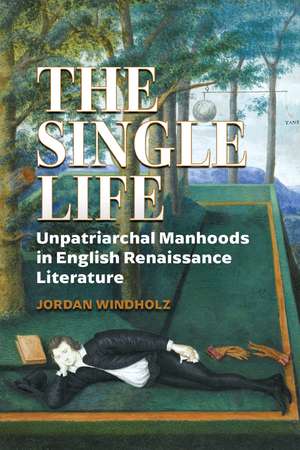
The Single Life: Unpatriarchal Manhoods in English Renaissance Literature: Strode Studies in Early Modern Literature and Culture
Autor Jordan Windholzen Limba Engleză Paperback – 15 iul 2025
What if the Renaissance bachelor wasn’t just a social outlier but a literary lens through which early modern masculinity reveals its cracks? In The Single Life: Unpatriarchal Manhoods in English Renaissance Literature, Jordan Windholz examines the overlooked and often subversive roles played by never-married men in shaping gender, sexuality, and social order.
Windholz challenges conventional views on gender and sexuality, identifying five archetypes of bachelorhood that complicate our understanding of patriarchal success: the chaste youth, the journeyman bachelor, the true gallant, the incel scholar, and the unmarried eunuch. These figures don’t conform to ideals of marriage, legacy, or economic productivity, but they also weren’t merely left behind. Instead, they served to define what early modern society valued by embodying what it resisted. Windholz shows how Renaissance texts constructed, contained, and occasionally celebrated these “unpatriarchal manhoods.”
By examining the intersections of sexuality, labor, gentility, emotion, and gender, the book provides a nuanced understanding of how single men both upheld and resisted patriarchal norms. Each chapter offers a detailed analysis of literary texts, blending historical and literary analysis with feminist and queer theory. The first study of its kind, Windholz’s work is essential reading for anyone interested in Renaissance literature, gender studies, or those looking to understand the margins of masculinity and the meanings of singledom—then and now.
Din seria Strode Studies in Early Modern Literature and Culture
-
 Preț: 236.70 lei
 -
 Preț: 236.04 lei
 -
 Preț: 256.70 lei
 -
 Preț: 236.73 lei
 -
 Preț: 417.18 lei
 -
 Preț: 231.76 lei
 -
 Preț: 235.02 lei
 - 9%
 Preț: 696.75 lei
Preț: 261.11 lei
Puncte Express: 392
Carte disponibilă
Livrare economică 13-27 noiembrie
Livrare prin curier în România Termenul estimat este afișat lângă disponibilitate.
Transport gratuit de la 400.00 lei Plată online sau ramburs, în funcție de opțiunile comenzii.
Retur gratuit în 14 zile Comandă securizată și suport în română.
Specificații
ISBN-13: 9780817362133
ISBN-10: 0817362134
Pagini: 300
Ilustrații: 3 bw figures
Dimensiuni: 152 x 229 x 23 mm
Greutate: 0.46 kg
Editura: University Of Alabama Press
Colecția University Alabama Press
Seria Strode Studies in Early Modern Literature and Culture
ISBN-10: 0817362134
Pagini: 300
Ilustrații: 3 bw figures
Dimensiuni: 152 x 229 x 23 mm
Greutate: 0.46 kg
Editura: University Of Alabama Press
Colecția University Alabama Press
Seria Strode Studies in Early Modern Literature and Culture
Notă biografică
JORDAN WINDHOLZ is associate professor of English at Shippensburg University. His scholarship has appeared in Shakespeare Studies, Modern Philology, and English Literary Renaissance.
Cuprins
Acknowledgments
Introduction: The Single Life in English Renaissance Literature and Culture
Chapter 1. The Single Life of the Chaste Youth: Early Modern Asexuality and the Naturalization of Desire in All’s Well That Ends Well
Chapter 2. The Single Life of the Journeyman Bachelor: Paronomasia and Communities of Labor Outside (and Inside) Much Ado About Nothing
Chapter 3. The Single Life of the True Gallant: Economic Men and Entrepreneurial Action in Epicene and Wit at Severall Weapons
Chapter 4. The Single Life of the Incel Scholar: Feelings of Entitlement in Hamlet and The Anatomy of Melancholy
Chapter 5. The Single Life of the Unmarried Eunuch: Elaborations of Gendered Embodiment in Mikrokosmographia, Twelfth Night, and The Roaring Girl
Epilogue: The Renaissance of the Single Life in the Amatonormative Renaissance
Notes
Bibliography
Index
Introduction: The Single Life in English Renaissance Literature and Culture
Chapter 1. The Single Life of the Chaste Youth: Early Modern Asexuality and the Naturalization of Desire in All’s Well That Ends Well
Chapter 2. The Single Life of the Journeyman Bachelor: Paronomasia and Communities of Labor Outside (and Inside) Much Ado About Nothing
Chapter 3. The Single Life of the True Gallant: Economic Men and Entrepreneurial Action in Epicene and Wit at Severall Weapons
Chapter 4. The Single Life of the Incel Scholar: Feelings of Entitlement in Hamlet and The Anatomy of Melancholy
Chapter 5. The Single Life of the Unmarried Eunuch: Elaborations of Gendered Embodiment in Mikrokosmographia, Twelfth Night, and The Roaring Girl
Epilogue: The Renaissance of the Single Life in the Amatonormative Renaissance
Notes
Bibliography
Index
Recenzii
“Focusing on the critically neglected category of unmarried men and judiciously engaging with recent work on queerness, transgender studies, and race, The Single Life significantly advances our understanding of manhood, marriage, and sexuality in early modern English drama and culture.” —Mario DiGangi, author of “The Winter’s Tale”: Language and Writing
“The Single Life has breadth and ambition, and it takes seriously the relevance of early modern literature to theoretical conversations that are often confined to contemporary texts." —James M. Bromley, author of Clothing and Queer Style in Early Modern English Drama
“Highly Recommended." —CHOICE
“The Single Life has breadth and ambition, and it takes seriously the relevance of early modern literature to theoretical conversations that are often confined to contemporary texts." —James M. Bromley, author of Clothing and Queer Style in Early Modern English Drama
“Highly Recommended." —CHOICE
Descriere
In The Single Life, Jordan Windholz uncovers five distinct portraits of never-married men in Renaissance literature—each resisting the era’s expectations of marriage, procreation, and patriarchal legacy. Drawing on historical literature, and meshing modern feminist and queer theory, Windholz reframes these bachelors not as failures of the system, but as figures who expose its limits—challenging assumptions about identity, individuality, and the narrowed boundaries of early modern masculinity.