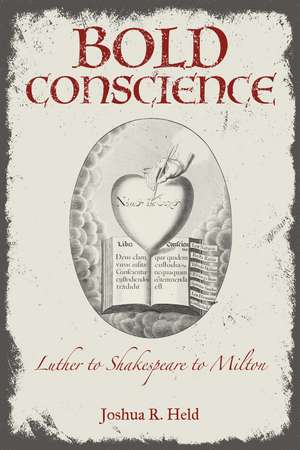
Bold Conscience: Luther to Shakespeare to Milton: Strode Studies in Early Modern Literature and Culture
Autor Joshua R. Helden Limba Engleză Paperback – 13 iun 2023
Bold Conscience: Luther to Shakespeare to Milton is a sweeping, original study of how conscience became one of the most powerful ideas in early modern England. Tracing the emergence of what Joshua R. Held calls the “bold conscience,” the book shows how inner moral conviction moved from the realm of private guilt to public action, fueling debates about authority, obedience, free speech, and resistance. By placing conscience at the center of literary, religious, and political conflict, Bold Conscience reveals a vital intellectual throughline linking the Reformation to the birth of modern ideas of liberty and toleration.
The book unfolds chronologically, beginning with Martin Luther and Henry VIII and moving through Shakespeare’s Hamlet and Henry VIII, John Donne’s court sermons, and John Milton’s polemical and poetic works, including Areopagitica and Paradise Lost. Each chapter combines close literary reading with historical and theological analysis, showing how conscience operates across genres—drama, sermon, pamphlet, and epic poetry. Joshua R. Held is a distinguished scholar of early modern literature whose work bridges literary criticism, intellectual history, and religious studies, bringing clarity and narrative energy to complex debates.
Bold Conscience will appeal to scholars and students of early modern literature, Shakespeare, Milton, and Reformation history, as well as readers interested in the origins of religious freedom and political dissent. It will also engage anyone concerned with how moral conviction shapes public life then and now.
Din seria Strode Studies in Early Modern Literature and Culture
-
 Preț: 236.70 lei
 -
 Preț: 236.04 lei
 -
 Preț: 261.11 lei
 -
 Preț: 256.70 lei
 -
 Preț: 236.73 lei
 -
 Preț: 422.95 lei
 -
 Preț: 235.61 lei
 - 9%
 Preț: 696.75 lei
Preț: 235.02 lei
Puncte Express: 353
Carte indisponibilă temporar
Doresc să fiu notificat când acest titlu va fi disponibil:
Se trimite...
Specificații
ISBN-13: 9780817361112
ISBN-10: 0817361111
Pagini: 248
Dimensiuni: 152 x 229 x 20 mm
Greutate: 0.31 kg
Editura: University Of Alabama Press
Colecția University Alabama Press
Seria Strode Studies in Early Modern Literature and Culture
ISBN-10: 0817361111
Pagini: 248
Dimensiuni: 152 x 229 x 20 mm
Greutate: 0.31 kg
Editura: University Of Alabama Press
Colecția University Alabama Press
Seria Strode Studies in Early Modern Literature and Culture
Notă biografică
Joshua R. Held is assistant professor of English at Southeastern Oklahoma State University. His scholarship has appeared in Studies in Philology, Modern Philology, Milton Studies, and Shakespeare Survey.
Cuprins
Acknowledgments
Introduction
Chapter 1. Conscience in Luther and Henry VIII
Chapter 2. Shakespearean Consciences: Hamlet in Wittenberg
Chapter 3. More Shakespearean Consciences: Looking back at Henry VIII’s Conscience
Chapter 4. Supporting Conscience in Donne’s Sermons
Chapter 5. The Toleration Crisis of 1644
Chapter 6. Contesting Conscience in Eikon Basilike and Eikonoklastes
Chapter 7. Revising Conscience in Paradise Lost
Conclusion
Note on Texts
Notes
Works Cited
Index
Introduction
Chapter 1. Conscience in Luther and Henry VIII
Chapter 2. Shakespearean Consciences: Hamlet in Wittenberg
Chapter 3. More Shakespearean Consciences: Looking back at Henry VIII’s Conscience
Chapter 4. Supporting Conscience in Donne’s Sermons
Chapter 5. The Toleration Crisis of 1644
Chapter 6. Contesting Conscience in Eikon Basilike and Eikonoklastes
Chapter 7. Revising Conscience in Paradise Lost
Conclusion
Note on Texts
Notes
Works Cited
Index
Recenzii
“This learned, agile book tracks pivotal changes in views of conscience from Luther through Locke. Offering nuanced readings of works by Shakespeare, Donne, and Milton, Held demonstrates the emergence of the idea of the bold conscience as a site of political resistance and as the locus of a dawning toleration.”—Michael Schoenfeldt, editor of John Donne in Context
“[Held's] ambitions are grand, and call for facility in a wide range of contexts, literary and historical alike. To his great credit, Held shows that he is more than equal to the task. Bold Conscience is the work of a very capable, confident scholar with a particular talent for bringing divergent authors into conversation with each other. It will surely earn a place of prestige amongst the growing body of work on conscience in the period." —Reformation
“Bold Conscience is distinguished not only by its learning, desire for rigour, and clarity of exposition but also by the imaginative way it establishes a series of surprisingly effective intertextual, print-enabled patterns. . . It is consistently intelligent and, most importantly, it brings the problem of conscience back to the centre of our attempts to understand the invention of modern individualism.”—Renaissance and Reformation / Renaissance et Réforme
“Held’s close readings are learned, thoughtful, and often illuminating. They are particularly strong on the rhetorical strategy and technique.”—Review of English Studies
“Held’s book has three virtues. First, it is exceptionally deeply grounded in a principal topic of early modern divinity, marrying this adroitly to some of the governmental discourse of the period. Second, his subtle literary analysis of the shifting connotations of both the concept and the word ‘conscience’ is not confined to the literary texts. The persuasive techniques used by theologians, casuists, and political texts are illuminated by the rhetoric of the literary texts, and vice versa. Third, the book makes its U-shaped argument crystal clear: its expression is plain and direct and the local argumentation admirably tight, so the reader will rarely be tempted to disagree with the direction of the reasoning.”—Spenser Review
“[Held's] ambitions are grand, and call for facility in a wide range of contexts, literary and historical alike. To his great credit, Held shows that he is more than equal to the task. Bold Conscience is the work of a very capable, confident scholar with a particular talent for bringing divergent authors into conversation with each other. It will surely earn a place of prestige amongst the growing body of work on conscience in the period." —Reformation
“Bold Conscience is distinguished not only by its learning, desire for rigour, and clarity of exposition but also by the imaginative way it establishes a series of surprisingly effective intertextual, print-enabled patterns. . . It is consistently intelligent and, most importantly, it brings the problem of conscience back to the centre of our attempts to understand the invention of modern individualism.”—Renaissance and Reformation / Renaissance et Réforme
“Held’s close readings are learned, thoughtful, and often illuminating. They are particularly strong on the rhetorical strategy and technique.”—Review of English Studies
“Held’s book has three virtues. First, it is exceptionally deeply grounded in a principal topic of early modern divinity, marrying this adroitly to some of the governmental discourse of the period. Second, his subtle literary analysis of the shifting connotations of both the concept and the word ‘conscience’ is not confined to the literary texts. The persuasive techniques used by theologians, casuists, and political texts are illuminated by the rhetoric of the literary texts, and vice versa. Third, the book makes its U-shaped argument crystal clear: its expression is plain and direct and the local argumentation admirably tight, so the reader will rarely be tempted to disagree with the direction of the reasoning.”—Spenser Review
Descriere
Traces how conscience—inner moral conviction—came to shape public life, fueling martyrdom, free speech, and political revolts