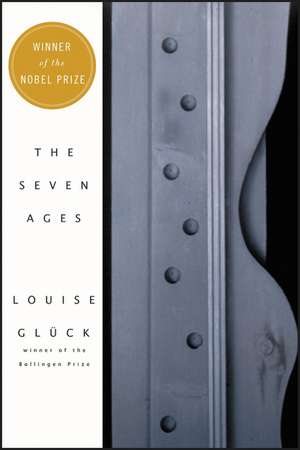
The Seven Ages
Autor Louise Glucken Limba Engleză Paperback – 25 mar 2002
The masterful collection from the acclaimed Pulitzer Prize-winning author of The Wild Iris and Vita Nova
Louise Glück has long practiced poetry as a species of clairvoyance. She began as Cassandra, at a distance, in league with the immortal; to read her books sequentially is to chart the oracle’s metamorphosis into unwilling vessel, reckless, mortal and crude. The Seven Ages is Glück’s ninth book, her strangest and most bold. In it she stares down her own death, and, in doing do, forces endless superimpositions of the possible on the impossible—an act that simultaneously defies and embraces the inevitable, and is, finally, mimetic. over and over, at each wild leap or transformation, flames shoot up the reader’s spine.
| Toate formatele și edițiile | Preț | Express |
|---|---|---|
| Paperback (2) | 67.34 lei 3-5 săpt. | +5.71 lei 7-13 zile |
| Carcanet Press Ltd. – 29 noi 2001 | 67.34 lei 3-5 săpt. | +5.71 lei 7-13 zile |
| HarperCollins Publishers – 25 mar 2002 | 102.33 lei 3-5 săpt. |
Preț: 102.33 lei
18.10€ • 21.50$ • 15.76£
Carte disponibilă
Livrare economică 07-21 martie
Specificații
ISBN-10: 0060933496
Pagini: 80
Dimensiuni: 152 x 229 x 5 mm
Greutate: 0.12 kg
Ediția:Reprint
Editura: HarperCollins Publishers
Colecția Ecco
V-ar putea interesa
-
 PoemsLouise Glück-28%Preț: 75.75 lei105.07 lei
 -
 Dead and AliveZadie SmithPreț: 152.54 lei
 -
 Poems 1962-2012Louise GlückPreț: 163.23 lei
 -
 Faithful and Virtuous NightLouise GlückPreț: 78.54 lei
 -
 Wild Iris, TheLouise GluckPreț: 81.41 lei
 -
 First Four Books Of PoemsLouise GluckPreț: 101.98 lei
 -
 Queries on Death, the Infinite and Irrational NumbersJohn StammersPreț: 86.97 lei
 -
 MEMORYDorothea LaskyPreț: 95.39 lei
 -
 Poetry Is Not a LuxuryAnonymous-25%Preț: 102.14 lei135.53 lei
 -
 Death StylesJoyelle McSweeney-29%Preț: 61.88 lei87.60 lei
 -
 ProphetKahlil GibranPreț: 24.54 lei
 -
 Will There Ever Be Another YouPatricia Lockwood-27%Preț: 74.85 lei102.99 lei
 -
 American OriginalityLouise GluckPreț: 102.24 lei
 -
 Marigold and RoseLouise GluckPreț: 73.40 lei
 -
 Faithful and Virtuous NightLouise GluckPreț: 67.38 lei
 -
 Proofs and TheoriesLouise GluckPreț: 87.90 lei
 -
 MeadowlandsLouise GluckPreț: 67.01 lei
 -
 Vita NovaLouise GluckPreț: 66.89 lei
 -
 Autobiography of DeathKim HyesoonPreț: 100.59 lei
 -
 Out of the AshesCourtney Peppernell-24%Preț: 77.18 lei101.98 leiRecomandat
Textul de pe ultima copertă
Recenzii
“As always, Glück demonstrates incredible craft; this is assured and quietly beautiful poetry.” — Library Journal
“Every poem in The Seven Ages [is] a weighty, incandescent marvel.” — Melanie Rehak, The New York Times Book Review
Notă biografică
Descriere
Louise Gluck has long practised poetry as a species of clairvoyance. She began as Cassandra, at a distance, in league with the immortals. To read her books sequentially is to chart the oracle's metamorphoses into unwilling vessel, reckless, mortal, down-to-earth.
"The Seven Ages" is Gluck's ninth book, one of her strangest and certainly her most bold. In it - like William Blake's mystical Thel - she gazes down at her own death and in so doing forces endless superimpositions of the possible on the impossible. Her act at once defies and embraces the inevitable and is finally mimetic.
Over and over, at each wild leap and transformation, flames shoot up the reader's spine. In an essay she writes, "one of the revelations of art is the discovery of a tone or perspective at once wholly unexpected and wholly true to a set of materials". This truth to materials -language, occasion, antecedent - is the proof of a poem.