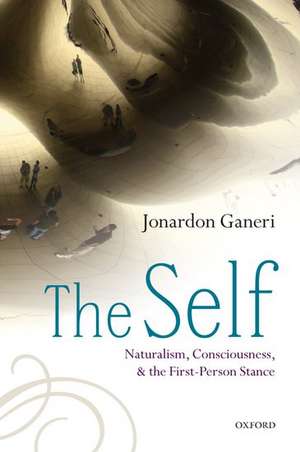
The Self: Naturalism, Consciousness, and the First-Person Stance
Autor Jonardon Ganerien Limba Engleză Hardback – 26 apr 2012
Preț: 793.13 lei
Preț vechi: 1148.89 lei
-31%
Puncte Express: 1190
Carte tipărită la comandă
Livrare economică 20 noiembrie-01 decembrie
Livrare prin curier în România Termenul estimat este afișat lângă disponibilitate.
Transport gratuit pentru acest produs Plată online sau ramburs, în funcție de opțiunile comenzii.
Retur gratuit în 14 zile Comandă securizată și suport în română.
Specificații
ISBN-13: 9780199652365
ISBN-10: 0199652368
Pagini: 386
Dimensiuni: 163 x 240 x 28 mm
Greutate: 0.76 kg
Editura: OUP OXFORD
Colecția OUP Oxford
Locul publicării:Oxford, United Kingdom
ISBN-10: 0199652368
Pagini: 386
Dimensiuni: 163 x 240 x 28 mm
Greutate: 0.76 kg
Editura: OUP OXFORD
Colecția OUP Oxford
Locul publicării:Oxford, United Kingdom
V-ar putea interesa
-
 -11%Preț: 352.78 lei397.68 lei
 -
 The Philosophy of InformationLuciano Floridi-11%Preț: 365.76 lei410.39 lei
 -
 Replacing TruthKevin Scharp-31%Preț: 680.92 lei985.77 lei
 -
 Essays on SkepticismAnthony Brueckner-21%Preț: 349.88 lei441.70 lei
 -
 -29%Preț: 502.39 lei704.32 lei
 -
 -6%Preț: 364.36 lei387.69 lei
 -
 Oxford Studies in Epistemology Volume 4Tamar Szabó Gendler-31%Preț: 776.19 lei1125.00 lei
 -
 Oxford Studies in Epistemology Volume 4Tamar Szabó Gendler-11%Preț: 377.88 lei424.54 lei
 -
 -13%Preț: 303.53 lei347.35 lei
 -
 The A Priori in PhilosophyAlbert Casullo-31%Preț: 636.02 lei920.53 lei
 -
 Philosophy of Science: A Unified ApproachGerhard Schurz-15%Preț: 461.35 lei542.77 lei
 -
 Preț: 315.80 lei
Recenzii
Ganeri covers a lot of groundâthe author has clearly succeeded in seamlessly moving back and forth across different schools and traditions of philosophy ... The organization of the book is in such a way that it touches all most all the major problems which are discussed in the philosophy of mind.
Ganeri's research into the Indian literature is impressive in its scope and detail, and he does his best to make it accessible.
Ganeri's book is truly impressive in its scope and sophistication.
Western-trained philosophers looking for answers to the puzzling questions the various properties of the self . . . will find a thorough and sophisticated discussion that at the same time introduces them to a stunning set of intellectual gems from India's philosophical history . . . scholars working on Ancient Indian materials dealing with the relation of body, mind, and self . . . will find new insights into ways of thinking about the Ancient Indian discussion and the interrelation between various philosophical traditions on almost every page. The ease with which Ganeri manages to keep both audiences on board . . . is nothing less than astonishing.
one of the key aims of the comparative philosophical enterprise is to think about familiar problems in a new light, and this aim is admirably fulfilled by Ganeri's book. . . It is no exaggeration to say that this book marks the beginning of a completely new phase in the study of Indian philosophy, one in which a firm grasp of the historical material forms the basis for going beyond pure exegesis, opening up the way for doing philosophy with ancient sources.
Ganeri's research into the Indian literature is impressive in its scope and detail, and he does his best to make it accessible.
Ganeri's book is truly impressive in its scope and sophistication.
Western-trained philosophers looking for answers to the puzzling questions the various properties of the self . . . will find a thorough and sophisticated discussion that at the same time introduces them to a stunning set of intellectual gems from India's philosophical history . . . scholars working on Ancient Indian materials dealing with the relation of body, mind, and self . . . will find new insights into ways of thinking about the Ancient Indian discussion and the interrelation between various philosophical traditions on almost every page. The ease with which Ganeri manages to keep both audiences on board . . . is nothing less than astonishing.
one of the key aims of the comparative philosophical enterprise is to think about familiar problems in a new light, and this aim is admirably fulfilled by Ganeri's book. . . It is no exaggeration to say that this book marks the beginning of a completely new phase in the study of Indian philosophy, one in which a firm grasp of the historical material forms the basis for going beyond pure exegesis, opening up the way for doing philosophy with ancient sources.
Notă biografică
Jonardon Ganeri's work has focused primarily on a retrieval of the Sanskrit philosophical tradition in relationship to contemporary Anglo-American analytical philosophy, and he has done work in this vein on theories of self, conceptions of rationality, and the philosophy of language. He has also worked extensively on the social and intellectual history of early modern South Asia, on the nature of philosophy as a practice, and on the political idea of identity. He is currently Professor of Philosophy at the University of Sussex and Professor of Philosophy at Monash University.