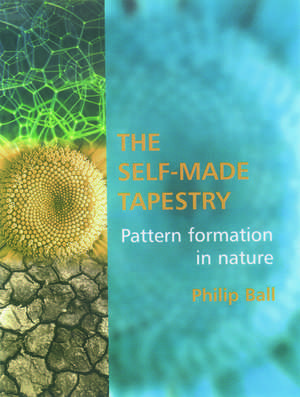
The Self-Made Tapestry: Pattern Formation in Nature
Philip Ballen Limba Engleză Paperback – 5 iul 2001
Preț: 534.90 lei
Preț vechi: 772.33 lei
-31%
Puncte Express: 802
Carte tipărită la comandă
Livrare economică 10-16 decembrie
Livrare prin curier în România Termenul estimat este afișat lângă disponibilitate.
Transport gratuit pentru acest produs Plată online sau ramburs, în funcție de opțiunile comenzii.
Retur gratuit în 14 zile Comandă securizată și suport în română.
Specificații
ISBN-13: 9780198502432
ISBN-10: 0198502435
Pagini: 296
Ilustrații: 24 plates, numerous halftones and line figures
Dimensiuni: 189 x 247 x 18 mm
Greutate: 0.63 kg
Editura: Oxford University Press
Colecția OUP Oxford
Locul publicării:Oxford, United Kingdom
ISBN-10: 0198502435
Pagini: 296
Ilustrații: 24 plates, numerous halftones and line figures
Dimensiuni: 189 x 247 x 18 mm
Greutate: 0.63 kg
Editura: Oxford University Press
Colecția OUP Oxford
Locul publicării:Oxford, United Kingdom
V-ar putea interesa
-
 Universe of StonePhilip BallPreț: 121.29 lei
 -
 Critical MassPhilip Ball-21%Preț: 70.24 lei89.16 lei
 -
 Preț: 137.11 lei
 -
 Bright EarthPhilip Ball-17%Preț: 101.88 lei123.10 lei
 -
 Molecules: A Very Short IntroductionPhilip Ball-19%Preț: 58.18 lei71.42 lei
 -
 Mathematical PhysicsDonald H. MenzelPreț: 110.74 lei
 -
 Life′s Matrix – A Biography of WaterPhilip BallPreț: 242.89 lei
 -
 -18%Preț: 959.93 lei1170.64 lei
 -
 Applied Parameter Estimation for Chemical EngineersPeter Englezos-18%Preț: 2196.73 lei2678.94 lei
 -
 Elegant SolutionsPhilip BallPreț: 186.80 lei
 -
 Modern Formal Methods and ApplicationsHossam A. Gabbar-15%Preț: 696.15 lei819.00 lei
 -
 Mathematics in the Real WorldW. D. WallisPreț: 408.44 lei
 -
 Qspr/Qsar Studies By Molecular DescriptorsMircea V Diudea-26%Preț: 847.53 lei1143.84 lei
 -
 Handbook of Thin Plate Buckling and PostbucklingFrederick Bloom-15%Preț: 690.82 lei812.73 lei
 -
 Numerical Methods for EngineersD. Vaughan Griffiths-20%Preț: 1490.52 lei1863.15 lei
 -
 GEOMETRIC MECHANICS (PART II)Holm Darryl D-19%Preț: 523.69 lei646.53 lei
 -
 Political GeometryMoon DuchinPreț: 325.66 lei
 -
 Preț: 301.64 lei
 -
 CONNECTIONS IN CLASSICAL & QUANTUM...Mangiarotti L-18%Preț: 961.10 lei1172.08 lei
Recenzii
Philip Ball has produced a superb book... countless examples give rise to fascinating reflections on the astounding order that exists amid chaos. Lavishly illustrated, this is a stunning book. John Cornwell, The Sunday Times, 29/11/98
Sand slides into neat heaps, a shell spirals into a delectable curve... How do these things get themselves in order? Philip Ball has some answers... Ball convincingly argues for some simple general principles. Per Bak, New Scientist, 12/12/98
Sand slides into neat heaps, a shell spirals into a delectable curve... How do these things get themselves in order? Philip Ball has some answers... Ball convincingly argues for some simple general principles. Per Bak, New Scientist, 12/12/98