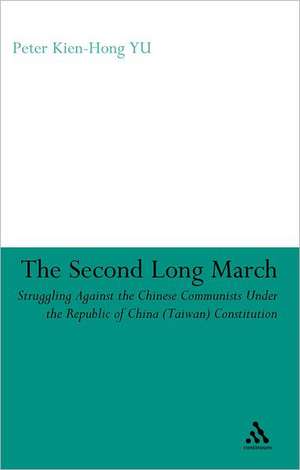
The Second Long March
Autor Peter Kien-Hong Yuen Limba Engleză Hardback – mar 2009
This work, written by an expert in the politics of Mainland China and Taiwan, looks at the role the Constitution of the Republic of China has played in the development of Taiwan since 1949 and its potential influence on the People's Republic of China.
The Chinese Communists conducted the first long march for the sake of the majority of Chinese people, with the victory of MAO Zedong. In the second long march, CHIANG Kai-shek and his successors tried to convert the Chinese mainland from a Communist, totalitarian system, into a democratic, prosperous one by relying on the spirit of the Republic of China (ROC) constitution and by setting itself as a good example, in gradually guaranteeing freedom and democracy. Needless to say, this march is long and difficult.
The Second Long March challenges other models and theories on the study of the relationship between the ROC (Taiwan area) and mainland China or the People's Republic of China (PRC) since China became politically (as opposed to legally) divided in December 1949. Arguably, it is the ROC Constitution that has helped ROC citizens to live in a non-Communist or anti-Communist political system. Actively promoting democracy and freedom on the Chinese mainland (neidi) can further guarantee the Taiwan area's survival.
The book will provide valuable scholarship of interest to anyone researching the political history of China and its prospects for democratization.
Preț: 916.56 lei
Preț vechi: 1387.79 lei
-34% Nou
Puncte Express: 1375
Preț estimativ în valută:
162.19€ • 190.19$ • 142.44£
162.19€ • 190.19$ • 142.44£
Carte tipărită la comandă
Livrare economică 04-18 februarie 26
Preluare comenzi: 021 569.72.76
Specificații
ISBN-13: 9780826430106
ISBN-10: 0826430104
Pagini: 220
Ilustrații: 1 illus
Dimensiuni: 161 x 240 x 17 mm
Greutate: 0.5 kg
Editura: BLOOMSBURY 3PL
Locul publicării:New York, United States
ISBN-10: 0826430104
Pagini: 220
Ilustrații: 1 illus
Dimensiuni: 161 x 240 x 17 mm
Greutate: 0.5 kg
Editura: BLOOMSBURY 3PL
Locul publicării:New York, United States
Caracteristici
Political change in China and how it can be achieved is of high interest to anyone studying Chinese politics.
Cuprins
Foreword
Preface
Chapter 1: Introductory Remarks
Chapter 2: The CHIANG Kai-shek March: A Straight Line
Chapter 3: The YAN Chia-kan March: A Short Line
Chapter 4: The CHIANG Ching-kuo March: A Meandering Line
Chapter 5: The LEE Teng-hui March: A Zig-Zag Line
Chapter 6: The CHEN Shui-bian March: A Forced, Untrodden Split Line with Sideroads
Chapter 7: Conclusion: Future Prospects
List of Important Documents
Bibliography
Index
Recenzii
"Yu deserves credit for formulating a basic theory. Few dare do this. His theory is heuristic. It makes one think. It is a useful framework for explaining Taiwan's success in democratizing, which still interests leaders of developing nations and scholars everywhere.Yu also provides an interesting look at Taiwan's politics as he goes. He is a homegrown observer and knows the ins and outs of how the system works in principle and in practice. He adds tidbits of inside information along the way, many of which have not been cited or at least assessed by other scholars. This makes the book a more interesting read.The Second Long March is recommended to all who want to view Taiwan's history and politics, especially its democratization, from a unique perspective. Why is this so important? Taiwan is the only non-negotiable issue between the United States and the People's Republic of China, the sole superpower and the world's foremost rising power, and the relationship between them is the basis of stability in the global economy and international politics." -- John F. Copper is the Stanley J. Buckman Professor of International Studies at Rhodes College in Memphis, Tennessee.
The Second Long March is recommended to all who want to view Taiwan's history and politics, especially its democratization, from a unique perspective.
"This work is worth reading especially for the people who are intereseted in the R.O.C.'s relations with the P.R.C and the U.S. or Taiwan's political development in general after WWII because it not only provides a new theory of why the R.O.C. on Tawan has survived since 1949 but also well documents much R.O.C.-related historic information including important domestic and international political events, public statements made by politicians, news reports, scholarly works, etc. in the period from 1949 to 2008." --Journal of Chinese Political Science, Vol 16, No 3, 2011
The Second Long March is recommended to all who want to view Taiwan's history and politics, especially its democratization, from a unique perspective.
"This work is worth reading especially for the people who are intereseted in the R.O.C.'s relations with the P.R.C and the U.S. or Taiwan's political development in general after WWII because it not only provides a new theory of why the R.O.C. on Tawan has survived since 1949 but also well documents much R.O.C.-related historic information including important domestic and international political events, public statements made by politicians, news reports, scholarly works, etc. in the period from 1949 to 2008." --Journal of Chinese Political Science, Vol 16, No 3, 2011