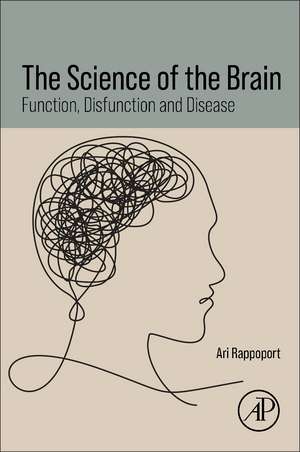
The Science of the Brain: Function, Dysfunction and Disease
Autor Ari Rappoporten Limba Engleză Paperback – 21 mai 2025
In addition to its comprehensive analysis of brain function, the book introduces readers to the latest innovations in neuroscience, including technological advancements in brain imaging and treatments. It also examines the ethical dilemmas posed by emerging technologies and their implications for society. With its blend of readability and scientific rigor, this work sheds light on the possibilities for future research and intervention, inspiring a deeper understanding of one of the most complex organs in the human body.
- Identifies connections between brain functionality and specific disorders, revealing previously unexplored therapeutic avenues
- Challenges existing paradigms in neuroscience by presenting the first comprehensive theories for a range of neurological and psychiatric conditions
- Utilizes detailed references and robust scientific data to support groundbreaking claims and methodologies
Preț: 887.92 lei
Preț vechi: 1171.15 lei
-24% Nou
Puncte Express: 1332
Preț estimativ în valută:
157.14€ • 184.29$ • 137.78£
157.14€ • 184.29$ • 137.78£
Carte tipărită la comandă
Livrare economică 19 ianuarie-02 februarie 26
Preluare comenzi: 021 569.72.76
Specificații
ISBN-13: 9780443450082
ISBN-10: 0443450080
Pagini: 358
Dimensiuni: 152 x 229 mm
Greutate: 0.56 kg
Editura: ELSEVIER SCIENCE
ISBN-10: 0443450080
Pagini: 358
Dimensiuni: 152 x 229 mm
Greutate: 0.56 kg
Editura: ELSEVIER SCIENCE
Cuprins
1. A CRH2-ACTH Theory of Autism Spectrum Disorder
2. A CRH2-CRH1 Theory of Anorexia and Bulimia
3. A Polyunsaturated Fatty Acid (PUFA) Theory of Schizophrenia
4. A Dynorphin Theory of Depression and Bipolar Disorder
5. A CRH-HCN Theory of Obsessive-Compulsive Disorder (OCD)
6. A KTAP Channel Theory of Attention-Deficit Hyperactivity Disorder
7. A Sympathetic Nervous System Theory of Migraine
8. A Ceramide Theory of Multiple Sclerosis
9. A Calcium Channel α2δ Subunit Theory of Amyotrophic Lateral Sclerosis and Frontotemporal Dementia
10. A Galactose Theory of Parkinson’s Disease
11. A Lipid-Raft Theory of Alzheimer’s Disease
12. The Brain’s Adaptive Response Process: Function and Anatomy
13. The Brain’s ‘Allow, Restrain, Amplify, Respond’ (ARAR) Architecture
14. A Comprehensive Biological Theory of Sleep
2. A CRH2-CRH1 Theory of Anorexia and Bulimia
3. A Polyunsaturated Fatty Acid (PUFA) Theory of Schizophrenia
4. A Dynorphin Theory of Depression and Bipolar Disorder
5. A CRH-HCN Theory of Obsessive-Compulsive Disorder (OCD)
6. A KTAP Channel Theory of Attention-Deficit Hyperactivity Disorder
7. A Sympathetic Nervous System Theory of Migraine
8. A Ceramide Theory of Multiple Sclerosis
9. A Calcium Channel α2δ Subunit Theory of Amyotrophic Lateral Sclerosis and Frontotemporal Dementia
10. A Galactose Theory of Parkinson’s Disease
11. A Lipid-Raft Theory of Alzheimer’s Disease
12. The Brain’s Adaptive Response Process: Function and Anatomy
13. The Brain’s ‘Allow, Restrain, Amplify, Respond’ (ARAR) Architecture
14. A Comprehensive Biological Theory of Sleep
Recenzii
"I highly recommend reading this exceptional book. It offers a series of chapters on brain research that masterfully combine original thinking with scientific precision. Theories presented in the book are not only supported by robust data and recent discoveries, but also form coherent and comprehensive models that trace the full course of disease—from underlying mechanisms to clinical manifestation. I have rarely encountered such a complete and insightful theoretical approach to major diseases, encompassing all stages of pathogenesis, diagnostic strategies, and therapeutic suggestions. This is a remarkable scientific, medical, and literary achievement, distinguished by its originality and outstanding quality." -- Iris Barshack, Head of Institute of Pathology, Sheba Medical Center; Prof. of Pathology, Gray’s Faculty of Health and Medical Sciences, Tel Aviv University; Accompanied Dean of MD PhD School of Medicine, Weizmann Institute; Chair of the Israeli Association of Pathologists
"Understanding the workings of the brain in health and disease is one of the greatest challenges of modern science, and therefore, it benefits tremendously from the perspectives of brilliant thinkers from a broad range of disciplines. In this book, Prof. Ari Rappoport–whose formal training is in computer science–brings such fresh perspective to brain science by offering a comprehensive
theoretical framework for thinking about the brain and some of the disorders afflicting it. An aspect of the book that especially appeals to an experimentalist neuroscientist like me is that it offers a rich foundation for formulating new testable hypotheses. This is a well-researched, well referenced, and well-written book that will be appreciated by anybody who studies the brain and its disorders or is simply interested in this fascinating topic." -- Gilad Barnea, PhD, Sidney A. Fox and Dorothea Doctors Fox Professor
of Ophthalmology, Visual Sciences, and Neuroscience
Department of Neuroscience, Director, Center for the Neurobiology of Cells and Circuits Robert J. and Nancy D. Carney Institute for Brain Science, Brown University, Providence, RI, USA
"This book by Professor Rappoport is an ambitious and thought-provoking collection of interrelated theories explaining a wide range of brain functions and dysfunctions. The vast scope of this effort may initially seem intimidating, but it is grounded in a thorough analysis of thousands of research articles. Despite being written by a “non-neuroscientist,” the book presents numerous hypotheses and predictions that are ready to be tested and challenged, related to topics such as autism, sleep, Parkinson’s disease, and anorexia, to name just a few. The content is delivered in a clear language, making it accessible to both experts in the field and laypersons alike." -- Gilad Silberberg, Professor, Department of Neuroscience, Karolinska Institutet, Sweden
"The Science of the Brain: Function, Dysfunction and Disease by Ari Rappaport is a new and refreshing view of the neuroscience of neuropsychiatric disorders. Rappaport has provided extensive literature reviews of the biology of specific disorders and a synthesis of the massive data into cogent theories regarding pathophysiology and optimizing treatment development. The book is impressive because while the author is not trained in the specific area, he has through diligence and scientific sleuthing produced a tome that provides truly innovative ways of thinking re the biology of disorders and their treatments. This is a book for anyone interested in learning about novel, but largely supported, hypotheses of neuropsychiatric disorders that are ready for research implementation." -- Alan F. Schatzberg, MD
Kenneth T. Norris, Jr., Professor, Department of Psychiatry and Behavioral Sciences, Stanford University School of Medicine
"Understanding the workings of the brain in health and disease is one of the greatest challenges of modern science, and therefore, it benefits tremendously from the perspectives of brilliant thinkers from a broad range of disciplines. In this book, Prof. Ari Rappoport–whose formal training is in computer science–brings such fresh perspective to brain science by offering a comprehensive
theoretical framework for thinking about the brain and some of the disorders afflicting it. An aspect of the book that especially appeals to an experimentalist neuroscientist like me is that it offers a rich foundation for formulating new testable hypotheses. This is a well-researched, well referenced, and well-written book that will be appreciated by anybody who studies the brain and its disorders or is simply interested in this fascinating topic." -- Gilad Barnea, PhD, Sidney A. Fox and Dorothea Doctors Fox Professor
of Ophthalmology, Visual Sciences, and Neuroscience
Department of Neuroscience, Director, Center for the Neurobiology of Cells and Circuits Robert J. and Nancy D. Carney Institute for Brain Science, Brown University, Providence, RI, USA
"This book by Professor Rappoport is an ambitious and thought-provoking collection of interrelated theories explaining a wide range of brain functions and dysfunctions. The vast scope of this effort may initially seem intimidating, but it is grounded in a thorough analysis of thousands of research articles. Despite being written by a “non-neuroscientist,” the book presents numerous hypotheses and predictions that are ready to be tested and challenged, related to topics such as autism, sleep, Parkinson’s disease, and anorexia, to name just a few. The content is delivered in a clear language, making it accessible to both experts in the field and laypersons alike." -- Gilad Silberberg, Professor, Department of Neuroscience, Karolinska Institutet, Sweden
"The Science of the Brain: Function, Dysfunction and Disease by Ari Rappaport is a new and refreshing view of the neuroscience of neuropsychiatric disorders. Rappaport has provided extensive literature reviews of the biology of specific disorders and a synthesis of the massive data into cogent theories regarding pathophysiology and optimizing treatment development. The book is impressive because while the author is not trained in the specific area, he has through diligence and scientific sleuthing produced a tome that provides truly innovative ways of thinking re the biology of disorders and their treatments. This is a book for anyone interested in learning about novel, but largely supported, hypotheses of neuropsychiatric disorders that are ready for research implementation." -- Alan F. Schatzberg, MD
Kenneth T. Norris, Jr., Professor, Department of Psychiatry and Behavioral Sciences, Stanford University School of Medicine