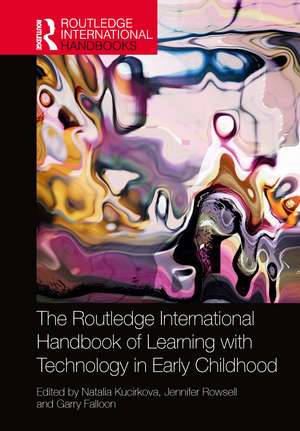
The Routledge International Handbook of Learning with Technology in Early Childhood: Routledge International Handbooks of Education
Editat de Natalia Kucirkova, Jennifer Rowsell, Garry Falloonen Limba Engleză Paperback – 16 ian 2020
Din seria Routledge International Handbooks of Education
- 9%
 Preț: 2426.28 lei
 -
 Preț: 420.65 lei
 -
 Preț: 384.89 lei
 -
 Preț: 466.79 lei
 - 18%
 Preț: 341.76 lei
 - 18%
 Preț: 1552.68 lei
 - 18%
 Preț: 341.76 lei
 -
 Preț: 406.50 lei
 -
 Preț: 438.31 lei
 - 14%
 Preț: 317.39 lei
 - 32%
 Preț: 1220.77 lei
 - 18%
 Preț: 1562.71 lei
 -
 Preț: 461.25 lei
 -
 Preț: 463.66 lei
 - 18%
 Preț: 1512.96 lei
 - 29%
 Preț: 468.78 lei
 - 18%
 Preț: 341.76 lei
 - 31%
 Preț: 557.52 lei
 - 18%
 Preț: 341.76 lei
 - 34%
 Preț: 1883.94 lei
 - 17%
 Preț: 350.06 lei
 - 32%
 Preț: 1227.92 lei
 - 18%
 Preț: 1559.37 lei
 - 17%
 Preț: 352.01 lei
 - 18%
 Preț: 1546.76 lei
 - 28%
 Preț: 439.15 lei
 - 15%
 Preț: 566.80 lei
 - 18%
 Preț: 1548.74 lei
 - 18%
 Preț: 1605.16 lei
 -
 Preț: 470.86 lei
 - 18%
 Preț: 1615.17 lei
 - 15%
 Preț: 568.35 lei
 -
 Preț: 401.89 lei
 - 17%
 Preț: 353.48 lei
 - 18%
 Preț: 1565.72 lei
Preț: 366.64 lei
Nou
Puncte Express: 550
Preț estimativ în valută:
64.89€ • 76.10$ • 56.89£
64.89€ • 76.10$ • 56.89£
Carte tipărită la comandă
Livrare economică 27 ianuarie-10 februarie 26
Preluare comenzi: 021 569.72.76
Specificații
ISBN-13: 9781138308190
ISBN-10: 1138308196
Pagini: 472
Dimensiuni: 174 x 246 x 23 mm
Greutate: 0.72 kg
Ediția:1
Editura: Taylor & Francis
Colecția Routledge
Seria Routledge International Handbooks of Education
Locul publicării:Oxford, United Kingdom
ISBN-10: 1138308196
Pagini: 472
Dimensiuni: 174 x 246 x 23 mm
Greutate: 0.72 kg
Ediția:1
Editura: Taylor & Francis
Colecția Routledge
Seria Routledge International Handbooks of Education
Locul publicării:Oxford, United Kingdom
Cuprins
Foreword
Rosie Flewitt (University College of London, UK)
Section One: Studying children’s contemporary play
Rosie Flewitt (University College of London, UK)
Section One: Studying children’s contemporary play
- Cut it out! Materiality and Action in Children’s Play and ToymakingKaren Wohlwend & Jaye Johnson Thiel Indiana University, USA
- Chestcam tales: Exploring embodied ethnography with young childrenJackie Marsh, University of Sheffield, UK
- The development of childhood culturesAnne Haas Dyson, Illinois University, USA
Section Two: Studying specific groups of children - Meeting the needs of students in a multilingual classroom: Linking Research to PracticeRahat Zaidi, University of Calgary, Canada
- Research with children with SENMelissa Allen, Lancaster University, UK
- Children from diverse backgroundsJim Anderson, British Columbia
Section Three: Studying children’s practices at home and in lab settings - Learning at homeLaidlaw, O’Mara & Wong, Deakin University, Australia
- Community-based researchPam Whitty, University of New Brunswick, Canada
- Using magnetic resonance imaging in infants and young children and its implication for bridging the fields of Neuroscience and EducationNadine Gaab, Harvard University, USA
Section Four: Children’s global practices and movement through space - "Talk into my GoPro, I’m making a movie!" Using digital ethnographic methods to explore children’s experiences in the woodsDebra Harwood & Diane Collier, Brock University, Canada
- Deep hanging out: artifactual literacies and ethnographic methodsMargaret Somerville & Sarah Powell, Western Sydney University, Australia
- Getting away from the screen: the play affordances of Internet connected toysDonell Holloway, Edith Cowan University, Australia
Section Five: Studying children’s learning with others - This is the stuff that literacies are made of: Researching children’s learning with grandparents and other elders through ethnographic methodsRachel Heydon, & Xiaoxiao Du, University of Western Ontario, Canada
- Children and parents interacting together with an app supportKathy Sylva & Fiona Roberts, University of Oxford, UK
- Children learning in their familiesTisha Lewis, University of Georgia, USA
Section Six: Children’s learning through body, embodiment and haptics - EmbodimentKerryn Dixon, Wits University, South Africa
- Technologies, affordances, children and (embodied) reading: a call for intedisciplinarityAnne Mangen, Trude Hoel, Thomas Moser, University of Oslo, Norway
- Valuing Signs of Learning: A Multimodal Perspective on Observation and Digital Documentation in Early Years ClassroomsKate Cowan, University College London, UK
Section Seven: Studying reading and interacting on screen - Eye-tracking and e-booksZsofia Takacs, Eötvös Loránd University, Hungray
- Lab-based studies of children’s reading on screenBrenna Hassinger and Rebecca Dore, University of Delaware, USA
- Visual methods for studying children’s interactions on screenAbi Hackett & Lucy Caton, Manchester Metorpolitan University, UK
Section Eight: Children’s multiliteracies - Who's helping who?: Young children seeking help when learning to writeAnnette Woods, Queensland University of Technology, Australia
- Children’s literature and critical literacyPeggy Albers, Georgia State University, USA, together with Vivian Vasquez and Jerry Harste
- Methodologies without methodology: (Re)imagining research practices when thinking with poststructural and posthumanist theoriesCandace Kuby, Missouri University, USA
Section Nine: Children’s drawing, mark-making and arts - Studying science apps in low-income pre-schoolsLena Lee, Miami University, USA
- Storying as a methodology in early years classroomsCathy Burnett and Guy Merchant, Sheffield Hallam University, UK
- Student generated visual narratives: lived experiences of learningNarelle Lemon, La Trobe University, Australia
- Arts-based methods
Descriere
This book brings together innovative work happening in childhood research across disciplinary boundaries and across the world. It focuses specifically on the most cutting-edge, innovative methodological approaches in the study of children’s use and learning with digital technologies and children’s experiences of key 21st century trends (e.g. immigration or multiculturalism). A true effort is made to have dialogues across diverse fields and contested fields of research (including educational psychology, post-humanist literacy, narrative approaches, developmental approaches).The book is a comprehensive survey of methods in the field of children’s technologies. The volume is a substantive and strategic collection of international approaches to early childhood and technologies. The authors reflect on what works and what doesn’t work in relation to specific innovative research methods.