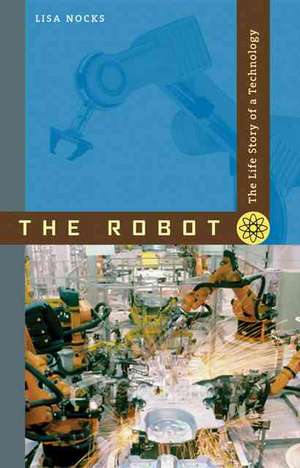
The Robot
Autor Lisa Nocksen Limba Engleză Paperback – oct 2008
Preț: 196.39 lei
Puncte Express: 295
Carte disponibilă
Livrare economică 10-24 noiembrie
Livrare prin curier în România Termenul estimat este afișat lângă disponibilitate.
Transport gratuit de la 400.00 lei Plată online sau ramburs, în funcție de opțiunile comenzii.
Retur gratuit în 14 zile Comandă securizată și suport în română.
Specificații
ISBN-13: 9780801890710
ISBN-10: 0801890713
Pagini: 224
Ilustrații: 20 halftones
Dimensiuni: 154 x 235 x 15 mm
Greutate: 0.38 kg
Editura: Johns Hopkins University Press
Locul publicării:Baltimore, United States
ISBN-10: 0801890713
Pagini: 224
Ilustrații: 20 halftones
Dimensiuni: 154 x 235 x 15 mm
Greutate: 0.38 kg
Editura: Johns Hopkins University Press
Locul publicării:Baltimore, United States
V-ar putea interesa
-
 Arduino Robot BonanzaGordon McComb-38%Preț: 210.57 lei339.85 lei
 -
 Robotics: A Very Short IntroductionAlan Winfield-20%Preț: 57.20 lei71.12 lei
 -
 The Technological SingularityMurray Shanahan-21%Preț: 97.48 lei122.92 lei
 -
 Optimal ControlFrank L Lewis-9%Preț: 992.25 lei1090.39 lei
 -
 Practical Field RoboticsSturges-8%Preț: 636.53 lei691.87 lei
 -
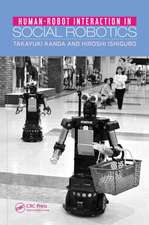 Human-Robot Interaction in Social RoboticsTakayuki Kanda-18%Preț: 1611.04 lei1964.69 lei
 -
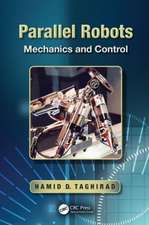 Parallel Robots: Mechanics and ControlHamid D. Taghirad-20%Preț: 1784.20 lei2230.26 lei
 -
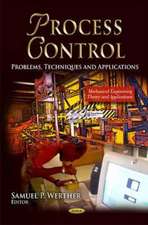 Process Control: Problems, Techniques and ApplicationsSamuel P. Werther-27%Preț: 1165.46 lei1585.77 lei
Notă biografică
Lisa Nocks is a University Lecturer at New Jersey Institute of Technology in the Federated Department of History, NJIT/Rutgers. She writes on the recent history of technology and the social impact of techno-science.
Descriere
Descriere de la o altă ediție sau format:
In almost all depictions of the future, one technology plays a prominent role - the robot. Science fiction movies and stories tell us that, in the not so distant future, robots - from Robbie the Robot to C3PO to the Terminator - will be everywhere, taking care of every human need. Those are projections of the future. But robots have a history as well, and The Robot: A Life Story of a Technology tells their story. During the Englightenment, automata were mechnical toys that could simulate human actions. Robots became essential parts of factories, performing tasks perfectly that would be either too dangerous or boring for humans. And recent advances in artificial intelligence have made robots that can behave with intelligence.
In almost all depictions of the future, one technology plays a prominent role - the robot. Science fiction movies and stories tell us that, in the not so distant future, robots - from Robbie the Robot to C3PO to the Terminator - will be everywhere, taking care of every human need. Those are projections of the future. But robots have a history as well, and The Robot: A Life Story of a Technology tells their story. During the Englightenment, automata were mechnical toys that could simulate human actions. Robots became essential parts of factories, performing tasks perfectly that would be either too dangerous or boring for humans. And recent advances in artificial intelligence have made robots that can behave with intelligence.
Recenzii
Concise and direct to the point, Nocks' technography on the robot offers a rich overview of the systems we understand as robotic. It summarizes the 30-some year-long history of a plethora of ideas, experiments, and implementations that have found their places in our everyday lives. . . . Kudos to the author on the perfect marriage between coverage and length in this volume. In fewer than 200 pages, one finds great essays that do not leave too much out. Everything relevant to robotics today can be found here, albeit in an introductory form. But that is exactly what this book aims to achieve: to give us the grand picture of a grand technology, and motivate us to explore further. Highly recommended. General readers; upper-division undergraduates through faculty.
Following the format of a life story, Nocks provides a volume for students and general readers on the development of robot technology. The volume moves from the robot's forerunners, to its invention, prominence, and final decline. How the technology affected society and culture is interwoven with the description of its history. She begins as far back as myths in ancient times, discusses clock and toymakers of the seventeenth through nineteenth centuries, and considers twentieth century advances in control engineering, the incorporation of robots in industry, and artificial intelligence and recent developments that incorporate perception, independence, and artificial muscles.
Following the format of a life story, Nocks provides a volume for students and general readers on the development of robot technology. The volume moves from the robot's forerunners, to its invention, prominence, and final decline. How the technology affected society and culture is interwoven with the description of its history. She begins as far back as myths in ancient times, discusses clock and toymakers of the seventeenth through nineteenth centuries, and considers twentieth century advances in control engineering, the incorporation of robots in industry, and artificial intelligence and recent developments that incorporate perception, independence, and artificial muscles.