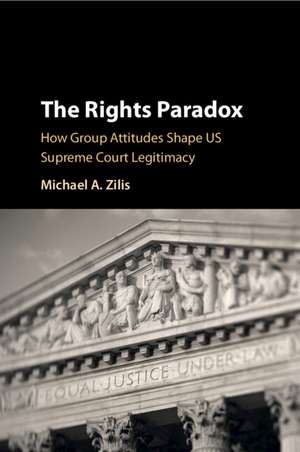
The Rights Paradox
Autor Michael A. Zilisen Limba Engleză Paperback – 6 oct 2022
Preț: 194.85 lei
Puncte Express: 292
Carte tipărită la comandă
Livrare economică 03-17 decembrie
Livrare prin curier în România Termenul estimat este afișat lângă disponibilitate.
Transport gratuit de la 400.00 lei Plată online sau ramburs, în funcție de opțiunile comenzii.
Retur gratuit în 14 zile Comandă securizată și suport în română.
Specificații
ISBN-13: 9781108927697
ISBN-10: 1108927696
Pagini: 196
Dimensiuni: 152 x 229 x 11 mm
Greutate: 0.29 kg
Editura: Cambridge University Press
Locul publicării:New York, United States
ISBN-10: 1108927696
Pagini: 196
Dimensiuni: 152 x 229 x 11 mm
Greutate: 0.29 kg
Editura: Cambridge University Press
Locul publicării:New York, United States
Cuprins
1. Legitimacy and minority rights; 2. The group antipathy theory of supreme court legitimacy; 3. Under siege: gay rights and immigration at the supreme court; 4. Opening the floodgates: big business, citizens united, and evaluations of the court; 5. Experimental tests of the group antipathy model; 6. How citizens use groups to evaluate judicial preferences; 7. Group antipathy and strategic behaviour on the supreme court; 8. Conclusion; References; Cases cited; Index.
Recenzii
'Drawing on a range of literatures, Zilis develops a compelling and original argument: Citizens evaluate the Supreme Court based on the groups they think the Court is supporting. That alone makes his book a great read. But Zilis goes further, assessing his claim against survey and experimental data covering a range of groups. No readers will leave The Rights Paradox without rethinking everything they thought they knew about the Court's legitimacy.' Lee Epstein, Washington University in St. Louis
'We're in a renaissance period right now with respect to how scholars assess the vital relationship between the US Supreme Court and public opinion. Zilis' The Rights Paradox demonstrates his role as a leading contributor to not just these efforts, but, as he persuasively demonstrates with a bevy of analyses, to our broader understanding of fundamental tenets of judicial behavior as well. This is an exceptionally important book that needs to be read by anyone who researches or teaches about the US Supreme Court.' Ryan Black, Michigan State University
'The Rights Paradox presents an insightful argument about public attitudes toward the Supreme Court and a set of well-designed studies to probe its validity. Zilis provides a new perspective on the forces that shape the Court's legitimacy, a perspective that has important implications for our understanding of the Court.' Lawrence Baum, The Ohio State University
'Zilis successfully integrates several scholarly strands - public opinion, identity politics, the substance of judicial decisions, institutional legitimacy, and judicial decision making - into a definitive scholarly contribution. Not only does The Rights Paradox provide an original explanation of how individuals' feelings toward groups involved in Supreme Court controversies translate into legitimacy judgments, it also connects that theory back to strategic decision making on the Supreme Court.' Brandon L. Bartels, George Washington University
'We're in a renaissance period right now with respect to how scholars assess the vital relationship between the US Supreme Court and public opinion. Zilis' The Rights Paradox demonstrates his role as a leading contributor to not just these efforts, but, as he persuasively demonstrates with a bevy of analyses, to our broader understanding of fundamental tenets of judicial behavior as well. This is an exceptionally important book that needs to be read by anyone who researches or teaches about the US Supreme Court.' Ryan Black, Michigan State University
'The Rights Paradox presents an insightful argument about public attitudes toward the Supreme Court and a set of well-designed studies to probe its validity. Zilis provides a new perspective on the forces that shape the Court's legitimacy, a perspective that has important implications for our understanding of the Court.' Lawrence Baum, The Ohio State University
'Zilis successfully integrates several scholarly strands - public opinion, identity politics, the substance of judicial decisions, institutional legitimacy, and judicial decision making - into a definitive scholarly contribution. Not only does The Rights Paradox provide an original explanation of how individuals' feelings toward groups involved in Supreme Court controversies translate into legitimacy judgments, it also connects that theory back to strategic decision making on the Supreme Court.' Brandon L. Bartels, George Washington University
Descriere
What happens to the legitimacy of the Supreme Court when it protects 'equal justice under law'?