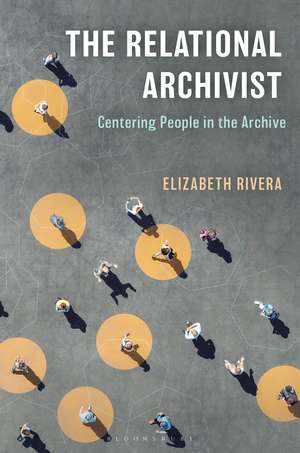
The Relational Archivist: Centering People in the Archive: Bloomsbury Libraries Unlimited
Autor Elizabeth Riveraen Limba Engleză Paperback – 12 oct 2026
The Relational Archivist argues that the future of archival practice depends on recognizing relationships as foundational to how we preserve and share history. While collections remain central to archives, their meaning and impact are realized through the connections archivists build with the people who create, use, support, and sustain archival work. This relationship-centered approach strengthens archival practice, enriches institutions, expands access, and fosters more engaged communities.
Drawing on public history, archival scholarship, and examples from university archives, this book demonstrates how intentional relationships lead to stronger collections, innovative exhibits, meaningful programs, donor partnerships, and collaborative opportunities. It offers practical strategies for cultivating shared authority, reducing professional isolation, and building sustainable archival practices.
More than a guide to archival outreach, The Relational Archivist challenges the profession to reconsider how archives define success. Archives preserve the stories of people, but they depend on the people who steward those stories. By supporting archivists, creating healthier workplaces, strengthening institutions, and fostering deeper community connections, relational practice helps ensure that the stories entrusted to archives continue to inspire future generations.
Din seria Bloomsbury Libraries Unlimited
- 11%
 Preț: 539.62 lei
 - 17%
 Preț: 343.42 lei
 - 18%
 Preț: 249.37 lei
 - nou
 Preț: 552.37 lei
 - 21%
 Preț: 187.19 lei
 - 24%
 Preț: 300.54 lei
 - 25%
 Preț: 204.85 lei
 - 16%
 Preț: 290.41 lei
 - 29%
 Preț: 613.82 lei
 - 26%
 Preț: 206.34 lei
 - 17%
 Preț: 385.31 lei
 - 32%
 Preț: 626.83 lei
 - 32%
 Preț: 630.61 lei
 - 29%
 Preț: 630.98 lei
 - 30%
 Preț: 482.30 lei
 - 26%
 Preț: 484.77 lei
 - 26%
 Preț: 453.10 lei
 - nou
 Preț: 186.19 lei
 - nou
 Preț: 611.80 lei
 - nou
 Preț: 545.29 lei
 - nou
 Preț: 616.59 lei
 - nou
 Preț: 661.60 lei
 - nou
 Preț: 176.60 lei
 - nou
 Preț: 612.94 lei
 - nou
 Preț: 240.85 lei
 - nou
 Preț: 240.56 lei
 - nou
 Preț: 628.13 lei
 - nou
 Preț: 626.95 lei
 - nou
 Preț: 612.89 lei
 - nou
 Preț: 418.98 lei
 - nou
 Preț: 275.42 lei
 - nou
 Preț: 270.00 lei
 - 5%
 Preț: 342.32 lei
 - nou
 Preț: 218.34 lei
 - nou
 Preț: 396.09 lei
 - nou
 Preț: 343.79 lei
 - nou
 Preț: 210.11 lei
Preț: 212.90 lei
Preț vechi: 274.60 lei
-22% Precomandă
Puncte Express: 319
Carte nepublicată încă
Livrare prin curier în România Precomanda se expediază când titlul devine disponibil.
Transport gratuit de la 400.00 lei Plată online sau ramburs, în funcție de opțiunile comenzii.
Retur gratuit în 14 zile Comandă securizată și suport în română.
Doresc să fiu notificat când acest titlu va fi disponibil:
Se trimite...
Specificații
ISBN-13: 9798216277156
Pagini: 208
Ilustrații: 15 bw illus
Dimensiuni: 156 x 235 mm
Editura: Bloomsbury Publishing
Colecția Bloomsbury Libraries Unlimited
Seria Bloomsbury Libraries Unlimited
Locul publicării:New York, United States
Pagini: 208
Ilustrații: 15 bw illus
Dimensiuni: 156 x 235 mm
Editura: Bloomsbury Publishing
Colecția Bloomsbury Libraries Unlimited
Seria Bloomsbury Libraries Unlimited
Locul publicării:New York, United States
Cuprins
1. Defining the Relational Archivist: Rooted in Public History and Library Science
2. Activating and Energizing University Archives through Outreach
3. Examining the Spectrum of University Archives
4. Public Programming and Publicity: Identifying and Promoting Your Collections
5. Crafting an Inclusive Archive & Working Toward Social Justice
6. Collaboration: Coming Together to Make a Difference in the Lives of People
7. Teaching and Learning in the Archive
8. From Beginning to End: It Is All About the People
Bibliography
Index
2. Activating and Energizing University Archives through Outreach
3. Examining the Spectrum of University Archives
4. Public Programming and Publicity: Identifying and Promoting Your Collections
5. Crafting an Inclusive Archive & Working Toward Social Justice
6. Collaboration: Coming Together to Make a Difference in the Lives of People
7. Teaching and Learning in the Archive
8. From Beginning to End: It Is All About the People
Bibliography
Index
Recenzii
The Relational Archivist is an inspired and hopeful volume. Using place-based case studies, interdisciplinary critical inquiry, and compelling (inter)personal experiences, Rivera challenges readers to reimagine archival practice as interwoven social responsibilities rooted in care and intention.
In a time of diminishing resources when archivists are being asked to do more with less, The Relational Archivist teaches archivists to find balance and build a realistic workload through the centering of relationships; in a time of neglect of the humanities when institutions value technology and production over people and meaning, it pushes us to remember that our work and the collections we serve are valuable only if they serve us and our communities. Drawing on hands-on archival experience and a degree in public history, Elizabeth Rivera's case studies demonstrate how to share authority with stakeholders and build bonds between an archive, its current and potential researchers, and its wider community. The Relational Archivist will inspire readers to build and grow their own people-centered archives.
Few people see archives as sites of public history and Elizabeth Rivera wants to change that. Drawing on her experience as both an archivist and public historian, Rivera demonstrates the immense potential of university archives to contribute to broader institutional missions by making people, rather than collections, the central focus. The Relational Archivist brings together the traditional constituencies of archivists and researchers with students, donors, and community members to co-create repositories of stories and experiences far beyond the collections themselves-offering a practical framework for the deeper collaboration among archivists, professors, administrators, and communities that university missions increasingly demand.
Historians have long recognized the significance of archives, and the acknowledgments pages of their books testify to the deep relationships developed between researcher and archivist. Yet most people will never visit an archive, in part because they believe it is not their space. The Relational Archivist reimagines the physical archive as more than a repository of documents but as a relational space for connection, presence, and inclusion. As a venue for public history, the archive becomes a place for anyone to encounter and contribute to the preservation of our shared past. By reimagining archives, Rivera opens pathways for universities to fulfill their public missions in ways that traditional collection-building never could-creating partnerships that enrich teaching, deepen institutional memory, and strengthen community relationships.
Rivera's framework is both timely and transformative. At a moment when universities face mounting financial pressures and archives can seem like a luxury, she repositions them as critical components of institutional mission and community engagement, providing concrete strategies for turning archives into sites of active collaboration rather than passive preservation. Grounded in archival practice, The Relational Archivist offers a vision that extends far beyond the archive itself-inviting administrators, professors, students, alumni, and community leaders to reimagine how universities preserve the past, engage the present, and build more inclusive futures.
The Relational Archivist: Centering People in the Archive is a timely, critical call to prioritize human connection within the archival enterprise. Drawing on research, experience, and training in public history, Rivera makes the case that archivists do our best work when we focus on the well-being of our colleagues, the communities with whom we engage, and ourselves. This book is an essential source for anyone who seeks insight into the practice of relationship-building in college and university archives.
In a time of diminishing resources when archivists are being asked to do more with less, The Relational Archivist teaches archivists to find balance and build a realistic workload through the centering of relationships; in a time of neglect of the humanities when institutions value technology and production over people and meaning, it pushes us to remember that our work and the collections we serve are valuable only if they serve us and our communities. Drawing on hands-on archival experience and a degree in public history, Elizabeth Rivera's case studies demonstrate how to share authority with stakeholders and build bonds between an archive, its current and potential researchers, and its wider community. The Relational Archivist will inspire readers to build and grow their own people-centered archives.
Few people see archives as sites of public history and Elizabeth Rivera wants to change that. Drawing on her experience as both an archivist and public historian, Rivera demonstrates the immense potential of university archives to contribute to broader institutional missions by making people, rather than collections, the central focus. The Relational Archivist brings together the traditional constituencies of archivists and researchers with students, donors, and community members to co-create repositories of stories and experiences far beyond the collections themselves-offering a practical framework for the deeper collaboration among archivists, professors, administrators, and communities that university missions increasingly demand.
Historians have long recognized the significance of archives, and the acknowledgments pages of their books testify to the deep relationships developed between researcher and archivist. Yet most people will never visit an archive, in part because they believe it is not their space. The Relational Archivist reimagines the physical archive as more than a repository of documents but as a relational space for connection, presence, and inclusion. As a venue for public history, the archive becomes a place for anyone to encounter and contribute to the preservation of our shared past. By reimagining archives, Rivera opens pathways for universities to fulfill their public missions in ways that traditional collection-building never could-creating partnerships that enrich teaching, deepen institutional memory, and strengthen community relationships.
Rivera's framework is both timely and transformative. At a moment when universities face mounting financial pressures and archives can seem like a luxury, she repositions them as critical components of institutional mission and community engagement, providing concrete strategies for turning archives into sites of active collaboration rather than passive preservation. Grounded in archival practice, The Relational Archivist offers a vision that extends far beyond the archive itself-inviting administrators, professors, students, alumni, and community leaders to reimagine how universities preserve the past, engage the present, and build more inclusive futures.
The Relational Archivist: Centering People in the Archive is a timely, critical call to prioritize human connection within the archival enterprise. Drawing on research, experience, and training in public history, Rivera makes the case that archivists do our best work when we focus on the well-being of our colleagues, the communities with whom we engage, and ourselves. This book is an essential source for anyone who seeks insight into the practice of relationship-building in college and university archives.
Notă biografică
Elizabeth Rivera is an archivist, public historian, and educator with experience in academic archives and a background in public history. She at earned her Ph.D. in public history with a focus on community inclusion in archival practices. Throughout her career, she has made significant contributions to research on best practices in library services, instructional programs, and collaborative student learning projects. Additionally, she has served as the principal investigator for several grant-funded initiatives with the National Endowment for the Humanities (NEH) and the National Historical Publications and Records Commission (NHPRC).