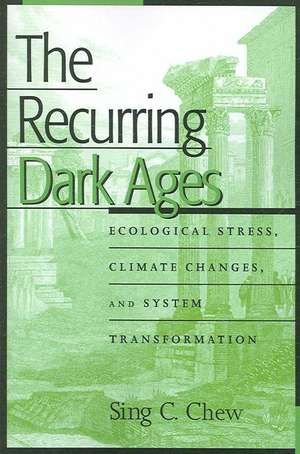
The Recurring Dark Ages: Ecological Stress, Climate Changes, and System Transformation
Autor Sing C. Chewen Limba Engleză Paperback – 17 noi 2006
Preț: 362.35 lei
Preț vechi: 463.40 lei
-22%
Puncte Express: 544
Carte tipărită la comandă
Livrare economică 04-18 decembrie
Livrare prin curier în România Termenul estimat este afișat lângă disponibilitate.
Transport gratuit de la 400.00 lei Plată online sau ramburs, în funcție de opțiunile comenzii.
Retur gratuit în 14 zile Comandă securizată și suport în română.
Specificații
ISBN-13: 9780759104525
ISBN-10: 0759104522
Pagini: 295
Dimensiuni: 148 x 228 x 18 mm
Greutate: 0.52 kg
Editura: Bloomsbury Publishing
Colecția AltaMira Press
Locul publicării:New York, United States
ISBN-10: 0759104522
Pagini: 295
Dimensiuni: 148 x 228 x 18 mm
Greutate: 0.52 kg
Editura: Bloomsbury Publishing
Colecția AltaMira Press
Locul publicării:New York, United States
V-ar putea interesa
-
 The Hunt for the Golden MoleRichard GirlingPreț: 112.51 lei
 -
 FeralGeorge Monbiot-31%Preț: 64.39 lei93.18 lei
 -
 A Passion for Nature: The Life of John MuirDonald Worster-16%Preț: 142.46 lei169.63 lei
 -
 -41%Preț: 450.46 lei765.81 lei
 -
 -30%Preț: 404.99 lei582.17 lei
 -
 -20%Preț: 318.84 lei398.60 lei
 -
 Ecological Futures: What History Can Teach UsSing C. Chew-29%Preț: 612.60 lei867.88 lei
 -
 -25%Preț: 346.36 lei463.46 lei
 -
 The Greenhouse: A Welfare Assessment and Some MoralsChristoph Lumer-34%Preț: 348.32 lei528.42 lei
 -
 Marjorie Harris CarrPeggy MacdonaldPreț: 151.81 lei
 -
 Climber's Paradise: Making Canada's Mountain Parks, 1906-1974PearlAnn Reichwein-14%Preț: 176.16 lei204.53 lei
 -
 The Sixth Extinction: An Unnatural HistoryElizabeth Kolbert-25%Preț: 69.89 lei93.77 lei
 -
 Limericks on NatureSadana, MR SanyamPreț: 68.85 lei
 -
 Sensitive BeekeepingJack Bresette-MillsPreț: 84.99 lei
 -
 -27%Preț: 68.01 lei92.93 lei
 -
 -24%Preț: 106.42 lei139.99 lei
Cuprins
Chapter 1 Preface
Part 2 I.The Dark Ages over World History
Chapter 3 1 System Crisis
Part 4 II.The Crisis of the Bronze Age
Chapter 5 2 Nature and Culture
Chapter 6 3 Ecological Crisis and System Transformation
Part 7 III.The Crisis of Antiquity
Chapter 8 4 Intensification of Natural and Social Systems Relations
Chapter 9 5 A Period of Darkness
Part 10 IV. System Transformation
Chapter 11 6 From the Past to the Future: Whither System Transformation?
Chapter 13 Appendix 1: Arboreal Pollen Influxes
Chapter 14 Appendix 2: Plantago Pollen Influxes
Chapter 15 Appendix 3: Arboreal and NonArboreal Pollen Influxes Percentages
Part 2 I.The Dark Ages over World History
Chapter 3 1 System Crisis
Part 4 II.The Crisis of the Bronze Age
Chapter 5 2 Nature and Culture
Chapter 6 3 Ecological Crisis and System Transformation
Part 7 III.The Crisis of Antiquity
Chapter 8 4 Intensification of Natural and Social Systems Relations
Chapter 9 5 A Period of Darkness
Part 10 IV. System Transformation
Chapter 11 6 From the Past to the Future: Whither System Transformation?
Chapter 13 Appendix 1: Arboreal Pollen Influxes
Chapter 14 Appendix 2: Plantago Pollen Influxes
Chapter 15 Appendix 3: Arboreal and NonArboreal Pollen Influxes Percentages
Recenzii
Dr. Chew's long awaited sequel to World Ecological Degradation provides the reader with new insights on the contemporary environmental crisis by providing a broad, long-range perspective on the interactions between natural changes and cultural changes. Interdisciplinary in scope, rich in theory and data, The Recurring Dark Ages helps the reader understand globalization in historical perspective.
Sing Chew offers groundbreaking insights for anyone seeking help in understanding the uneven course of the history of human culture in the context of nature. By a fine analysis of the times often discounted in world histories, Sing Chew provides a masterful new way of seeing the import of the interaction of human societies and the forces of the natural world.
Recurring Dark Ages takes ecological disasters based on systematic long-term overexploitation back to the beginnings of urban life and early industrialization in the Bronze Age. Sing Chew thus situates Dark Ages in a long-term historical perspective linked to the operation of an ancient world system. The book provides an original historical framework for understanding Dark Ages past and present.
This could be a fascinating romp through world history; each chapter whizzes across space and time in lightening fashion....The strength of this approach is the way it synthesizes and presents so much information about the ingenuity of diverse communities and their efforts to produce and trade across large distances and on changing ecological terrains, and it does so with a novel and persuasive analytic frame.
The world system has evolved and continues to do so. The question is what drives this evolutionary process. Sing Chew has developed a substantial argument built around intermittent and, hitherto, poorly understood Dark Ages. Chew shines an analytical light on the phases of deterioration that we usually ignore while favoring the periods of growth and expansion. Yet it is unlikely that you can have one without the other.
Sing Chew offers groundbreaking insights for anyone seeking help in understanding the uneven course of the history of human culture in the context of nature. By a fine analysis of the times often discounted in world histories, Sing Chew provides a masterful new way of seeing the import of the interaction of human societies and the forces of the natural world.
Recurring Dark Ages takes ecological disasters based on systematic long-term overexploitation back to the beginnings of urban life and early industrialization in the Bronze Age. Sing Chew thus situates Dark Ages in a long-term historical perspective linked to the operation of an ancient world system. The book provides an original historical framework for understanding Dark Ages past and present.
This could be a fascinating romp through world history; each chapter whizzes across space and time in lightening fashion....The strength of this approach is the way it synthesizes and presents so much information about the ingenuity of diverse communities and their efforts to produce and trade across large distances and on changing ecological terrains, and it does so with a novel and persuasive analytic frame.
The world system has evolved and continues to do so. The question is what drives this evolutionary process. Sing Chew has developed a substantial argument built around intermittent and, hitherto, poorly understood Dark Ages. Chew shines an analytical light on the phases of deterioration that we usually ignore while favoring the periods of growth and expansion. Yet it is unlikely that you can have one without the other.