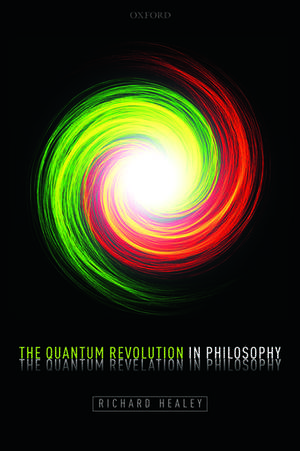
The Quantum Revolution in Philosophy
Autor Richard Healeyen Limba Engleză Paperback – 11 iul 2019
Preț: 217.03 lei
Preț vechi: 274.13 lei
-21%
Puncte Express: 326
Carte tipărită la comandă
Livrare economică 19-25 noiembrie
Livrare prin curier în România Termenul estimat este afișat lângă disponibilitate.
Transport gratuit de la 400.00 lei Plată online sau ramburs, în funcție de opțiunile comenzii.
Retur gratuit în 14 zile Comandă securizată și suport în română.
Specificații
ISBN-13: 9780198844679
ISBN-10: 0198844670
Pagini: 320
Dimensiuni: 156 x 234 x 17 mm
Greutate: 0.5 kg
Editura: OUP OXFORD
Colecția OUP Oxford
Locul publicării:Oxford, United Kingdom
ISBN-10: 0198844670
Pagini: 320
Dimensiuni: 156 x 234 x 17 mm
Greutate: 0.5 kg
Editura: OUP OXFORD
Colecția OUP Oxford
Locul publicării:Oxford, United Kingdom
V-ar putea interesa
-
 The Quantum Story: A history in 40 momentsJim Baggott-16%Preț: 100.77 lei119.50 lei
 -
 -12%Preț: 275.55 lei314.40 lei
 -
 Quantum Concepts in PhysicsMalcolm Longair-11%Preț: 609.33 lei684.65 lei
 -
 Elementary Particle PhysicsAndrew J. Larkoski-8%Preț: 437.26 lei475.29 lei
 -
 Quantum Mechanics Between Ontology and EpistemologyFlorian J. Boge-18%Preț: 709.77 lei865.57 lei
Recenzii
The book is primarily intended for those without a background in QT: philosophers, scientists, and laypeople interested in going beyond the metaphors found in popular presentations. ... The Quantum Revolution marks a major advance. The vast majority of quantum interpreters have simply assumed that QT provides a novel description of reality. Those that have recognized other options typically have in mind subjectivist views like QBism. Healey's view provides an important third option: QT provides objectively correct guidance about the world. Healey's view suggests a radical revision to the standard problems and the philosophical import of QT, and such a shake-up is certainly good for progress in the area.
Richard Healey is not messing around. His new book on quantum theory promises to overturn most of what we thought we knew about the quantum world (spoiler alert: there is no such thing), and in the process prompt a reappraisal of long-held assumptions about explanation, causation and other core scientific concepts. . . . In its main aims, to communicate this new picture of quantum theory to a wide range of readers and to situate it as part of a coherent pragmatist philosophical package, the book succeeds admirably. . . . There is a great deal of novelty and philosophical interest in the resulting picture, especially in the connections that are drawn with contemporary pragmatism and inferentialism. Healey's book is sure to become a standard point of reference in the interpretive literature.
Richard Healey is not messing around. His new book on quantum theory promises to overturn most of what we thought we knew about the quantum world (spoiler alert: there is no such thing), and in the process prompt a reappraisal of long-held assumptions about explanation, causation and other core scientific concepts. . . . In its main aims, to communicate this new picture of quantum theory to a wide range of readers and to situate it as part of a coherent pragmatist philosophical package, the book succeeds admirably. . . . There is a great deal of novelty and philosophical interest in the resulting picture, especially in the connections that are drawn with contemporary pragmatism and inferentialism. Healey's book is sure to become a standard point of reference in the interpretive literature.
Cuprins
- 1: Overview: A New Kind of Science
- I: Quantum Theory
- 2: Superposition
- 3: Entanglement
- 4: Non-locality
- 5: Assigning Values and States
- 6: Measurement
- 7: Interlude: Some Alternative Interpretations
- II: Philosophical Revelations
- 8: Theories, Models, and Representation
- 9: Probability and Explanation
- 10: Causation and Locality
- 11: Observation and Objectivity
- 12: Meaning
- 13: Fundamentality
- Conclusion
- Appendices
Notă biografică
Richard Healey has been Professor of Philosophy at the University of Arizona since 1991. One aim of his research has been to inquire how far foundational studies of physics shed light on metaphysical topics such as holism, realism, composition, time and causation. He is now exploring the relations between science and metaphysics from a broadly pragmatist perspective. His Gauging What's Real (2007), exploring the conceptual foundations of gauge theories in physics, was awarded the Lakatos Prize in the philosophy of science.