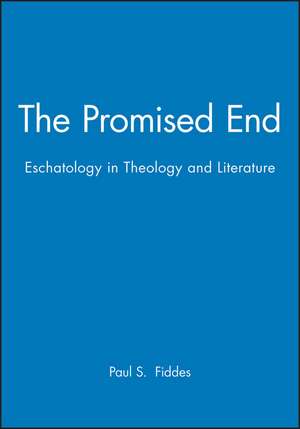
The Promised End
Autor Fiddesen Limba Engleză Paperback – 15 sep 2000
Analiza propusă de P Fiddes debutează prin exerciții riguroase de exegeză literară, examinând modul în care sfârșitul este construit în operele unor autori fundamentali precum James Joyce, Samuel Beckett sau Virginia Woolf. Considerăm că forța acestui volum rezidă în capacitatea de a pune în dialog direct structura narativă a romanului modern cu dogmatica teologică. Autorul nu se limitează la o analiză estetică, ci utilizează studiile de caz literare pentru a interoga concepte metafizice complexe, precum parusia sau natura eternității, oferind o perspectivă critică asupra lucrărilor lui Jürgen Moltmann și Wolfhart Pannenberg. În cadrul seriei Challenges in Contemporary Theology, lucrarea se distinge printr-un aparat critic ce armonizează teoria literară a lui Jacques Derrida sau Paul Ricoeur cu datele recente din științele naturii privind scurgerea timpului. Putem afirma că textul reușește să demonstreze cum eschatologia creștină, deși adesea percepută ca o structură rigidă, oferă de fapt un model de „întregire” a persoanei umane care poate absorbi deconstrucția postmodernă a imaginilor dominatoare. Comparabil cu European Literature and Theology in the Twentieth Century de D. Jasper în rigurozitatea explorării temelor mântuirii și timpului, volumul lui Fiddes este însă actualizat pentru a răspunde provocărilor specifice ale teoriei critice contemporane. Dacă Jasper se concentrează pe amenințarea lipsei de sens, The Promised End – Eschatology in Theology and Literature caută activ o coerență a sfârșitului care să poată fi aplicată în experiența umană prezentă, transformând o temă abstractă într-un instrument de înțelegere a condiției umane.
Preț: 505.69 lei
Carte tipărită la comandă
Livrare economică 09-23 noiembrie
Specificații
ISBN-10: 0631220852
Pagini: 316
Dimensiuni: 152 x 229 x 17 mm
Greutate: 0.46 kg
Editura: Wiley
Locul publicării:Chichester, United Kingdom
V-ar putea interesa
-
 Special Delivery: Epistolary Modes in Modern FictionLinda S. KauffmanPreț: 279.65 lei
 -
 Man on his Nature 2edCharles SherringtonPreț: 234.63 lei
 -
 Outlines of Logic: An English Translation of Trendelenburg's Elementa ...Friedrich Adolf Trendelenburg AristotlePreț: 85.63 lei
 -
 Preț: 94.44 lei
 -
 Preț: 94.44 lei
 -
 Remarks on Dr. Ware's Answer, Pp. 3-62Leonard WoodsPreț: 95.46 lei
 -
 Experience: A Chapter of Prolegomena, Pp. 7-62Wilfrid RichmondPreț: 95.46 lei
 -
 Preț: 95.09 lei
 -
![The Philosophy of Insanity, by a Late Inmate of the Glasgow Royal Asylum [- Frame].](https://i4.books-express.ro/bt/9780649427840/the-philosophy-of-insanity-by-a-late-inmate-of-the-glasgow-royal-asylum-frame.jpg) Preț: 101.95 lei
Preț: 101.95 lei -
 Psyche: A Study of the SoulWilliam Reed HuntingtonPreț: 102.39 lei
 -
 A Plain Argument for GodGeorge Stuart FullertonPreț: 103.05 lei
 -
![Die Glückseligkeitslehr Des Aristoteles Und Des Hl. Thomas V.A. [microform]: Ein Historisch-Kritischer Vergleich](https://i2.books-express.ro/bt/9780649769971/die-glueckseligkeitslehr-des-aristoteles-und-des-hl-thomas-v-a-microform-ein-historisch-kritischer-vergleich.jpg) Preț: 98.88 lei
Preț: 98.88 lei -
 Doris Lessing: Border CrossingsDr Alice Ridout-34%Preț: 919.91 lei1387.87 lei
 -
 Wittgenstein and His InterpretersGuy KahanePreț: 211.80 lei
 -
 ZizekMarko Zlomisli¿Preț: 236.54 lei
 -
 Christ the Original MysteryJean BorellaPreț: 249.93 lei
 -
 On the Law of NatureNiels HemmingsenPreț: 86.54 lei
 -
 The Deep & the ProfoundScott HolmesPreț: 112.11 lei
 -
 Nietzsche Werke, Band 5, Arbeitsheft W I 8Friedrich Nietzsche-23%Preț: 2574.23 lei3343.16 lei
 -
 Werner Heisenberg e Alfred N. WhiteheadMarcos GiustiPreț: 234.52 lei
Public țintă
Upper level students and scholars of systematic theology and particularly students studying courses in theology and literature; inter–disciplinary studies in eschatology and apocalyptic; upper level students and scholars of biblical studies, literary studies, and continental philosophy.De ce să citești această carte
Recomandăm această carte cercetătorilor și studenților de la facultățile de teologie și litere care doresc să exploreze intersecția dintre dogmatică și ficțiune. Cititorul câștigă o înțelegere profundă a modului în care marii scriitori ai secolului XX au prelucrat temele apocaliptice, primind în același timp un cadru teoretic solid pentru a naviga între deschiderea postmodernă și nevoia umană de sens și finalitate.
Descriere scurtă
Notă biografică
Cuprins
1. The Problem of Closure: John Fowles' the French Lieutenant's Woman and Julian Barnes' Flaubert's Parrot.
2. Theology and Literature - A Dialogue.
3. The End Organizes the Human Story: Frank Kermode.
4. The End Discloses a Desired World: Northrop Frye.
5. Biblical Eschatology and Openness.
6. Closure and Openness in Ending.
Part II: Deferment and Hope:.
7. The End Defers Meaning: Jacques Derrida.
8. Death and the Other.
9. Openness and Relativism.
10. The End Opens Hope: Paul Ricoeur.
11. Hope and a Passion for the Possible.
12. Hoping in the Face of Death.
Part III: Taking Death Seriously:.
13. A Journey to Nothingness: Shakespeare's King Lear.
14. Human Surplus and Excess.
15. Images of a Desirable and Undesirable World.
16. The Configuring of Time.
17. Looking Upon Death.
18. Death the Last Enemy.
19. Creation from Nothing.
Part IV: A Question of Identity:.
20. Resurrection and the Idea of Replication.
21. Problems About Identity.
22. Closing the Gap? A Modified Dualism.
23. The Person and the Finality of Death.
24. Survival and Relationships: Doris Lessing's Memoirs of A Survivor.
25. Corporate Resurrection.
26. The Identity of the Self: Lessing's the Making of the Representative for Planet 8.
27. The Making of the Person.
Part V: the Eternal Moment:.
28. The Problem of Fragmentation By Time: T.S. Eliot's 'Ash Wednesday'.
29. The Problem of Isolation in Time: Virginia Woolf's Mrs Dalloway.
30. Eliot and the Timeless Moment: the Four Quartets.
31. Eternity as Simultaneity?.
32. The Healing of Time.
33. Woolf and the Symbols of Eternity: to the Lighthouse and Between the Acts.
Part VI: Expecting the Unexpected:.
34. Two Parables of Waiting.
35. The Reversal of Expectations.
36. Two Plays of Waiting: Samuel Beckett's Waiting for Godot and Endgame.
37. The Futility of Waiting: (A) Waiting for the 'Not Yet'.
38. Waiting For a Possible Future.
39. The Futility of Waiting: (B) A Programmed Future.
Part VII: The Arrow of Time:.
40. The One-Way Flight of the Arrow.
41. The Arrow Points Backwards: Martin Amis' Time's Arrow.
42. The Counter-Movement to Evolution.
43. Cycles of Torment and Renewal: Flann O'Brien's the Third Policeman and James Joyce's Finnegans Wake.
44. Preservation and Retroaction.
45. The Eternal Dance.
Part VIII: A Fuller Presence:.
46. The Desire for Presence.
47. Millennium and Utopia.
48. Fictional Images of Utopia: Aldous Huxley's Island and Ursula Leguin's the Dispossessed.
49. The Postmodern Critique of Full Presence.
50. Absence at the Heart of Existence.
51. Theological Versions of Hidden Presence.
52. The Millennial Hope.
Part IX: Our Eternal Dwelling-Place:.
53. Participating in Triune Relationships.
54. Dwelling in Triune Spaces.
55. Particularity and Eschatology.
56. The Eternal City.
Index.