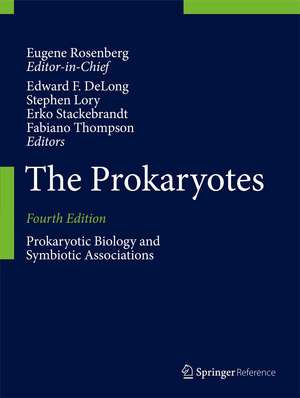
The Prokaryotes: The Prokaryotes
Editat de Edward F. DeLong, Erko Stackebrandt, Stephen Lory, Fabiano Thompsonen Limba Engleză Hardback – 2 ian 2013
Different from other resources, this new Springer product includes not only taxonomy, but also prokaryotic biology and technology of taxa in a broad context. Technological aspects highlight the usefulness of prokaryotes in processes and products, including biocontrol agents and as genetics tools.
The content of the expanded fourth edition is divided into two parts: Part 1 contains review chapters dealing with the most important general concepts in molecular, applied and general prokaryote biology; Part 2 describes the known properties of specific taxonomic groups.
Two completely new sections have been added to Part 1: bacterial communities and human bacteriology. The bacterial communities section reflects the growing realization that studies on pure cultures of bacteria have led to an incomplete picture of the microbial world for two fundamental reasons: the vast majority of bacteria in soil, water and associated with biological tissues are currently not culturable, and that an understanding of microbial ecology requires knowledge on how different bacterial species interact with each other in their natural environment. The new section on human microbiology deals with bacteria associated with healthy humans and bacterial pathogenesis. Each of the major human diseases caused by bacteria is reviewed, from identifying the pathogens by classical clinical and non-culturing techniques to the biochemical mechanisms of the disease process.
The 4th edition of The Prokaryotes is the most complete resource on the biology of prokaryotes.
The following volumes are published consecutively within the 4th Edition:
Prokaryotic Biology and Symbiotic Associations
Prokaryotic Communities and Ecophysiology
Prokaryotic Physiology and Biochemistry
Applied Bacteriology and Biotechnology
Human Microbiology
Actinobacteria
Firmicutes
Alphaproteobacteria and Betaproteobacteria
Gammaproteobacteria
Deltaproteobacteria and Epsilonproteobacteria
Other Major Lineages of Bacteria and the Archaea
Preț: 2982.30 lei
Preț vechi: 3924.08 lei
-24%
Puncte Express: 4473
Carte tipărită la comandă
Livrare economică 27 noiembrie-03 decembrie
Livrare prin curier în România Termenul estimat este afișat lângă disponibilitate.
Transport gratuit pentru acest produs Plată online sau ramburs, în funcție de opțiunile comenzii.
Retur gratuit în 14 zile Comandă securizată și suport în română.
Specificații
ISBN-13: 9783642301933
ISBN-10: 3642301932
Pagini: 632
Ilustrații: XX, 609 p. 189 illus., 76 illus. in color.
Dimensiuni: 215 x 285 x 40 mm
Greutate: 1.69 kg
Ediția:4th edition 2013
Editura: Springer
Colecția The Prokaryotes
Seria The Prokaryotes
Locul publicării:Berlin, Heidelberg, Germany
ISBN-10: 3642301932
Pagini: 632
Ilustrații: XX, 609 p. 189 illus., 76 illus. in color.
Dimensiuni: 215 x 285 x 40 mm
Greutate: 1.69 kg
Ediția:4th edition 2013
Editura: Springer
Colecția The Prokaryotes
Seria The Prokaryotes
Locul publicării:Berlin, Heidelberg, Germany
V-ar putea interesa
-
 Microbiology Coloring BookLawrence M. ElsonPreț: 323.81 lei
 -
 -23%Preț: 317.56 lei412.56 lei
 -
 MicrocosmCarl ZimmerPreț: 109.62 lei
 -
 The Demon in the FreezerRichard PrestonPreț: 58.91 lei
 -
 The Hidden Half of NatureDavid R MontgomeryPreț: 105.39 lei
 -
 -23%Preț: 608.96 lei790.85 lei
 -
 Bacteriophage EcologyStephen T Abedon-14%Preț: 1076.20 lei1251.39 lei
 -
 -5%Preț: 926.13 lei974.87 lei
 -
 Mushrooms DemystifiedDavid Arora-22%Preț: 248.98 lei320.55 lei
 -
 Psilocybin Mushrooms of the WorldPaul Stamets-23%Preț: 159.54 lei208.06 lei
 -
 -27%Preț: 840.08 lei1150.80 lei
 -
 Molecular Mycorrhizal SymbiosisFrancis Martin-23%Preț: 1152.61 lei1496.90 lei
 -
 Missing MicrobesMartin J. BlaserPreț: 107.79 lei
 -
 New Trends in Corynebacterium Glutamicum: Beyond the Amino AcidsDr Carlos Barreiro-27%Preț: 1521.72 lei2074.85 lei
 -
 Computing for Comparative Microbial GenomicsDavid Wayne UsseryPreț: 408.44 lei
Public țintă
Professional/practitionerCuprins
Preface.- Foreword.- About the Editors.- List of Contributors.- (Section 1) Biology of Bacteria and Archaea.- How We Do, Don’t and Should Look at Bacteria and Bacteriology.- What Is a Prokaryote?.- Prokaryotes and Their Habitats.- Origin of Life: RNA World versus Autocatalytic Anabolism.- Morphological and Physiological Diversity.- Prokaryote Characterization and Identification.- Principles of Enrichment, Isolation, Cultivation, and Preservation of Prokaryotes.- Comparative Genomics.- Defining Taxonomic Ranks.- Covering All the Bases: Next-Generation Sequence Data and the Microevolution of Bacterial Pathogens.- Public Service Collections and Biological Resource Centres of Microorganisms (Biological resource centres).- Repositories for Patented and Safeguarded Material, Budapest Treaty, and Safe Deposit.- Biotechnology and Applied Microbiology.- Genome and Post-genome Technology.- (section 2) Symbiotic Associations.- Role of Microorganisms in the Adaptation, Development, and Evolution of Animals and Plants: the Hologenome Concept.- Cyanobacterial-Plant Symbioses.- Root and Stem Nodule Bacteria of Legumes.- Symbiotic Associations Between Ciliates and Prokaryotes.- Bacteriocyte-Associated Endosymbionts of Insects .- Vibrio fischeri: A Bioluminescent Light-Organ Symbiont of the Bobtail Squid Euprymna scolopes.- Rumen Symbioses.- Symbiotic Associations Between Termites and Prokaryotes.- Marine Chemosynthetic Symbioses.
Notă biografică
Eugene Rosenberg, Professor of Microbiology at Tel Aviv University, Israel
Edward F. DeLong, Professor at Department of Civil and Environmental Engineering & Department of Biological Engineering, Massachusetts Institute of Technology, Cambridge, MA, USA
Fabiano Thompson, Professor at Center of Health Sciences, Federal University of Rio de Janeiro, Brazil
Stephen Lory, Professor at Department of Microbiology and Molecular Genetics, Harvard Medical School, Boston, MA, USA
Erko Stackebrandt, Director of the German Collection of Microorganisms and Cell Cultures GmbH, Braunschweig, Germany
Edward F. DeLong, Professor at Department of Civil and Environmental Engineering & Department of Biological Engineering, Massachusetts Institute of Technology, Cambridge, MA, USA
Fabiano Thompson, Professor at Center of Health Sciences, Federal University of Rio de Janeiro, Brazil
Stephen Lory, Professor at Department of Microbiology and Molecular Genetics, Harvard Medical School, Boston, MA, USA
Erko Stackebrandt, Director of the German Collection of Microorganisms and Cell Cultures GmbH, Braunschweig, Germany
Caracteristici
The most complete resource on the biology of prokaryotes Represents molecular, applied and general prokaryotic biology, bacterial communities, and human bacteriology Covers all taxonomic diversity using the family level to delineate chapters
Recenzii
From the book reviews:
“This book … edited and written by great scientists covers essential contributions on different types of prokaryotic communities as well as on the prokaryotic functions in different environments. … This volume, as well as the whole series, should be available in every large scientific library.” (Ioan I. Ardelean, Bulletin of Micro and Nanoelectrotechnologies, Vol. 5 (3-4), December, 2014)
“This book … edited and written by great scientists covers essential contributions on different types of prokaryotic communities as well as on the prokaryotic functions in different environments. … This volume, as well as the whole series, should be available in every large scientific library.” (Ioan I. Ardelean, Bulletin of Micro and Nanoelectrotechnologies, Vol. 5 (3-4), December, 2014)