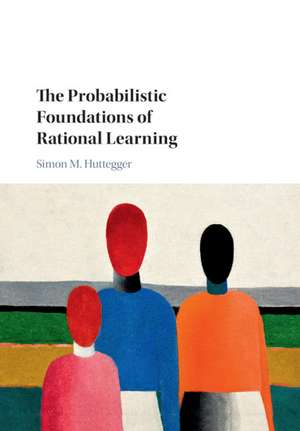
The Probabilistic Foundations of Rational Learning
Autor Simon M Hutteggeren Limba Engleză Paperback – 19 dec 2019
Preț: 305.16 lei
Puncte Express: 458
Carte tipărită la comandă
Livrare economică 15-29 octombrie
Livrare prin curier în România Termenul estimat este afișat lângă disponibilitate.
Transport gratuit de la 400.00 lei Plată online sau ramburs, în funcție de opțiunile comenzii.
Retur gratuit în 14 zile Comandă securizată și suport în română.
Specificații
ISBN-13: 9781107535664
ISBN-10: 1107535662
Pagini: 240
Ilustrații: 5 b/w illus.
Dimensiuni: 170 x 244 x 13 mm
Greutate: 0.39 kg
Editura: Cambridge University Press
Locul publicării:New York, United States
ISBN-10: 1107535662
Pagini: 240
Ilustrații: 5 b/w illus.
Dimensiuni: 170 x 244 x 13 mm
Greutate: 0.39 kg
Editura: Cambridge University Press
Locul publicării:New York, United States
Cuprins
1. Consistency and symmetry; 2. Bounded rationality; 3. Pattern learning; 4. Large worlds; 5. Radical probabilism; 6. Reflection; 7. Disagreement; 8. Consensus; Appendices.
Descriere
This book extends Bayesian epistemology to develop new approaches to general rational learning within the framework of probability theory.