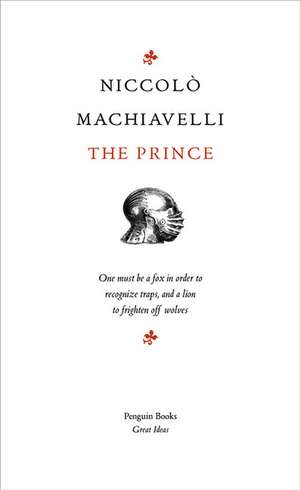
The Prince
Autor Nicolas Machiavel Traducere de George Bullen Limba Engleză Paperback – 6 sep 2005
Throughout history, some books have changed the world. They have transformed the way we see ourselves—and each other. They have inspired debate, dissent, war and revolution. They have enlightened, outraged, provoked and comforted. They have enriched lives—and destroyed them.
Now, Penguin brings you the works of the great thinkers, pioneers, radicals and visionaries whose ideas shook civilization, and helped make us who we are. Penguin's Great Ideas series features twelve groundbreaking works by some of history's most prodigious thinkers, and each volume is beautifully packaged with a unique type-drive design that highlights the bookmaker's art. Offering great literature in great packages at great prices, this series is ideal for those readers who want to explore and savor the Great Ideas that have shaped the world.
Rejecting the traditional values of political theory, Machiavelli drew upon his own experiences of office in the turbulent Florentine republic to write his celebrated treatise on statecraft. While Machiavelli was only one of the many Florentine “prophets of force,” he differed from the ruling elite in recognizing the complexity and fluidity of political life.
Now, Penguin brings you the works of the great thinkers, pioneers, radicals and visionaries whose ideas shook civilization, and helped make us who we are. Penguin's Great Ideas series features twelve groundbreaking works by some of history's most prodigious thinkers, and each volume is beautifully packaged with a unique type-drive design that highlights the bookmaker's art. Offering great literature in great packages at great prices, this series is ideal for those readers who want to explore and savor the Great Ideas that have shaped the world.
Rejecting the traditional values of political theory, Machiavelli drew upon his own experiences of office in the turbulent Florentine republic to write his celebrated treatise on statecraft. While Machiavelli was only one of the many Florentine “prophets of force,” he differed from the ruling elite in recognizing the complexity and fluidity of political life.
Preț: 68.43 lei
Puncte Express: 103
Carte disponibilă
Livrare economică 11-25 mai
Specificații
ISBN-13: 9780143036333
ISBN-10: 0143036335
Pagini: 128
Dimensiuni: 112 x 179 x 9 mm
Greutate: 0.1 kg
Editura: Transworld Publishers Ltd
ISBN-10: 0143036335
Pagini: 128
Dimensiuni: 112 x 179 x 9 mm
Greutate: 0.1 kg
Editura: Transworld Publishers Ltd
V-ar putea interesa
-
 The PrinceNiccolo MachiavelliPreț: 27.52 lei
 -
 The Art of WarSun TzuPreț: 27.24 lei
 -
 CLASSIC THE ART OF RHETORICAristotlePreț: 28.18 lei
 -
 Animal FarmGeorge OrwellPreț: 24.60 lei
 -
 The TempestWilliam ShakespearePreț: 24.60 lei
 -
 Letters from a StoicLucius Annaeus SenecaPreț: 54.75 lei
 -
 Letters from a StoicLucius SenecaPreț: 28.37 lei
 -
 RepublicPlatoPreț: 29.30 lei
 -
 Fire and Blood: TV Tie-InGeorge R. R. MartinPreț: 57.69 lei
 -
 The DiscoursesNicolas Machiavel-19%Preț: 73.95 lei90.80 lei
 -
 The PlagueAlbert Camus-21%Preț: 54.21 lei68.23 lei
 -
 The RebelAlbert Camus-27%Preț: 54.92 lei75.27 lei
 -
 Machiavelli: A Very Short IntroductionQuentin Skinner-22%Preț: 52.18 lei67.16 lei
 -
 BreathJames Nestor-20%Preț: 60.96 lei75.86 lei
 -
 The Hobbit Classic HardbackJ.R.R. TolkienPreț: 151.64 lei
 -
 -27%Preț: 55.24 lei75.77 lei
 -
 MeditationsMarcus AureliusPreț: 31.49 lei
 -
 The Will to PowerFriedrich Nietzsche-21%Preț: 54.15 lei68.18 lei
 -
 Marx and the Robots: Networked Production, AI, and Human LabourFlorian ButolloPreț: 167.30 lei
 -
 The Essential Writings of MachiavelliNicolas Machiavel-12%Preț: 94.35 lei107.12 lei
 -
 The Prince: The Original ClassicNiccolo MachiavelliPreț: 83.74 lei
 -
 Machiavelli: Selected Political WritingsNiccolo Machiavelli-12%Preț: 116.34 lei132.62 lei
 -
 -26%Preț: 56.72 lei76.66 lei
 -
 The Prince (Signature Editions): and The Art of WarNiccolo Machiavelli-31%Preț: 86.45 lei126.12 lei
 -
 -37%Preț: 50.22 lei79.25 lei
 -
 -20%Preț: 59.92 lei75.22 lei
 -
 The ThroneFranco BerniniPreț: 69.61 lei
 -
 The Prince (Hero Classics)Niccolo Machiavelli-13%Preț: 53.10 lei61.36 lei
 -
 The PrinceNicolo MachiavelliPreț: 40.28 lei
 -
 The PrinceNiccolò MachiavelliPreț: 31.97 lei
Notă biografică
Niccolò Machiavelli (1469-1527) was a Florentine statesman who was later forced out of public life. He then devoted himself to studying and writing political philosophy, history, fiction, and drama.
George Bull is an author and journalist who has translated six volumes for the Penguin Classics: Benvenuto Cellini’s Autobiography, The Book of the Courtier by Castiglione, Vasari’s Lives of the Artists (two volumes), The Prince by Machiavelli and Pietro Aretino’s Selected Letters. He is also Consultant Editor to the Penguin Business Series. After reading history at Brasenose College, Oxford, George Bull worked for the Financial Times, McGraw-Hill World News, and for the Director magazine, of which he was Editor-in-Chief until 1984. His other books include Vatican Politics; Bid for Power (with Anthony Vice), a history of take-over bids; Renaissance Italy, a book for children; Venice: The Most Triumphant City; and Inside the Vatican.
George Bull is an author and journalist who has translated six volumes for the Penguin Classics: Benvenuto Cellini’s Autobiography, The Book of the Courtier by Castiglione, Vasari’s Lives of the Artists (two volumes), The Prince by Machiavelli and Pietro Aretino’s Selected Letters. He is also Consultant Editor to the Penguin Business Series. After reading history at Brasenose College, Oxford, George Bull worked for the Financial Times, McGraw-Hill World News, and for the Director magazine, of which he was Editor-in-Chief until 1984. His other books include Vatican Politics; Bid for Power (with Anthony Vice), a history of take-over bids; Renaissance Italy, a book for children; Venice: The Most Triumphant City; and Inside the Vatican.
Extras
I
How many kinds of principality there are and the ways in which they are acquired All the states, all the dominions under whose authority men have lived in the past and live now have been and are either republics or principalities. Principalities are hereditary, with their prince's family long established as rulers, or they are new. The new are completely new, as was Milan to Francesco Sforza, or they are like limbs joined to the hereditary state of the prince who acquires them, as is the kingdom of Naples in relation to the king of Spain. Dominions so acquired are accustomed to be under a prince, or used to freedom; a prince wins them either with the arms of others or with his own, either by fortune or by prowess.
How many kinds of principality there are and the ways in which they are acquired All the states, all the dominions under whose authority men have lived in the past and live now have been and are either republics or principalities. Principalities are hereditary, with their prince's family long established as rulers, or they are new. The new are completely new, as was Milan to Francesco Sforza, or they are like limbs joined to the hereditary state of the prince who acquires them, as is the kingdom of Naples in relation to the king of Spain. Dominions so acquired are accustomed to be under a prince, or used to freedom; a prince wins them either with the arms of others or with his own, either by fortune or by prowess.
Recenzii
“[Machiavelli] can still engage our attention with remarkable immediacy, and this cannot be explained solely by the appeal of his ironic observations on human behaviour. Perhaps the most important thing is the way he can compel us to reflect on our own priorities and the reasoning behind them; it is this intrusion into our own defenses that makes reading him an intriguing experience. As a scientific exponent of the political art Machiavelli may have had few followers; it is as a provocative rhetorician that he has had his real impact on history.” –from the Introduction by Dominic Baker-Smith
Descriere
Descriere de la o altă ediție sau format:
A new translation of the infamous classic, now in a striking deluxe edition. "The Prince" shocked 16th-century Europe with its advocacy of ruthless tactics for gaining absolute sovereignty, and it retains its power to alarm and to instruct.
A new translation of the infamous classic, now in a striking deluxe edition. "The Prince" shocked 16th-century Europe with its advocacy of ruthless tactics for gaining absolute sovereignty, and it retains its power to alarm and to instruct.
Textul de pe ultima copertă
That Machiavelli's name has become synonymous with cold-eyed political calculation only heightens the intrinsic fascination of The Prince - the world's pre-eminent how-to manual on the art of getting and keeping power, and one of the literary landmarks of the Italian Renaissance. Written in a vigorous, straightforward style which reflects its author's realism, this treatise on states, statecraft, and the ideal ruler is essential reading for anyone seeking to understand how human society actually works.