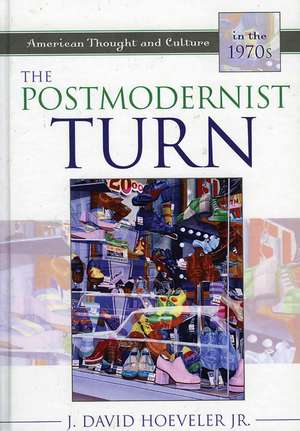
The Postmodernist Turn: American Thought and Culture in the 1970s: American Thought and Culture
Autor J. David Hoeveler, Jr.en Limba Engleză Hardback – 11 aug 2004




Preț: 804.44 lei
Preț vechi: 1242.94 lei
-35%
Puncte Express: 1207
Carte tipărită la comandă
Livrare economică 07-21 decembrie
Livrare prin curier în România Termenul estimat este afișat lângă disponibilitate.
Transport gratuit pentru acest produs Plată online sau ramburs, în funcție de opțiunile comenzii.
Retur gratuit în 14 zile Comandă securizată și suport în română.
Specificații
ISBN-13: 9780742542563
ISBN-10: 0742542564
Pagini: 248
Dimensiuni: 142 x 232 x 20 mm
Greutate: 0.53 kg
Editura: Bloomsbury Publishing
Colecția Rowman & Littlefield
Seria American Thought and Culture
Locul publicării:New York, United States
ISBN-10: 0742542564
Pagini: 248
Dimensiuni: 142 x 232 x 20 mm
Greutate: 0.53 kg
Editura: Bloomsbury Publishing
Colecția Rowman & Littlefield
Seria American Thought and Culture
Locul publicării:New York, United States
Descriere
During the 1970s, the United States became the world's preeminent postindustrial society. The new conditions changed the way Americans lived and worked, and even their perceptions of reality. Americans struggled to find their place in a world where symbol became more important than fact, appearance more important than reality, where image supplanted essence.
In this reassessment of a little studied decade, J. David Hoeveler, Jr., finds that the sense of detachment and dislocation that characterizes the postindustrial society serves as a paradigm for American thought and culture in the 1970s. The book examines major developments in literary theory, philosophy, architecture, and painting as expressions of a 1970s consciousness. Hoeveler also explores the rival "political" readings of these subjects and considers the postmodernist phenomenon as it became an ideological battleground in the decade. Clear and engaging, the work will be of great interest to historians, theorists, and everyone who wants to further explore the 1970s.
In this reassessment of a little studied decade, J. David Hoeveler, Jr., finds that the sense of detachment and dislocation that characterizes the postindustrial society serves as a paradigm for American thought and culture in the 1970s. The book examines major developments in literary theory, philosophy, architecture, and painting as expressions of a 1970s consciousness. Hoeveler also explores the rival "political" readings of these subjects and considers the postmodernist phenomenon as it became an ideological battleground in the decade. Clear and engaging, the work will be of great interest to historians, theorists, and everyone who wants to further explore the 1970s.
Cuprins
Chapter 1: Postindustrialism
Chapter 2: Wars of Words
Chapter 3: Reading Left
Chapter 4: Postmodernism I, Painting
Chapter 5: Postmodernism II, architecture
Chapter 6: Writing Feminist
Chapter 7: Debating Black
Chapter 8: Neoconservatism
Chapter 9: On Liberalism
Afterword
Bibliographic Essay
Chapter 2: Wars of Words
Chapter 3: Reading Left
Chapter 4: Postmodernism I, Painting
Chapter 5: Postmodernism II, architecture
Chapter 6: Writing Feminist
Chapter 7: Debating Black
Chapter 8: Neoconservatism
Chapter 9: On Liberalism
Afterword
Bibliographic Essay
Recenzii
The Postmodernist Turn not only charts historical change in a decade of the recent past. It accomplishes what some of Hoeveler's subjects doubted was ever really possible in historical study: it helps us to understand the intellectual landscape in which we find ourselves several decades later.