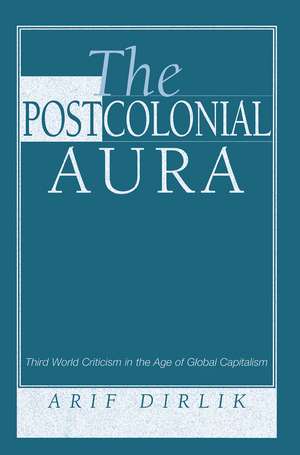
The Postcolonial Aura: Third World Criticism In The Age Of Global Capitalism
Autor Arif Dirliken Limba Engleză Hardback – 13 sep 2019
Preț: 1112.48 lei
Preț vechi: 1356.68 lei
-18%
Puncte Express: 1669
Carte tipărită la comandă
Livrare economică 28 noiembrie-12 decembrie
Livrare prin curier în România Termenul estimat este afișat lângă disponibilitate.
Transport gratuit pentru acest produs Plată online sau ramburs, în funcție de opțiunile comenzii.
Retur gratuit în 14 zile Comandă securizată și suport în română.
Specificații
ISBN-13: 9780367318901
ISBN-10: 0367318903
Pagini: 272
Dimensiuni: 152 x 229 mm
Greutate: 0.45 kg
Ediția:1
Editura: Taylor & Francis
Colecția Routledge
Locul publicării:Oxford, United Kingdom
ISBN-10: 0367318903
Pagini: 272
Dimensiuni: 152 x 229 mm
Greutate: 0.45 kg
Ediția:1
Editura: Taylor & Francis
Colecția Routledge
Locul publicării:Oxford, United Kingdom
V-ar putea interesa
-
 Digital SociologyNoortje MarresPreț: 157.11 lei
 -
 Muslim Youth: Tensions And Transitions In TajikistanColette HarrisPreț: 405.33 lei
 -
 Community as Urban PracticeTalja BloklandPreț: 147.70 lei
 -
 Why Democracies Need ScienceHarry CollinsPreț: 186.70 lei
 -
 RetrotopiaZygmunt BaumanPreț: 140.83 lei
 -
 Preț: 116.91 lei
 -
 Preț: 117.80 lei
 -
 Another Economy Is PossibleManuel CastellsPreț: 233.82 lei
 -
 The Other Hundred EducatorsGlobal Institute for TomorrowPreț: 225.70 lei
 -
 Collective Intelligence and Digital ArchivesSamuel Szoniecky-20%Preț: 959.44 lei1199.30 lei
Cuprins
Preface -- Credits -- Introduction: Postcoloniality and the Perspective of History -- Culturalism as Hegemonic Ideology and Liberating Practice -- The Postcolonial Aura: Third World Criticism in the Age of Global Capitalism -- The Global in the Local -- Chinese History and the Question of Orientalism -- There Is More in the Rim than Meets the Eye: Thoughts on the "Pacific Idea" -- Three Worlds or One, or Many? The Reconfiguration of Global Relations Under Contemporary Capitalism -- Postcolonial or Postrevolutionary? The Problem of History in Postcolonial Criticism -- The Postmodernization of Production and Its Organization: Flexible Production, Work and Culture -- The Past as Legacy and Project: Postcolonial Criticism in the Perspective of Indigenous Historicism
Notă biografică
Arif Dirlik is professor of history at Duke University.
Descriere
This book presents a range of issues from cultural self-representation in China to more general problems of reconceptualizing global relationships in response to contemporary changes. It offers "multi-historicalism," which presupposes a historically grounded conception of cultural difference.