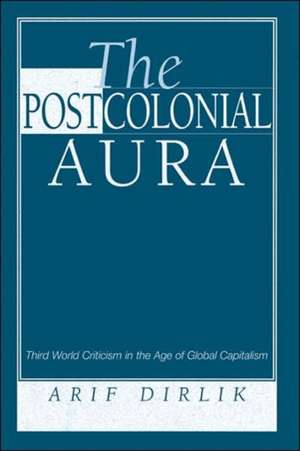
The Postcolonial Aura: Third World Criticism In The Age Of Global Capitalism
Autor Arif Dirliken Limba Engleză Paperback – 6 oct 1998
| Toate formatele și edițiile | Preț | Express |
|---|---|---|
| Paperback (1) | 315.17 lei 3-5 săpt. | |
| Taylor & Francis – 6 oct 1998 | 315.17 lei 3-5 săpt. | |
| Hardback (1) | 841.56 lei 3-5 săpt. | |
| Taylor & Francis – 13 sep 2019 | 841.56 lei 3-5 săpt. |
Preț: 315.17 lei
Preț vechi: 386.35 lei
-18%
Puncte Express: 473
Preț estimativ în valută:
55.78€ • 65.19$ • 48.43£
55.78€ • 65.19$ • 48.43£
Carte disponibilă
Livrare economică 29 ianuarie-12 februarie
Preluare comenzi: 021 569.72.76
Specificații
ISBN-13: 9780813332499
ISBN-10: 0813332494
Pagini: 272
Dimensiuni: 152 x 229 x 18 mm
Greutate: 0.5 kg
Ediția:1
Editura: Taylor & Francis
Colecția Routledge
Locul publicării:Oxford, United Kingdom
ISBN-10: 0813332494
Pagini: 272
Dimensiuni: 152 x 229 x 18 mm
Greutate: 0.5 kg
Ediția:1
Editura: Taylor & Francis
Colecția Routledge
Locul publicării:Oxford, United Kingdom
V-ar putea interesa
-
 Preț: 152.15 lei
 -
 Muslim Youth: Tensions And Transitions In TajikistanColette Harris-21%Preț: 264.04 lei335.36 lei
 -
 Community as Urban PracticeTalja BloklandPreț: 143.12 lei
 -
 Why Democracies Need ScienceHarry CollinsPreț: 178.88 lei
 -
 RetrotopiaZygmunt BaumanPreț: 134.13 lei
 -
 Preț: 111.56 lei
 -
 Preț: 111.73 lei
 -
 Another Economy Is PossibleManuel CastellsPreț: 216.58 lei
 -
 -30%Preț: 1100.70 lei1561.59 lei
 -
 The Other Hundred EducatorsGlobal Institute For TomorrowPreț: 210.01 lei
 -
 -20%Preț: 886.91 lei1108.63 lei
Cuprins
Preface -- Credits -- Introduction: Postcoloniality and the Perspective of History -- Culturalism as Hegemonic Ideology and Liberating Practice -- The Postcolonial Aura: Third World Criticism in the Age of Global Capitalism -- The Global in the Local -- Chinese History and the Question of Orientalism -- There Is More in the Rim than Meets the Eye: Thoughts on the “Pacific Idea” -- Three Worlds or One, or Many? The Reconfiguration of Global Relations Under Contemporary Capitalism -- Postcolonial or Postrevolutionary? The Problem of History in Postcolonial Criticism -- The Postmodernization of Production and Its Organization: Flexible Production, Work and Culture -- The Past as Legacy and Project: Postcolonial Criticism in the Perspective of Indigenous Historicism
Notă biografică
Arif Dirlik is professor of history at Duke University.
Descriere
This book presents a range of issues from cultural self-representation in China to more general problems of reconceptualizing global relationships in response to contemporary changes. It offers "multi-historicalism," which presupposes a historically grounded conception of cultural difference.