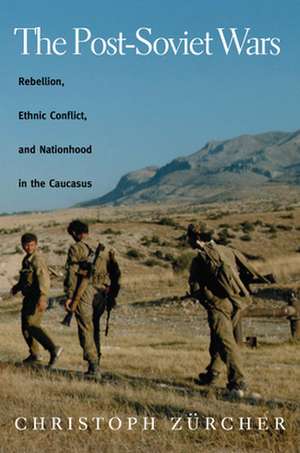
The Post-Soviet Wars
Autor Christoph Zurcheren Limba Engleză Hardback – noi 2007
Preț: 631.42 lei
Preț vechi: 820.03 lei
-23%
Puncte Express: 947
Carte tipărită la comandă
Livrare economică 28 noiembrie-12 decembrie
Livrare prin curier în România Termenul estimat este afișat lângă disponibilitate.
Transport gratuit pentru acest produs Plată online sau ramburs, în funcție de opțiunile comenzii.
Retur gratuit în 14 zile Comandă securizată și suport în română.
Specificații
ISBN-13: 9780814797099
ISBN-10: 0814797091
Pagini: 302
Dimensiuni: 155 x 233 x 24 mm
Greutate: 0.54 kg
Editura: NYU Press - IPS
ISBN-10: 0814797091
Pagini: 302
Dimensiuni: 155 x 233 x 24 mm
Greutate: 0.54 kg
Editura: NYU Press - IPS
V-ar putea interesa
-
 -21%Preț: 106.17 lei134.47 lei
 -
 -21%Preț: 372.44 lei469.17 lei
 -
 Understanding Collective Political ViolenceY. Guichaoua-15%Preț: 669.02 lei787.08 lei
 -
 Preț: 214.66 lei
 -
 Preț: 223.60 lei
 -
 Bletchley Park: The Code-breakers of Station XMichael Smith-31%Preț: 42.27 lei61.56 lei
 -
 MinersAnthony BurtonPreț: 95.94 lei
 -
 The Best Days of Our LivesSimon WebbPreț: 108.96 lei
 -
 A Grim Almanac of the WorkhousePeter Higginbotham-20%Preț: 114.56 lei143.73 lei
 -
 Churchill: The Power of WordsMartin Gilbert-17%Preț: 91.70 lei110.49 lei
 -
 The English Breakfast: The Biography of a National Meal, with RecipesDr Kaori O'Connor-23%Preț: 203.39 lei265.18 lei
 -
 The Forgetting RiverDoreen CarvajalPreț: 149.39 lei
 -
 Preț: 89.74 lei
 -
 Governing Britain: Power, Politics and the Prime MinisterPatrick Diamond-26%Preț: 174.04 lei233.73 lei
 -
 The Case for Withdrawal from AfghanistanNick TursePreț: 137.54 lei
 -
 French Scientific and Cultural DiplomacyPhilippe LanePreț: 371.02 lei
 -
 Conflict and DevelopmentEleanor O' Gorman-17%Preț: 128.50 lei154.32 lei
 -
 In Paris We SangRose CannanPreț: 146.58 lei
 -
 The End of WarPaul K. ChappellPreț: 72.39 lei
Recenzii
"This is an uncommonly well-argued and well-written explanation of the violent conflicts that erupted across the Caucasus during and after the collapse of the Soviet Union. With exceptional clarity of thought, Zürcher melds established statistical studies of internal wars with a carefully constructed comparison of the origins and courses of the Chechen, Georgian, and Nagorno-Karabakh wars. Foreign Affairs"With his exciting narratives and compelling analysis of the twentieth century's Caucasian Wars, Zürcher brings events on the periphery of Europe into the mainstream of social science and comparative politics. Disputing existing explanations of internal wars, he shows that rather than mountainous terrain or poverty, a more powerful causal explanation of civil bloodletting can be located in state capacities and the abilities of combatants to finance their struggles. This book is sure to stir debate. Ronald Grigor Suny, University of Michigan"Democracy is commonly paired with order while ethnic violence is paired with strife and chaos. The Post-Soviet Wars painstakingly documents that both violence and stability have institutional reasons and must be organized politically by specific human agencies. This lesson is obviously relevant to the contemporary discussion of democratization as well as failing states, let alone the effects wrought by the American war on terror. Georgi Derlugyan, author of Bourdieu's Secret Admirer in the Caucasus: A World-System Biography
"This is an uncommonly well-argued and well-written explanation of the violent conflicts that erupted across the Caucasus during and after the collapse of the Soviet Union. With exceptional clarity of thought, Zurcher melds established statistical studies of internal wars with a carefully constructed comparison of the origins and courses of the Chechen, Georgian, and Nagorno-Karabakh wars." Foreign Affairs "With his exciting narratives and compelling analysis of the twentieth century's Caucasian Wars, Zurcher brings events on the periphery of Europe into the mainstream of social science and comparative politics. Disputing existing explanations of internal wars, he shows that rather than mountainous terrain or poverty, a more powerful causal explanation of civil bloodletting can be located in state capacities and the abilities of combatants to finance their struggles. This book is sure to stir debate." Ronald Grigor Suny, University of Michigan "Democracy is commonly paired with order while ethnic violence is paired with strife and chaos. The Post-Soviet Wars painstakingly documents that both violence and stability have institutional reasons and must be organized politically by specific human agencies. This lesson is obviously relevant to the contemporary discussion of democratization as well as failing states, let alone the effects wrought by the American war on terror." Georgi Derlugyan, author of Bourdieu's Secret Admirer in the Caucasus: A World-System Biography
"This is an uncommonly well-argued and well-written explanation of the violent conflicts that erupted across the Caucasus during and after the collapse of the Soviet Union. With exceptional clarity of thought, Zurcher melds established statistical studies of internal wars with a carefully constructed comparison of the origins and courses of the Chechen, Georgian, and Nagorno-Karabakh wars." Foreign Affairs "With his exciting narratives and compelling analysis of the twentieth century's Caucasian Wars, Zurcher brings events on the periphery of Europe into the mainstream of social science and comparative politics. Disputing existing explanations of internal wars, he shows that rather than mountainous terrain or poverty, a more powerful causal explanation of civil bloodletting can be located in state capacities and the abilities of combatants to finance their struggles. This book is sure to stir debate." Ronald Grigor Suny, University of Michigan "Democracy is commonly paired with order while ethnic violence is paired with strife and chaos. The Post-Soviet Wars painstakingly documents that both violence and stability have institutional reasons and must be organized politically by specific human agencies. This lesson is obviously relevant to the contemporary discussion of democratization as well as failing states, let alone the effects wrought by the American war on terror." Georgi Derlugyan, author of Bourdieu's Secret Admirer in the Caucasus: A World-System Biography
Descriere
Provides both an overview of the Caucasus that is both up-to-date and comprehensive as well as an accessible understanding of the current scholarship on mobilization and violence
Cuprins
Preface; 1. Introduction 1; 2. Setting the Stage: The Past, the Nation, and the State 14; 3. Making Sense: Conflict Theory and the Caucasus 51; 4. Wars over Chechnya 90; 5. Wars in Georgia 151; 6. The War over Karabakh 202; 7. Wars that did not happen: Dagestan and Ajaria 249; 8. Conclusion: Post-Soviet Wars and Theories of Internal Wars 280; Bibliography 311; Notes 337; About the Author; Index