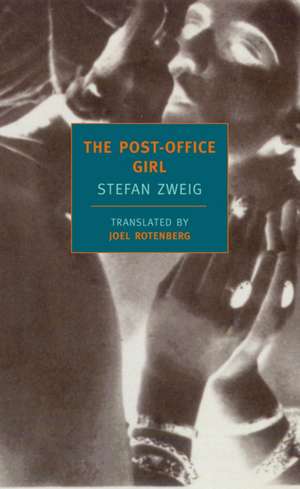
The Post-Office Girl
Autor Stefan Zweig Traducere de Joel Rotenbergen Limba Engleză Paperback – 15 apr 2008
Remarcăm, încă din primele pagini, imaginea aproape hipnotică a tinerei Christine, moțăind printre formulare oficiale și timbre într-un oficiu poștal provincial din Austria postbelică. Această stare de inerție este spulberată de sosirea unei telegrame care promite o evadare feerică: o invitație în Alpii elvețieni, la brațul unei mătuși înstărite. Stefan Zweig construiește aici ceea ce critica a numit un „basm realist”, unde ascensiunea socială amețitoare este urmată de o prăbușire brutală în realitatea sărăciei. Forța narativă a lui Stefan Zweig combinată cu sensibilitatea explorată de Elizabeth von Arnim în Christine — dar cu un glas propriu, marcat de o analiză psihologică necruțătoare — transformă această experiență într-un studiu despre resentiment și disperare. Dacă în biografiile sale celebre, precum Mary Queen of Scots, autorul analiza mecanismele puterii la nivel istoric, în acest roman el coboară în abisul individului strivit de istorie. A doua parte a cărții introduce o schimbare de ton surprinzătoare; odată cu apariția lui Ferdinand, un veteran marcat de traumele frontului, atmosfera devine densă, aproape de roman polițist noir. Cei doi protagoniști nu caută doar consolare, ci o formă de revoltă împotriva unei societăți care i-a abandonat. Ritmul lecturii reflectă această transformare: de la lentoarea contemplativă a provinciei, la strălucirea vertiginoasă a stațiunii montane și, în final, la tensiunea sumbră a unui plan care pendulează între mântuire și condamnare.
Preț: 96.18 lei
Carte disponibilă
Livrare economică 29 octombrie-12 noiembrie
Specificații
ISBN-10: 1590172620
Pagini: 272
Dimensiuni: 130 x 203 x 15 mm
Greutate: 0.27 kg
Editura: NEW YORK REVIEW OF BOOKS
V-ar putea interesa
-
 A Stitch of IntegrityCharles William OchsenhirtPreț: 79.62 lei
 -
 Sons of NeverlandDella Van HisePreț: 123.44 lei
 -
 The Grass WidowMary Burnett SmithPreț: 97.05 lei
 -
 The Drawing LessonMary E. MartinPreț: 119.84 lei
 -
 The Fate of Pryde, the Second in the Trilogy of Remembrance.Mary E. MartinPreț: 122.14 lei
 -
 Silence of CentervilleBuzz MalonePreț: 84.86 lei
 -
 Samantha's DozenTerri LoguePreț: 97.88 lei
 -
 UndeliverableRebecca a. DemarestPreț: 82.97 lei
 -
 Journey to the Other Side of DarkMS Vonnie M. KunyszPreț: 101.65 lei
 -
 The AmateurTrace FarrellPreț: 92.59 lei
 -
 Drei MeisterStefan ZweigPreț: 46.76 lei
 -
 Der Kampf Mit Dem DamonStefan ZweigPreț: 79.66 lei
 -
 Preț: 76.57 lei
 -
 AmokStefan ZweigPreț: 65.09 lei
 -
 The Mountain LionJean StaffordPreț: 105.33 lei
 -
 The Outward RoomMillen BrandPreț: 126.23 lei
De ce să citești această carte
Recomandăm această carte cititorilor care doresc să descopere o fațetă mai întunecată a geniului lui Stefan Zweig. Este un roman despre contrastul violent dintre opulență și mizerie, oferind o perspectivă emoționantă asupra „generației pierdute” de după 1918. Cititorul va câștiga o înțelegere profundă a fragilității umane în fața hazardului, totul într-o proză de o eleganță desăvârșită, specifică literaturii austriece clasice.
Despre autor
Stefan Zweig (1881–1942) a fost unul dintre cei mai traduși și populari scriitori ai perioadei interbelice, un maestru incontestabil al portretului psihologic. Originar din Viena, Zweig s-a remarcat prin biografii magistrale ale unor figuri precum Marie Antoinette sau Mary Stuart, dar și prin nuvele de o intensitate emoțională remarcabilă, ca „Scrisoarea unei necunoscute”. Exilat din cauza ascensiunii nazismului, Zweig a purtat cu sine nostalgia unei Europe cosmopolite, temă care traversează întreaga sa operă. The Post-Office Girl, publicată postum, rămâne una dintre cele mai surprinzătoare lucrări ale sale, îmbinând analiza socială cu elemente de suspans.
Notă biografică
Joel Rotenberg has produced NYRB original translations for Stefan Zweig’s Chess Story and Hugo von Hofmannsthal’s The Lord Chandos Letter.
Descriere scurtă
But Christine’s aunt drops her as abruptly as she picked her up, and soon the young woman is back at the provincial post office, consumed with disappointment and bitterness. Then she meets Ferdinand, a wounded but eloquent war veteran who is able to give voice to the disaffection of his generation. Christine’s and Ferdinand’s lives spiral downward, before Ferdinand comes up with a plan which will be either their salvation or their doom.
Never before published in English, this extraordinary book is an unexpected and haunting foray into noir fiction by one of the masters of the psychological novel.
Recenzii
“An exhilarating ski run of poverty, joy and misery... it is the girl's ecstatic naivety and Zweig's sparkling prose that makes the old stories so sweetly fresh and, when the whole dream collapses, so devastatingly sad”. --The Sunday Times (UK)
"In The Post-Office Girl Stefan Zweig explores the details of everyday life in language that pierces both brain and heart...The story is poignant, painful, and must be one of fiction’s darkest indictments of how poverty destroys hope, enjoyment, beauty, brightness and laughter, and how money, no matter how falsely, provides ease and delight." --The Spectator (UK)
"This is a fascinating depiction of the effects of history on individual lives." --The Financial Times
"The Post Office Girl is a fine novel and an excellent place to start if you are new to this great Austrian novelist. It is a powerful social history, describing in moving detail the social impact of the First World War, and the extreme poverty in which so many people were forced to live. It shows up the challenge to European civilisation of the early Thirties and the failure of humanism, in which Zweig believed until the end of his life. And it is remarkable for the bleak interior worlds it depicts of anxiety, self-doubt, depression and disintegration. Zweig succeeded in taking the most complex concepts of psychoanalysis and bringing them vividly to life." --The Telegraph
"Stefan Zweig was a late and magnificent bloom from the hothouse of fin de siecle Vienna...The posthumous publication of a Zweig novel affords an opportunity to revisit this gifted writer...The Post-Office Girl is captivating." --The Wall Street Journal
"... nowhere else in his fiction does Zweig confront the legacy of the Great War with as deep a social reach or as detailed a human sympathy as he does in The Post-Office Girl... we are lucky to have the book, not only for its devastating picture of postwar Austrian life but also because it represents so radical a departure from Zweig's other fiction as to signal the existence of a hitherto unsuspected literary personality..." —William Deresiewicz, The Nation
"[In this] ... beautiful translation by Joel Rotenberg.... Stefan Zweig finds a universal story of psychological struggle and spiritual testing in a bitter but humane indictment of class inequality. He finds a love story, of a sort, in a quest story, and a quest story in a love story. He finds anger in compassion, and compassion in anger; beauty in suffering, and suffering in beauty." --The New York Observer
"[Zweig is a] writer who understands perfectly the life he is describing, and who has great analytic gifts . . . " –Stephen Spender, The New York Review of Books
"Always [Zweig] remains essentially the same, revealing in all . . . mediums his subtlety of style, his profound psychological knowledge and his inherent humaneness." –Barthold Fles, The New Republic
"His writing reveals his sympathy for fellow human beings." –Ruth Franklin, London Review of Books
“The experience of reading Zweig is not so much of entering the world of the story as of plunging inward and dreaming the story.” –Rachel Cohen, Bookforum
“A brilliant writer.” –Louis Kronenberger, The New York Times
“Admired by readers as diverse as Freud, Einstein, Toscanini, Thomas Mann and Herman Goering.” –Edwin McDowell, The New York Times