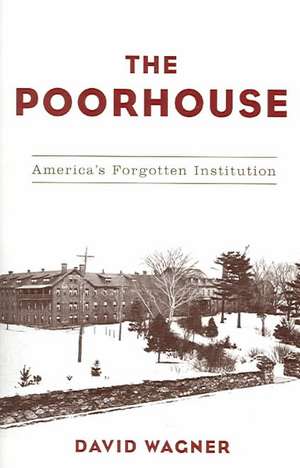
The Poorhouse: America's Forgotten Institution
Autor David Wagneren Limba Engleză Paperback – 17 ian 2005
Based on the author's study of six New England poorhouses/poor farms, a hidden story in America's history is presented which will be of popular interest as well as useful as a text in social welfare and social history. While the poorhouse's mission was character reform and "repressing pauperism," these goals were gradually undermined by poor people themselves, who often learned to use the poorhouse for their own benefit, as well as by staff and officials of the houses, who had agendas sometimes at odds with the purposes for which the poorhouse was invented.
Preț: 262.34 lei
Preț vechi: 343.05 lei
-24%
Puncte Express: 394
Carte tipărită la comandă
Livrare economică 08-22 decembrie
Livrare prin curier în România Termenul estimat este afișat lângă disponibilitate.
Transport gratuit de la 400.00 lei Plată online sau ramburs, în funcție de opțiunile comenzii.
Retur gratuit în 14 zile Comandă securizată și suport în română.
Specificații
ISBN-13: 9780742529458
ISBN-10: 0742529452
Pagini: 200
Dimensiuni: 155 x 232 x 15 mm
Greutate: 0.29 kg
Ediția:New.
Editura: Bloomsbury Publishing
Colecția Rowman & Littlefield
Locul publicării:New York, United States
ISBN-10: 0742529452
Pagini: 200
Dimensiuni: 155 x 232 x 15 mm
Greutate: 0.29 kg
Ediția:New.
Editura: Bloomsbury Publishing
Colecția Rowman & Littlefield
Locul publicării:New York, United States
V-ar putea interesa
-
 A Censured PlayEdward GarnettPreț: 90.42 lei
 -
 Unlikely Fame: Poor People Who Made HistoryDavid WagnerPreț: 404.23 lei
 -
 Familiar lettersWalter ScottPreț: 306.89 lei
 -
 Irenæus lettersSamuel Irenaeus PrimePreț: 286.98 lei
 -
 Three Oxfordshire parishes:Mary Helen Alicia Dolman StapletonPreț: 302.01 lei
 -
 Preț: 305.82 lei
 -
 Dante Gabriel Rossetti;Dante Gabriel RossettiPreț: 313.59 lei
 -
 A discourse of the pastoral careGilbert BurnetPreț: 249.26 lei
 -
 Considerations on the Council of Trent Being the Fifth DiscourseWoodhead AbrahamPreț: 209.58 lei
 -
 Discourses on various occasionsPe¿re HyacinthePreț: 188.00 lei
 -
 Mrs. Montague Jones' dinner party: or,John J. NunnPreț: 185.56 lei
 -
 Hand-list of seals, morses,John E. GrayPreț: 138.26 lei
 -
 Sixteen Years in SiberiaLeo DeutschPreț: 126.83 lei
 -
 Equity in Discourse for Mathematics EducationBeth Herbel-Eisenmann-18%Preț: 784.79 lei957.06 lei
Cuprins
Chapter 1 Poorhouse, Almshouse, Poor Farm: Buried American History
Chapter 2 Scenes from the Poorhouse
Chapter 3 What the Forefathers Had in Mind: The Purpose and Contradictions of the Poorhouse
Chapter 4 Undermining the Poorhouse: Long and Short-Term Inmates in the Late Nineteenth Century
Chapter 5 Inmates, Overseers, and the Politics of the Poorhouse
Chapter 6 The Long End: Inmates in the Twentieth Century Poorhouse
Chapter 7 Matrons, Doctors, Staff, and the End of the Poorhouse
Chapter 8 The Ironies of History: The Return of the Poorhouse
Chapter 2 Scenes from the Poorhouse
Chapter 3 What the Forefathers Had in Mind: The Purpose and Contradictions of the Poorhouse
Chapter 4 Undermining the Poorhouse: Long and Short-Term Inmates in the Late Nineteenth Century
Chapter 5 Inmates, Overseers, and the Politics of the Poorhouse
Chapter 6 The Long End: Inmates in the Twentieth Century Poorhouse
Chapter 7 Matrons, Doctors, Staff, and the End of the Poorhouse
Chapter 8 The Ironies of History: The Return of the Poorhouse
Recenzii
An eye-opener! Wagner carefully and judiciously combs through the data to give us a vivid picture of 19th century institutions for the care of the American poor. There is nothing quite like this, and American social welfare history will never be the same.
David Wagner's extraordinary journey through the history of 'the poorhouse' in the United States is meticulously researched and brings alive, in eminently readable prose, the lives of those human beings who were both victims and overseers of this much-neglected part of American life. This is an important contribution to our social history.
At a time in which the Social Security Act (1935) itself is under ideological assault, Wagner's informative book is required reading.
This impressively researched history of the poorhouse, a mainstay social welfare resource for 300 years in America, will fascinate and enlighten even a casual reader.
For a small volume, David Wagner's The Poorhouse: Ameica's Forgotten Institution has a hefty agenda. Over seven short chapters, Wagner sketches the story of the fabeled symbol of vulnerability and failure that for generations accumulated America's infirm, superannuated, and dipossessed while birthing specialized institutions for child wellfare, substance abuse treatment, and psychiatric, medical, and geriatric care.
The Poorhouse: America's Forgotten Institution takes its place as a thought-provoking, well-researched volume that has no rival in the field. It will be the standard of reference for years to come.
The Poorhouse turns out to be a most appealing and timely book with much to say about contemporary social policy. It is highly recommended for undergraduate and graduate students in schools of social work, for social welfare and social policy historians, and for historians of disability.
Based on newspaper accounts, poorhouse records, oral history interviews, and local government records, Wagner provides and rich description of life in six New England poorhouses between the 1830s and the 1940s.
With many photographs, the book provides an excellent picture of a forgotten aspect of American history.
David Wagner's extraordinary journey through the history of 'the poorhouse' in the United States is meticulously researched and brings alive, in eminently readable prose, the lives of those human beings who were both victims and overseers of this much-neglected part of American life. This is an important contribution to our social history.
At a time in which the Social Security Act (1935) itself is under ideological assault, Wagner's informative book is required reading.
This impressively researched history of the poorhouse, a mainstay social welfare resource for 300 years in America, will fascinate and enlighten even a casual reader.
For a small volume, David Wagner's The Poorhouse: Ameica's Forgotten Institution has a hefty agenda. Over seven short chapters, Wagner sketches the story of the fabeled symbol of vulnerability and failure that for generations accumulated America's infirm, superannuated, and dipossessed while birthing specialized institutions for child wellfare, substance abuse treatment, and psychiatric, medical, and geriatric care.
The Poorhouse: America's Forgotten Institution takes its place as a thought-provoking, well-researched volume that has no rival in the field. It will be the standard of reference for years to come.
The Poorhouse turns out to be a most appealing and timely book with much to say about contemporary social policy. It is highly recommended for undergraduate and graduate students in schools of social work, for social welfare and social policy historians, and for historians of disability.
Based on newspaper accounts, poorhouse records, oral history interviews, and local government records, Wagner provides and rich description of life in six New England poorhouses between the 1830s and the 1940s.
With many photographs, the book provides an excellent picture of a forgotten aspect of American history.