
The Physics of Sound
Autor Richard E. Berg, David G. Storken Limba Engleză Paperback – 31 iul 2004
This book incorporates the developments in digital audio technology, including consumer products, into a firm foundation of the physics of sound. No knowledge of physics, mathematics, or music is required. Includes updated information on musical synthesizers. Provides recent information on the ear, including new advances in cochlear implant technology. Updates material for modern technology, particularly MP3. Features abundant examples, including discussion of demonstration experiments. Includes historical discussion of musical temperaments and instruments. Offers videotapes of musical demonstrations on topics discussed in the book, available from author. A useful reference for musicians or anyone interested in learning more about the physics of music.
Preț: 1307.52 lei
Preț vechi: 1698.09 lei
-23% Nou
231.41€ • 271.38$ • 202.89£
Carte disponibilă
Livrare economică 05-19 ianuarie 26
Specificații
ISBN-10: 0131457896
Pagini: 416
Dimensiuni: 184 x 238 x 20 mm
Greutate: 0.77 kg
Ediția:Nouă
Editura: Pearson
Locul publicării:Boston, United States
V-ar putea interesa
-
 Cox, T: Sonic WonderlandTrevor Cox-20%Preț: 70.88 lei89.12 lei
 -
 Quantum and Statistical Field TheoryMichel Le Bellac-30%Preț: 556.13 lei790.26 lei
 -
 -48%Preț: 512.83 lei983.74 lei
 -
 Sound: A Very Short IntroductionMike Goldsmith-22%Preț: 52.24 lei67.16 lei
 -
 Path Integrals and Quantum AnomaliesKazuo Fujikawa-23%Preț: 493.16 lei638.86 lei
 -
 Vibrations and WavesGC KingPreț: 377.53 lei
 -
 -19%Preț: 507.63 lei626.69 lei
 -
 -9%Preț: 937.28 lei1029.98 lei
 -
 Fundamentals of Physical AcousticsDavid T Blackstock-23%Preț: 1091.62 lei1417.68 lei
 -
 Introduction to the Physics of WavesTim FreegardePreț: 292.39 lei
 -
 -19%Preț: 588.67 lei726.75 lei
 -
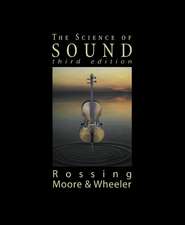 The Science of SoundThomas D. Rossing-23%Preț: 1257.77 lei1633.48 lei
 -
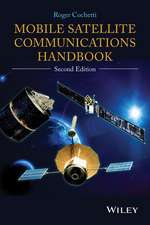 Mobile Satellite Communications Handbook 2eR Cochetti-9%Preț: 797.44 lei876.30 lei
 -
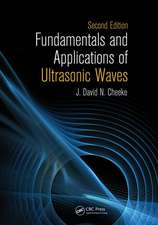 Fundamentals and Applications of Ultrasonic WavesJ. David N. Cheeke-18%Preț: 1555.90 lei1897.43 lei
 -
 -31%Preț: 1216.36 lei1751.40 lei
 -
 Dictionary of HearingMichael Martin-5%Preț: 469.97 lei494.70 lei
Descriere
Using a hands-on and experimental approach, this book incorporates developments in digital audio technology—including consumer products—into a firm foundation of the physics of sound. Selected topics are interesting to a broad audience, with many applications of sound and waves beyond strictly musical applications. No background in physics, mathematics, or music is required.
Cuprins
1. Simple Harmonic Motion and Applications
2. Waves and Sound
3. Standing Waves and the Overtone Series
4. Analysis and Synthesis of Complex Waves
5. Electronic Music and Synthesizers
6. The Human Ear and Voice
7. Sound Recording and Reproduction
8. Room and Auditorium Acoustics
9. Musical Temperament and Pitch
10. Woodwind Instruments
11. Brass Instruments
12. String Instruments
13. The Piano
14. Percussion Instruments
Appendix A: Elementary Music Theory
Appendix B: Terms and Units
Appendix C: Prefixes with Common Units
Glossary of Terms
Index
Notă biografică
David G. Stork is Chief Scientist of Ricoh Innovations, Inc., and Consulting Professor of Electrical Engineering at Stanford University. He received his B.S. degree in physics from the Massachusetts Institute of Technology, and his M.S. and Ph.D. degrees in physics from the University of Maryland. Dr. Stork is an accomplished orchestral and chamber timpanist/percussionist, has performed in major concert halls throughout the United States, and performed on more than a dozen compact disks, including four world premier recordings. His principal research interests are in pattern classification, machine learning, and novel uses of the internet. He is an award-winning teacher (Ralph D. Myers Teaching Award, University of Maryland) and publishes and lectures widely on his research and scholarly topics as diverse as Renaissance painting and the relation of science fiction to science fact. His other books include Pattern Classification (2nd ed., Wiley 2000, W R. Duda and P Hart), Speechreading by Humans and Machines (Springer, 1996, W M. Hennecke), Seeing the Light (Whey, 1986, W D. Falk and D. Brill), and HAL's Legacy: 2001's Computer as Dream and Reality (MIT 1997), the latter serving as the source for his PBS television documentary "2001: HAL's Legacy." Dr. Stork sits on the editorial boards of four international journals and is a member of IEEE (Institute of Electrical and Electronics Engineers), ACM (Association for Computing Machinery), OSA (Optical Society of America), INNS (International Neural Network Society), and the Sigma XI Honorary Research Society.
Caracteristici
- NEW - Summaries now provided for each chapter—Emphasizes key words that are included in the glossary at the end of the text.
- NEW - Numerous new problems added.
- NEW - Over 30 new figures.
- NEW - New applications presented throughout—Includes applications of simple harmonic motion, of topics in sound, ultrasound, and infrasound updated for modern technology, and applications that use updated electronic analysis equipment.
- NEW - Updated information on musical synthesizers—Illustrates new technology.
- NEW - Updates for recent information on the ear—Includes recent advances in cochlear implant technology.
- NEW - Updates for modern technology, particularly MP3.
- NEW - New discussion of the left-handed piano.
- Many experiments that can be done readily in the classroom—Illustrate how the concepts discussed in the book can be applied and how many of the fundamental ideas about sound were developed.
- Abundant examples, including discussion of demonstration experiments.
- Historical discussion of musical temperaments and instruments.
- Videotapes of musical demonstrations on topics discussed in the book Ñ Available from author.
- Wide range of topics—Introduces students to other areas of sound beyond the physics of music concepts.
- Accessible mathematical level—Makes text useful for the basic college core course curriculum.
Caracteristici noi
- Summaries now provided for each chapter—Emphasizes key words that are included in the glossary at the end of the text.
- Numerous new problems added.
- Over 30 new figures.
- New applications presented throughout—Includes applications of simple harmonic motion, of topics in sound, ultrasound, and infrasound updated for modern technology, and applications that use updated electronic analysis equipment.
- Updated information on musical synthesizers—Illustrates new technology.
- Updates for recent information on the ear—Includes recent advances in cochlear implant technology.
- Updates for modern technology, particularly MP3.
- New discussion of the left-handed piano.