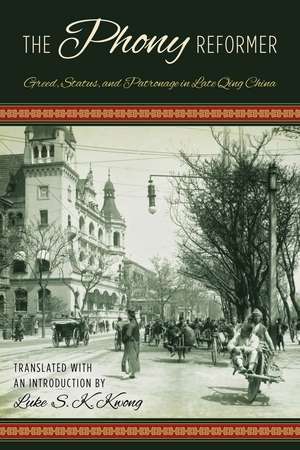
The Phony Reformer: Greed, Status, and Patronage in Late Qing China
Editat de Luke S. K. Kwongen Limba Engleză Paperback – 15 iun 2018
Preț: 219.46 lei
Preț vechi: 292.26 lei
-25%
Puncte Express: 329
Carte tipărită la comandă
Livrare economică 04-18 decembrie
Livrare prin curier în România Termenul estimat este afișat lângă disponibilitate.
Transport gratuit de la 400.00 lei Plată online sau ramburs, în funcție de opțiunile comenzii.
Retur gratuit în 14 zile Comandă securizată și suport în română.
Specificații
ISBN-13: 9781538112403
ISBN-10: 153811240X
Pagini: 192
Ilustrații: 11 b/w illustrations; 1 table
Dimensiuni: 150 x 228 x 14 mm
Greutate: 0.28 kg
Editura: Bloomsbury Publishing
Colecția Rowman & Littlefield
Locul publicării:New York, United States
ISBN-10: 153811240X
Pagini: 192
Ilustrații: 11 b/w illustrations; 1 table
Dimensiuni: 150 x 228 x 14 mm
Greutate: 0.28 kg
Editura: Bloomsbury Publishing
Colecția Rowman & Littlefield
Locul publicării:New York, United States
Cuprins
Preface and Acknowledgments
Translator's Introduction: A Long Vigil Before Daybreak
Notes on the Translation
Chapter 1
An anti-missionary case funnels public funds into private pockets;
Old-school folks break down prejudices to go after new measures.
Chapter 2
Promotions up official ranks and making riches are words of sound advice;
Patronage and gift-giving are shortcuts to success for which people scramble.
Chapter 3
The job of machine procurement comes as a reward for the cash contribution;
In the name of civilization is the effort made to join the Natural Feet Society.
Chapter 4
Mockery is what motivates the effort to study the English primer;
The social circle broadens to lead to making friends with Wilkes.
Chapter 5
The hunt for the Wealth Voucher rebels leads to a good friend's death;
The investigation into local mining rights gives rise to covetous thought.
Chapter 6
Mining shares are peddled on Fuzhou Road to attract investors;
A company is set up in Guangxin prefecture to produce camphor.
Chapter 7
New rules are drafted to forestall school education's harmful effects;
Preemptive action is the key to success in handling foreign relations.
Chapter 8
An old friend's cooperation helps resolve a Sino-foreign dispute;
A police surcharge is enforced in the name of policy innovation.
Chapter 9
An old flame cannot reignite as the nestled bird is scared away;
The heartache lingers as the male fox sets out to look for a mate.
Chapter 10
A superior's favor incurs add-on duties at the correctional center;
In search of marital bliss, a letter is sent with a marriage proposal.
Chapter 11
The dress-up embrace of Great Universality dazzles every eye;
Vengeance over a private feud goes public in the newspapers.
Chapter 12
Harsh words in heated argument cause affection and fortune to vanish;
Endurance through hardship yields fruits of fame and riches in the end.
Chapter 13
Commendation for the intendant status fulfills a long-standing career desire;
Supervision of school affairs calls for implementation of authoritarian rules.
Chapter 14
Deft skills in making money are applied to maximize mining profits;
Army duties become a concurrent job when no other deputy is found.
Chapter 15
Grandees play favorites with those who beseech their patronage;
Colleagues throw a banquet to celebrate his transfer and promotion.
Chapter 16
Once the mask is stripped away, the tracks of the past are fully revealed;
In a lyrical poem, warm-hearted but trite, the point of the tale is unveiled.
Bibliography
Translator's Introduction: A Long Vigil Before Daybreak
Notes on the Translation
Chapter 1
An anti-missionary case funnels public funds into private pockets;
Old-school folks break down prejudices to go after new measures.
Chapter 2
Promotions up official ranks and making riches are words of sound advice;
Patronage and gift-giving are shortcuts to success for which people scramble.
Chapter 3
The job of machine procurement comes as a reward for the cash contribution;
In the name of civilization is the effort made to join the Natural Feet Society.
Chapter 4
Mockery is what motivates the effort to study the English primer;
The social circle broadens to lead to making friends with Wilkes.
Chapter 5
The hunt for the Wealth Voucher rebels leads to a good friend's death;
The investigation into local mining rights gives rise to covetous thought.
Chapter 6
Mining shares are peddled on Fuzhou Road to attract investors;
A company is set up in Guangxin prefecture to produce camphor.
Chapter 7
New rules are drafted to forestall school education's harmful effects;
Preemptive action is the key to success in handling foreign relations.
Chapter 8
An old friend's cooperation helps resolve a Sino-foreign dispute;
A police surcharge is enforced in the name of policy innovation.
Chapter 9
An old flame cannot reignite as the nestled bird is scared away;
The heartache lingers as the male fox sets out to look for a mate.
Chapter 10
A superior's favor incurs add-on duties at the correctional center;
In search of marital bliss, a letter is sent with a marriage proposal.
Chapter 11
The dress-up embrace of Great Universality dazzles every eye;
Vengeance over a private feud goes public in the newspapers.
Chapter 12
Harsh words in heated argument cause affection and fortune to vanish;
Endurance through hardship yields fruits of fame and riches in the end.
Chapter 13
Commendation for the intendant status fulfills a long-standing career desire;
Supervision of school affairs calls for implementation of authoritarian rules.
Chapter 14
Deft skills in making money are applied to maximize mining profits;
Army duties become a concurrent job when no other deputy is found.
Chapter 15
Grandees play favorites with those who beseech their patronage;
Colleagues throw a banquet to celebrate his transfer and promotion.
Chapter 16
Once the mask is stripped away, the tracks of the past are fully revealed;
In a lyrical poem, warm-hearted but trite, the point of the tale is unveiled.
Bibliography
Recenzii
An illuminating satire of bureaucratic 'reformers' on the make in the post-Boxer late-Qing reform era. Serialized in 1905, this short novel chronicles the unlikely career climb of Yuan Bozhen, who time and again manages to make bad decisions and still land on his feet. The novel reads like a tongue-in-cheek 'how-to-succeed' manual for low-level bureaucrats at the turn of the century. It concludes with a poem spelling out the moral of the story, like a big red bow on a box of candy. Luke Kwong's fluid translation is accompanied by an informative introduction and extensive annotations. With realistic ground-level details of officials interacting with each other, with foreigners, and with the Chinese citizenry, the novel makes an ideal supplement to any course on the late Qing or modern China.
I know of no other work-fictional or otherwise-that captures so vividly and insightfully the motivations and machinations of Chinese elites as they sought to turn the dramatic political, social, and cultural changes of the early twentieth century to their own purposes. Luke Kwong knows this period better than anyone, and he has done a superlative job translating and annotating the novel, making the work not only accessible but also illuminating and absorbing.
What did reform mean at the end of the Qing dynasty? And how could one profit from it? The Phony Reformer is a lively and engaging tale of an intrepid, if sometimes morally dubious, scholar-official and his rise to prominence. How he successfully, fortuitously schemes his way from obscurity to power and profit opens our eyes to the complexity and intrigues of late Qing politics. This translation will be great for undergraduate Chinese history surveys as well as more specialized seminars on late imperial life, the civil service examination system, elite culture, and late imperial and twentieth-century Chinese fiction.
I know of no other work-fictional or otherwise-that captures so vividly and insightfully the motivations and machinations of Chinese elites as they sought to turn the dramatic political, social, and cultural changes of the early twentieth century to their own purposes. Luke Kwong knows this period better than anyone, and he has done a superlative job translating and annotating the novel, making the work not only accessible but also illuminating and absorbing.
What did reform mean at the end of the Qing dynasty? And how could one profit from it? The Phony Reformer is a lively and engaging tale of an intrepid, if sometimes morally dubious, scholar-official and his rise to prominence. How he successfully, fortuitously schemes his way from obscurity to power and profit opens our eyes to the complexity and intrigues of late Qing politics. This translation will be great for undergraduate Chinese history surveys as well as more specialized seminars on late imperial life, the civil service examination system, elite culture, and late imperial and twentieth-century Chinese fiction.