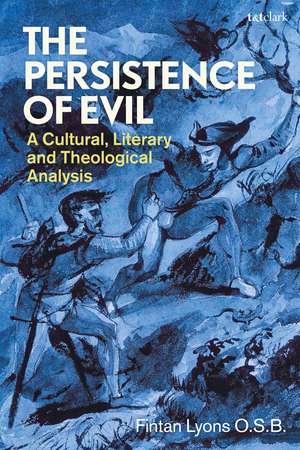
The Persistence of Evil: A Cultural, Literary and Theological Analysis
Autor Revd Fintan Lyons O.S.B.en Limba Engleză Paperback – 21 sep 2023
At the heart of this book is the attempt to synthesise or reconcile traditional belief with contemporary concern or even alarm regarding evil in the world. Lyons argues that evidence for the persistence of evil has been striking in modern times in wars and atrocities, while phenomena such as Satanic Cults and possible or real diabolical possession have continued to increase. The Catholic Church reacted to this situation in 1998 with a revision of the 1614 Rite of Exorcism, analysed in this book from both theological and psychological standpoints. By arguing that the transition from belief in Satan to personification of evil in historical regimes and characters brings contemporary culture into sharp focus, this book chronicles the history of humanity's attempt to understand the disturbing and mysterious reality of evil.
Preț: 189.34 lei
Preț vechi: 230.96 lei
-18%
Puncte Express: 284
Carte disponibilă
Livrare economică 09-23 noiembrie
Livrare express 23-29 octombrie pentru 81.72 lei
Livrare prin curier în România Termenul estimat este afișat lângă disponibilitate.
Transport gratuit de la 400.00 lei Plată online sau ramburs, în funcție de opțiunile comenzii.
Retur gratuit în 14 zile Comandă securizată și suport în română.
Specificații
ISBN-13: 9780567710116
ISBN-10: 0567710114
Pagini: 384
Dimensiuni: 156 x 234 x 22 mm
Greutate: 0.6 kg
Editura: Bloomsbury Publishing
Colecția T&T Clark
Locul publicării:London, United Kingdom
ISBN-10: 0567710114
Pagini: 384
Dimensiuni: 156 x 234 x 22 mm
Greutate: 0.6 kg
Editura: Bloomsbury Publishing
Colecția T&T Clark
Locul publicării:London, United Kingdom
Cuprins
Introduction
Chapter 1:
Theodicy
Chapter 2:
Doing Theodicy while Talking of Evil
Chapter 3:
Does the Devil Exist? A Persistent Belief
Chapter 4:
The Representation of Satan up to the Reformation
Chapter 5:
The Reformation
Chapter 6:
The Catholic Reform and the Struggle with Satan
Chapter 7:
The Devil in the Era of Modernity
Chapter 8:
Twentieth-Century Chronicles of Evil
Chapter 9:
Exorcism. Preliminary Considerations
Chapter 10:
Toward a theological and psychological analysis of the Rite of Exorcism
Chapter 11:
Concluding Reflections
Bibliography
Index
Chapter 1:
Theodicy
Chapter 2:
Doing Theodicy while Talking of Evil
Chapter 3:
Does the Devil Exist? A Persistent Belief
Chapter 4:
The Representation of Satan up to the Reformation
Chapter 5:
The Reformation
Chapter 6:
The Catholic Reform and the Struggle with Satan
Chapter 7:
The Devil in the Era of Modernity
Chapter 8:
Twentieth-Century Chronicles of Evil
Chapter 9:
Exorcism. Preliminary Considerations
Chapter 10:
Toward a theological and psychological analysis of the Rite of Exorcism
Chapter 11:
Concluding Reflections
Bibliography
Index
Recenzii
As enlightening as it is engaging, this book is a masterful survey of the toughest of all subjects. Fintan Lyons not only surveys the ways in which Christians and Western thinkers have wrestled with the problem of evil for two millennia, but also wrestles gracefully with the theological, philosophical, ethical, and pastoral questions raised by it.
Books that examine evil and Satan are usually doing different things, with the former striving to produce a theodicy that is not always rooted in religion or Christian theology while the latter are usually of a popular sort and rarely helpful. The Persistence of Evil, which examines the history of belief in the existence of Satan from a wide variety of perspectives and genres, is not something easily found on one's bookshelf and is an excellent study. Fintan Lyons' sources are interdisciplinary, making the book attractive to readers and scholars from a range of backgrounds and areas of expertise. In light of the recent pandemic and the war in Ukraine, questions on the origin and nature of evil remain timely, making this book appealing to a wide audience.
Through the eyes of theologians, mystics and great literary figures, Fintan Lyons has given us a magisterial survey of the human struggle with evil down the ages. Of particular interest is his wide-ranging study of demonology and the practice of exorcism.
At the heart of Christian prayer is the invocation to be delivered from evil. Yet how many of us know what we are praying about? There is hardly a more thorough yet accessible account of evil than Lyons'. Multidisciplinary in its approach, his magnificent mapping of the mystery of evil exemplifies how good theology, in dialogue with historical and literary sources as well as the human sciences, can illuminate a core aspect of human experience. The soundness of Lyons' scholarship means that this book will be of interest to believer and non-believer alike. It should be a key textbook in all courses that seek to unfold the Catholic Intellectual Tradition for contemporary students.
Books that examine evil and Satan are usually doing different things, with the former striving to produce a theodicy that is not always rooted in religion or Christian theology while the latter are usually of a popular sort and rarely helpful. The Persistence of Evil, which examines the history of belief in the existence of Satan from a wide variety of perspectives and genres, is not something easily found on one's bookshelf and is an excellent study. Fintan Lyons' sources are interdisciplinary, making the book attractive to readers and scholars from a range of backgrounds and areas of expertise. In light of the recent pandemic and the war in Ukraine, questions on the origin and nature of evil remain timely, making this book appealing to a wide audience.
Through the eyes of theologians, mystics and great literary figures, Fintan Lyons has given us a magisterial survey of the human struggle with evil down the ages. Of particular interest is his wide-ranging study of demonology and the practice of exorcism.
At the heart of Christian prayer is the invocation to be delivered from evil. Yet how many of us know what we are praying about? There is hardly a more thorough yet accessible account of evil than Lyons'. Multidisciplinary in its approach, his magnificent mapping of the mystery of evil exemplifies how good theology, in dialogue with historical and literary sources as well as the human sciences, can illuminate a core aspect of human experience. The soundness of Lyons' scholarship means that this book will be of interest to believer and non-believer alike. It should be a key textbook in all courses that seek to unfold the Catholic Intellectual Tradition for contemporary students.