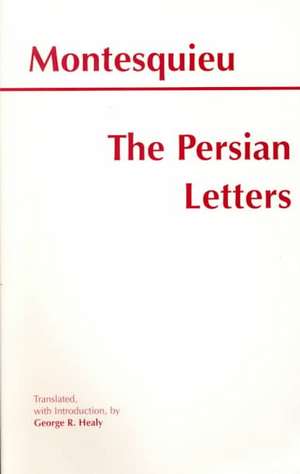
The Persian Letters
Autor Montesquieu Traducere de George R. Healyen Limba Engleză Paperback – 15 sep 1999
Based on the 1758 edition, this translation strives for fidelity and retains Montesquieu's paragraphing. George R. Healy's Introduction discusses The Persian Letters as a kind of overture to the Enlightenment, a work of remarkable diversity designed more to explore a problem of great urgency for eighteenth century thought than to resolve it: that of discovering universals, or at least the pragmatic constants, amid the diversity of human culture and society, and of confronting the proposition that there are no values in human relationships except those imposed by force or agreed upon in self-interested conventions.
Preț: 96.11 lei
Preț vechi: 115.15 lei
-17%
Puncte Express: 144
Carte disponibilă
Livrare economică 02-16 noiembrie
Livrare prin curier în România Termenul estimat este afișat lângă disponibilitate.
Transport gratuit de la 400.00 lei Plată online sau ramburs, în funcție de opțiunile comenzii.
Retur gratuit în 14 zile Comandă securizată și suport în română.
Specificații
ISBN-13: 9780872204904
ISBN-10: 0872204901
Pagini: 320
Dimensiuni: 140 x 216 x 139 mm
Greutate: 0.34 kg
Editura: Hackett Publishing Company,Inc
Colecția Hackett Publishing Company, Inc.
Locul publicării:United States
ISBN-10: 0872204901
Pagini: 320
Dimensiuni: 140 x 216 x 139 mm
Greutate: 0.34 kg
Editura: Hackett Publishing Company,Inc
Colecția Hackett Publishing Company, Inc.
Locul publicării:United States
V-ar putea interesa
-
 The PersiansSanam MahloudjiPreț: 101.44 lei
 -
 Les Liaisons dangereusesPierre Choderlos De LaclosPreț: 60.89 lei
 -
 Preț: 61.37 lei
 -
 The First and Second DiscoursesRoger MastersPreț: 272.05 lei
 -
 MeditationsMarcus AureliusPreț: 33.99 lei
 -
 CandideVoltairePreț: 32.48 lei
 -
 The Island of HermaphroditesKathleen Perry Long-8%Preț: 567.60 lei616.96 lei
 -
 -15%Preț: 446.78 lei525.62 lei
 -
 Empire's Son, Empire's OrphanNile GreenPreț: 174.41 lei
 -
 Candide and L'IngénuVoltaire Voltaire-32%Preț: 56.82 lei83.52 lei
 -
 On HorsemanshipXenophonPreț: 115.02 lei
 -
 Candide, or The OptimistVoltaire-36%Preț: 49.20 lei76.56 lei
 -
 On HorsemanshipXenophonPreț: 56.84 lei
 -
 Delusions of ParadiseMaiwand BanayeePreț: 145.52 lei
 -
 -17%Preț: 48.41 lei58.25 lei
 -
 Philosophy In The BoudoirDe Sade-29%Preț: 57.59 lei81.45 lei
 -
 The Idea of Persia: A Philosophical EnquiryRamin JahanbeglooPreț: 191.42 lei
 -
 The PrinceNiccolò MachiavelliPreț: 33.48 lei
 -
 Desert EagleR P WollbaumPreț: 136.55 lei
 -
 Les vacances de ToinonGaston BonnefontPreț: 139.66 lei
 -
 Preț: 109.67 lei
 -
 La France dans l'Extrême OrientHenri BornierPreț: 79.03 lei
 -
 Les pieds dans l'eauMarie de BosguérardPreț: 116.59 lei
 -
 La France sauvée, poème en dix chants, avec des notes historiquesJean-Pierre Simon BoubéePreț: 162.28 lei
 -
 Le fils du suppliciéJules BoulabertPreț: 86.49 lei
 -
 Fables nouvelles, suivies de fables traduites ou imitéesV. -Adolphe BoulengerPreț: 109.06 lei
 -
 Preț: 87.20 lei
 -
 Preț: 65.10 lei
 -
 UtopiaThomas MorePreț: 33.19 lei
Notă biografică
Charles-Louis de Secondat was born in 1689 at La Brède, near Bordeaux, into an eminent family of parlementaires. His mother died when he was ten and Charles-Louis was sent to Paris to be educated and completed a law degree in Bordeaux in 1708. He returned to Paris in order to finish his education, staying until his father died in 1713. In 1714 he became a councilor at the Bordeaux Parlement and a year later married a Huguenot lady, Jeanne de Lartigue, probably for her money. They had three children. A year after their marriage Charles-Louis inherited the barony of Montesquieu and the post of président à mortier at the Bordeaux Parlement and five years later, in 1721, he published anonymously in Holland the Persian Letters, which ran into ten editions in one year. From 1721 to 1725 he lived in Paris frequenting fashionable society and conducting several love-affairs. He sold his post of président in 1726 because of financial difficulties, was elected to the French academy in 1727 and spent the next three years traveling in Europe (he stayed about eighteen months in England and became a freemason). He returned to France working mainly in Paris but occasionally traveling to the southwest to look after his estates and wine business. During this period his persistent eye troubles got worse and he gave up freemasonry because of the Church’s disapproval. In 1748 he published his most important work, The Spirit of Laws, which made an immediate impression and caused a lot of controversy. Montesquieu died in Paris of a fever in 1755. In 1751 The Spirit of Laws was placed on the Vatican Index and likewise the Persian Letters in 1761.
Christopher Betts was born in 1936 and is at present a lecturer in the School of French Studies at the University of Warwick.
Christopher Betts was born in 1936 and is at present a lecturer in the School of French Studies at the University of Warwick.
Christopher Betts was born in 1936 and is at present a lecturer in the School of French Studies at the University of Warwick.
Christopher Betts was born in 1936 and is at present a lecturer in the School of French Studies at the University of Warwick.