
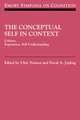
The Perceived Self: Ecological and Interpersonal Sources of Self Knowledge: Emory Symposia in Cognition, cartea 5
Editat de Ulric Neisseren Limba Engleză Hardback – 26 mai 1994


Preț: 812.51 lei
Preț vechi: 944.78 lei
-14%
Puncte Express: 1219
Carte tipărită la comandă
Livrare economică 14-28 iulie
Livrare prin curier în România Termenul estimat este afișat lângă disponibilitate.
Transport gratuit pentru acest produs Plată online sau ramburs, în funcție de opțiunile comenzii.
Retur gratuit în 14 zile Comandă securizată și suport în română.
Specificații
ISBN-13: 9780521415095
ISBN-10: 0521415098
Pagini: 336
Ilustrații: 18 b/w illus.
Dimensiuni: 159 x 228 x 24 mm
Greutate: 0.57 kg
Ediția:New.
Editura: Cambridge University Press
Colecția Cambridge University Press
Seria Emory Symposia in Cognition
Locul publicării:New York, United States
ISBN-10: 0521415098
Pagini: 336
Ilustrații: 18 b/w illus.
Dimensiuni: 159 x 228 x 24 mm
Greutate: 0.57 kg
Ediția:New.
Editura: Cambridge University Press
Colecția Cambridge University Press
Seria Emory Symposia in Cognition
Locul publicării:New York, United States
V-ar putea interesa
-
 The 33 Strategies of WarRobert GreenePreț: 164.21 lei
 -
 The Psychology of MoneyMichael Argyle-15%Preț: 421.31 lei495.66 lei
 -
 Psychology Culture ShockColleen WardPreț: 406.05 lei
 -
 Taking Care: Understanding and Encouraging Self-Protective BehaviorNeil D. WeinsteinPreț: 331.80 lei
 -
 The Ecology of the Self: Relocation and Self-Concept ChangeStefan E. HormuthPreț: 292.26 lei
 -
 National CharacteristicsDean PeabodyPreț: 293.94 lei
 -
 Account Episodes: The Management or Escalation of ConflictPeter SchönbachPreț: 292.05 lei
 -
 Preț: 294.31 lei
 -
 The Measurement of Moral JudgmentAnne ColbyPreț: 408.95 lei
 -
 Preț: 360.73 lei
 -
 Preț: 430.30 lei
 -
 Social IntelligenceDaniel GolemanPreț: 107.80 lei
 -
 Understanding Cross-Cultural PsychologyPittu D Laungani-15%Preț: 549.94 lei646.99 lei
 -
 Culture of Fear RevisitedFrank Furedi-42%Preț: 128.49 lei220.72 lei
 -
 Self in Social Psychology: Key ReadingsRoy F. Baumeister-15%Preț: 519.46 lei611.12 lei
 -
 Human RelationshipsSteve Duck-23%Preț: 488.53 lei634.45 lei
Cuprins
Preface; List of contributors; Part I. Introduction: 1. The self perceived Ulric Neisser; Part II. The Concept of an Ecological Self: 2. Ontogenesis of the perceived self Eleanor J. Gibson; 3. Body-environment coupling David N. Lee; 4. A theory of representation-driven actions Marc Jeannerod; 5. The ecological self in historical context Franklin C. Shontz; 6. Good intentions and dancing moments: Agency, freedom and self-knowledge in dance Sondra Horton Fraleigh; 7. The primacy of the ecological self Marjorie Grene; Part III. The Interpersonal Self and Its Implications: 8. The self born in intersubjectivity: the psychology of an infant communicating Colwyn Trevarthen; 9. On the interpersonal origins of self-concept Michael Tomasello; 10. Infant's knowledge of self, other, and relationship Sandra Pipp; 11. The role of feelings for an interpersonal self Daniel N. Stern; 12. Spontaneous communication and foundation of the interpersonal self Ross Buck; 13. Autism, affordances and the self Katherine A. Loveland; 14. Through feeling and sight to self and symbol R. Peter Hobson; 15. G. H. Mead and Martin Buber on the interpersonal self James M. Gustafson; 16. Cognitive science, other minds, and the philosophy of dialogue and the egocentric predicament David Jopling; Author index; Subject index.
Descriere
An interesting theory of self, based on perception, is explored by a distinguished interdisciplinary group of scholars.