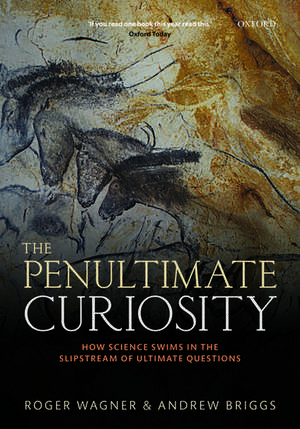
The Penultimate Curiosity: How Science Swims in the Slipstream of Ultimate Questions
Autor Roger Wagner, Andrew Briggsen Limba Engleză Paperback – 17 apr 2019
Preț: 218.49 lei
Preț vechi: 254.59 lei
-14%
Puncte Express: 328
Carte tipărită la comandă
Livrare economică 13-24 noiembrie
Livrare prin curier în România Termenul estimat este afișat lângă disponibilitate.
Transport gratuit de la 400.00 lei Plată online sau ramburs, în funcție de opțiunile comenzii.
Retur gratuit în 14 zile Comandă securizată și suport în română.
Specificații
ISBN-13: 9780198839286
ISBN-10: 0198839286
Pagini: 496
Ilustrații: 190 illustrations
Dimensiuni: 168 x 239 x 23 mm
Greutate: 0.89 kg
Editura: OUP OXFORD
Colecția OUP Oxford
Locul publicării:Oxford, United Kingdom
ISBN-10: 0198839286
Pagini: 496
Ilustrații: 190 illustrations
Dimensiuni: 168 x 239 x 23 mm
Greutate: 0.89 kg
Editura: OUP OXFORD
Colecția OUP Oxford
Locul publicării:Oxford, United Kingdom
V-ar putea interesa
-
 American Cosmic: UFOs, Religion, TechnologyD. W. Pasulka-20%Preț: 130.48 lei162.58 lei
 -
 -31%Preț: 628.04 lei911.24 lei
 -
 -15%Preț: 219.46 lei259.71 lei
 -
 Faith and Science in Russian Religious ThoughtTeresa Obolevitch-14%Preț: 677.39 lei787.66 lei
 -
 Shadow Sophia: The Evolution of Wisdom, Volume IICelia E. Deane-Drummond-33%Preț: 710.34 lei1053.92 lei
 -
 The Physics of ChristianityFrank J. TiplerPreț: 113.54 lei
 -
 Religion and Science in Context: A Guide to the DebatesWillem B. Drees-18%Preț: 1113.77 lei1358.26 lei
 -
 Thank God for EvolutionMichael DowdPreț: 156.14 lei
 -
 Creationism and Its Critics in AntiquityDavid SedleyPreț: 276.38 lei
 -
 Worship and the New Cosmology: Liturgical and Theological ChallengesCatherine VinciePreț: 90.30 lei
 -
 Preț: 159.47 lei
 -
 Religion and Science in the Mirror of BuddhismFrancisca Cho-15%Preț: 415.55 lei488.89 lei
 -
 The Apple's ApprenticeRoger WagnerPreț: 162.73 lei
 -
 No Work and All PlayRoger WagnerPreț: 193.06 lei
 -
 The World in the TrinityJoseph A Bracken S JPreț: 292.67 lei
 -
 Advances in Acoustic MicroscopyAndrew BriggsPreț: 395.62 lei
 -
 Advances in Acoustic Microscopy: Volume 2Andrew Briggs-18%Preț: 1164.55 lei1420.18 lei
 -
 The Science of God's ExistenceJohn AnthonyPreț: 66.81 lei
 -
 Preț: 100.87 lei
Recenzii
This book offers a fascinating perspective on the perennial human quest for understanding and meaning. Its two distinguished authors - with contrasting backgrounds - have meshed their expertise together to create a thought-provoking and original synthesis.
Our species should be called Homo spiritualis rather than sapiens. Asking "Why?" about the world gave rise to Religion, Philosophy, and Science. The interactions and entanglements are outlined in this book of amazing scope and interest.
The achievements of science are breathtaking. At times so breathtaking that they cause us to lose perspective on the wonderful created world of which we, the most 'curious' of animals, are a part. This book is a remarkable achievement in that whilst reaching from prehistory, through ancient Greece to the present day, it draws upon the distinctive intellectual resources of a distinguished artist and art historian and a researcher at the cutting-edge of contemporary science. The resulting, beautifully illustrated volume, is a feast of interdisciplinary thinking at its best. It raises profound questions, The Penultimate Curiosity, posed for millennia by philosophers, religious people and more recently scientists, and points to constructive answers.
Evidence-based scientific rationality is very good at finding answers to the how questions. How did the Universe evolve from the Big Bang? How does matter arrange itself into objects ranging from atomic nuclei to human beings, planets and stars? But when it comes to the why questions, science does not necessarirly have the answers. Instead of putting science and religion in opposition to each other, we should therefore be asking if dialogue can exist between the two, whether they can respect each other and accept each other's points of view. In the Penultimate Curiosity, Andew Briggs and Roger Wagner demonstrate that it is not only possible, but also enriching to follow such a course.
Our species should be called Homo spiritualis rather than sapiens. Asking "Why?" about the world gave rise to Religion, Philosophy, and Science. The interactions and entanglements are outlined in this book of amazing scope and interest.
The achievements of science are breathtaking. At times so breathtaking that they cause us to lose perspective on the wonderful created world of which we, the most 'curious' of animals, are a part. This book is a remarkable achievement in that whilst reaching from prehistory, through ancient Greece to the present day, it draws upon the distinctive intellectual resources of a distinguished artist and art historian and a researcher at the cutting-edge of contemporary science. The resulting, beautifully illustrated volume, is a feast of interdisciplinary thinking at its best. It raises profound questions, The Penultimate Curiosity, posed for millennia by philosophers, religious people and more recently scientists, and points to constructive answers.
Evidence-based scientific rationality is very good at finding answers to the how questions. How did the Universe evolve from the Big Bang? How does matter arrange itself into objects ranging from atomic nuclei to human beings, planets and stars? But when it comes to the why questions, science does not necessarirly have the answers. Instead of putting science and religion in opposition to each other, we should therefore be asking if dialogue can exist between the two, whether they can respect each other and accept each other's points of view. In the Penultimate Curiosity, Andew Briggs and Roger Wagner demonstrate that it is not only possible, but also enriching to follow such a course.
Notă biografică
Roger Wagner has been described by Charles Moore as the "best religious painter in Britain today". He gained first class honours in English Literature at Oxford, and then studied for three years at the Royal Academy before returning to live in Oxford and paint full time. Both The Ashmolean Museum at Oxford and The Fitzwilliam Museum at Cambridge have his work in their permanent collections. He has produced several books of illustrated poems and translations of the Psalms. Since 2010 he has taught at the Ruskin School of Art. A book about his work Forms of Transcendence The Art of Roger Wagner by Chris Miller was published in 2009. His 2012 Gresham College lecture was published on the web http://www.youtube.com/watch?v=uMb8rIQbTGc. His new stained glass window was installed in St Mary's Iffley in 2012. He was commissioned to paint the first portrait of Justin Welby as Archbishop of Canterbury, which in 2014 was hung in Auckland Castle.Andrew Briggs was elected in 2002 as the first holder of the newly created Chair in Nanomaterials at the University of Oxford. After studying physics at Oxford he gained a PhD at the Cavendish Laboratory in Cambridge, where the inscription from the Psalms was placed over the entrance of the new laboratory at his initiative. He then studied for a degree in Theology at Cambridge, winning the Chase Prize for Greek, before returning to Oxford in 1980 to pursue an academic career in science. In what is now the Department of Materials he has been successively Royal Society Research Fellow, University Lecturer, Reader, and Professor. His scientific research focuses on materials and techniques for quantum technologies, in which non-classical superposition and entanglement are harnessed for future applications such as computers and information processors. Simultaneously his experiments also probe foundational questions such as the nature of reality in the context of quantum theory.