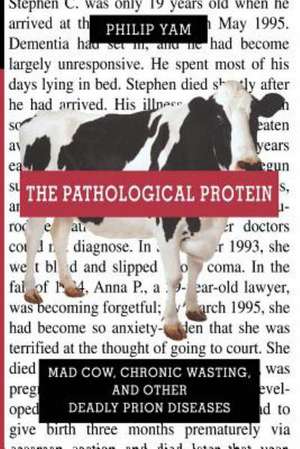
The Pathological Protein
Autor Philip Yamen Limba Engleză Paperback – 23 mar 2013
În ultimele decenii, medicina a fost forțată să își reevalueze înțelegerea asupra agenților infecțioși, pe măsură ce descoperirea prionilor a dărâmat dogma centrală a biologiei moleculare. Putem afirma că The Pathological Protein de Philip Yam surprinde exact acest moment de cotitură, când o proteină fără material genetic s-a dovedit a fi cauza unor boli neurodegenerative fatale. Remarcăm o tranziție de la medicina veterinară la patologia umană, declanșată de criza „vacii nebune”, care a transformat o curiozitate de laborator într-o urgență de sănătate publică. Structura volumului este organizată cronologic și tematic, începând cu primele semne de boală și continuând cu explorarea unor afecțiuni precum Kuru sau boala Creutzfeldt-Jakob. Capitolele precum „Neuro-Invasion” și „Straining the Hypothesis” indică o progresie de la observația clinică la mecanismul molecular, oferind în același timp un context social necesar în secțiuni precum „Consuming Fears”. Față de lucrări cu o rigoare academică strictă, precum Prions Prions Prions de Stanley B. Prusiner, care se concentrează pe caracterizarea genetică și moleculară premiată cu Nobel, volumul lui Yam aprofundează dimensiunea jurnalistică și controversele medicale care au însoțit aceste descoperiri. Acolo unde Mad Cow Disease and Related Spongiform Encephalopathies acoperă biologia prionilor pentru specialiști, The Pathological Protein analizează impactul uman și eșecurile administrative în gestionarea riscului. Deși este publicat de Springer, stilul adoptat de Philip Yam rămâne accesibil, păstrând totodată precizia clinică necesară pentru a descrie o patologie ce a sfidat decenii de cercetare. Este o cronică a modului în care știința se adaptează în fața necunoscutului, fiind esențială pentru înțelegerea modului în care agenții patogeni non-convenționali pot redefini siguranța alimentară și transfuzională la nivel global.
Preț: 173.83 lei
Preț vechi: 182.97 lei
-5%
Carte disponibilă
Livrare economică 27 octombrie-10 noiembrie
Specificații
ISBN-10: 1475788193
Pagini: 308
Ilustrații: XVIII, 286 p.
Dimensiuni: 155 x 235 x 17 mm
Greutate: 0.47 kg
Ediția:Softcover reprint of the original 1st edition 2003
Editura: Springer
Locul publicării:New York, NY, United States
V-ar putea interesa
-
 Late FragmentsKate GrossPreț: 72.37 lei
 -
 My Stroke of InsightJill Bolte Taylor-28%Preț: 55.43 lei77.06 lei
 -
 The Only Answer to Cancer: Defeating the Root Cause of All DiseaseLeonard ColdwellPreț: 138.92 lei
 -
 Pregnancy All-In-One for DummiesThe Experts at DummiesPreț: 186.39 lei
 -
 Jelinek MD, G: Overcoming Multiple SclerosisGeorge Jelinek MD-21%Preț: 98.80 lei125.31 lei
 -
 The Noonday DemonAndrew Solomon-24%Preț: 105.54 lei138.82 lei
 -
 Instinct Based MedicineLeonard ColdwellPreț: 181.60 lei
Public țintă
Popular/generalDe ce să citești această carte
Această carte este recomandată celor care doresc să înțeleagă istoria și mecanismul din spatele bolii vacii nebune fără a se pierde în jargon tehnic excesiv. Cititorul câștigă o perspectivă clară asupra modului în care o proteină defectuoasă poate deveni infecțioasă, oferind un studiu de caz fascinant despre intersecția dintre știința de frontieră, sănătatea publică și etica medicală.
Descriere scurtă
Cuprins
Recenzii
"The book is written for a general audience and is not necessarily targeted specifically to those in the medical field, according to the author. … This is an excellent book for the person who has a broad interest in prion diseases. It is well written and informative. I was impressed with the quality of the book and how easy it is to read. … I would recommend it to both physicians and lay people." (Leah D. Kroger, www.doody.com, February, 2004)
"Scientists still have more questions than answers about BSE, vCJD and the related scourges which make up the transmissible spongiform encephalopathies (TSEs). Philip Yam’s book, ‘The Pathological Protein’, does an admirable job of exploring them. … is full of such sensible observations, a welcome novelty in discussions on this fraught topic. The author is particularly good at explaining the complex and controversial science behind TSEs, as well as the prospects for better diagnosis and treatment … ." (The Economist –online, March, 2004)
"Philip Yam, Scientific American writer and editor, has a knack for boiling down complex science and making it palatable to the general public. Yam demonstrates his skills in an important new book, The Pathological Protein. … His treatment is thorough, entertaining, and honest. … This is definitely a book for decision-makers to read and underline. … it is a sourcebook of extremely valuable information about TSEs and a guide to some very suspect areas of farming and meat producing." (James A. Swan, National Review Online, www.nationalreview.com, August, 2003)
"Yam, a writer and editor for Scientific American since 1989, presents a detailed yet readable history of the mad cow scare and other prion diseases that affect humans and animals, such as scrapie. … Yam gives more coverage to the U.S. reactions to BSE and delves into the problems of chronic wasting disease (CWD) in elk and deer in North America and the research on other prion diseases like fatal familial insomnia (FFI). Recommended for most science collections." (Margaret Henderson, Library Journal, June, 2003)
"Yam, who has written and edited for the Scientific American has a singularly easy style to read and the story that he tells is of how the family in Devizes in England first found their son had variant CJD. … He writes this for a wide audience with it being interesting for everyone from the scientists to the average reader and he includes large amounts of information … . A book aimed at a very wide audience but scientifically involving." (Stephen Dealler, priondata.org, August, 2003)
"When bovine spongiform encephalopathy (BSE) first appeared in 1986 in the UK, many of the worries focused on the country’s agricultural industry … . Much of the literature on the subject tells the story of how we gradually realized that maybe humans were at risk … . In his well-written and easy-to-understand book ‘The Pathological Protein … Philip Yam paints a different picture. … Anyone who reads Yam’s excellent book will understand how data on TSEs were in fact readily accessible during the past 20years." (Stephen F. Dealler, C&EN - Chemical & Engineering News, November, 2003)
"It is indisputable that interest in the rare and unusual greatly exceeds that given to the common and mundane. The appearance of yet another book on transmissible spongiform encephalopathies (TSEs) should not therefore be surprising … . All this suggests that writing a book about TSEs should be easy. How was it for Philip Yam? In The Pathological Protein … he does a good job. … his accounts of technical matters are reader-friendly, but do not dumb down. … It is comprehensive, well researched and well referenced." (Hugh Pennington, Times Higher Education Supplement, December, 2003)