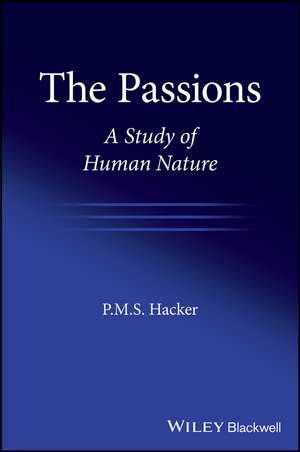
The Passions
Autor P. M. S. Hackeren Limba Engleză Paperback – 8 dec 2017
Destinată studenților la filozofie, cercetătorilor în neuroștiințe cognitive și specialiștilor în literatură, The Passions oferă o cartografiere riguroasă a peisajului afectiv uman. Găsim în această lucrare o critică pertinentă a tendinței contemporane de a reduce emoțiile la simple procese biologice. P. M. S. Hacker argumentează că scriitorii și poeții au reușit adesea descrieri mai fidele ale naturii umane decât psihologii experimentali, integrând astfel bogăția literaturii europene în analiza conceptuală. Observăm o structură metodică: primele capitole definesc cadrul teoretic prin diferențierea emoțiilor de alte „pasiuni” (precum apetiturile sau atitudinile), în timp ce secțiunile ulterioare se concentrează pe disecarea unor stări specifice, de la mândrie și vinovăție până la furie. Ca alternativă la Philosophy and the Emotions de Anthony Hatzimoysis pentru cursurile de filozofia minții, volumul lui Hacker are avantajul unei profunzimi antropologice rar întâlnite, fiind ancorat în tradiția analitică, dar deschis către dimensiunea morală. Această lucrare continuă proiectul vast început de autor în Human Nature: The Categorial Framework și The Intellectual Powers, consolidând o viziune coerentă asupra omului ca agent rațional și senzitiv. Finalul cărții, dedicat iubirii și empatiei ca rădăcini ale moralității, transformă un tratat tehnic într-o reflecție esențială despre sursele valorii în viața umană.
Preț: 251.50 lei
Carte disponibilă
Livrare economică 20 august-03 septembrie
Livrare express 06-12 august pentru 39.05 lei
Specificații
ISBN-10: 1119440467
Pagini: 480
Dimensiuni: 151 x 228 x 25 mm
Greutate: 0.59 kg
Editura: John Wiley and Sons Ltd
Locul publicării:Chichester, United Kingdom
V-ar putea interesa
-
 Law, Morality and Society: Essays in Honour of H.L.A HartP. M. S. Hacker-37%Preț: 965.64 lei1539.13 lei
 -
 Wittgenstein: Comparisons and ContextP. M. S. Hacker-22%Preț: 214.47 lei273.81 lei
 -
 Life, the Universe, God, and all that Stuff: 'an inside-out view'Johnny R. O'NeillPreț: 69.23 lei
 -
 Cognitive PracticesNolanPreț: 315.27 lei
 -
 Imagination and TimeMary WarnockPreț: 368.09 lei
 -
 PragmatismHilary PutnamPreț: 323.55 lei
 -
 -23%Preț: 450.50 lei585.07 lei
 -
 A Dictionary of Philosophical QuotationsA. J. AyerPreț: 385.89 lei
 -
 Exploring PhilosophyBrenda AlmondPreț: 382.69 lei
 -
 Connectionism ExplanationMacdonaldPreț: 493.94 lei
 -
 Preț: 343.38 lei
 -
 Wittgenstein s PlaceHackerPreț: 417.82 lei
 -
 History of Cognitive NeuroscienceM R Bennett-5%Preț: 292.53 lei307.93 lei
 -
 Intellectual PowersP M S HackerPreț: 252.71 lei
 -
 Wittgenstein 2eGordon P BakerPreț: 284.46 lei
 -
 Human NatureP M S HackerPreț: 346.13 lei
 -
 Intellectual EntertainmentsP. M. S. Hacker-8%Preț: 611.13 lei664.28 lei
 -
 Finding Our Way HomeCharles Determan Sr.Preț: 187.21 lei
 -
 Penseurs libres et liberté de penséeL. DugasPreț: 138.73 lei
De ce să citești această carte
Această carte este indispensabilă pentru cei care doresc să înțeleagă mecanismele subtile ale emoțiilor dincolo de scanările cerebrale. Cititorul câștigă o claritate conceptuală deosebită în distingerea sentimentelor complexe, beneficiind de expertiza unuia dintre cei mai mari filozofi analitici contemporani. Este un instrument valoros atât pentru rigoarea academică, cât și pentru perspectivele inedite oferite de analiza textelor literare clasice.
Despre autor
P. M. S. Hacker este Emeritus Research Fellow la St John’s College, Oxford, și profesor onorific la Institute of Neurology, UCL. Recunoscut drept cea mai importantă autoritate în filozofia lui Wittgenstein, el a coordonat monumentalul Analytic Commentary on Wittgenstein’s Philosophical Investigations. Opera sa vastă explorează granițele dintre filozofia minții, limbaj și antropologie filozofică. Prin seria sa dedicată naturii umane, Hacker a redefinit modul în care filozofia analitică abordează puterile intelectuale, pasiunile și moralitatea, rămânând un apărător al clarității conceptuale în fața reducționismului științific.
Notă biografică
Descriere scurtă
Parashkev Nachev, Institute of Neurology, UCL
There is not a slack moment in the whole of this impressive work. With his remarkable facility for making fine distinctions, and his commitment to lucidity, Peter Hacker has subtly characterised those emotions such as pride, shame, envy, jealousy, love or sympathy which make up our all too human nature. This is an important book for philosophers but since most of its illustrative material comes from an astonishing range of British and European literature, it is required reading also for literary scholars, or indeed for anyone with an interest in understanding who and what we are.
David Ellis, University of Kent
Human beings are all subject to boundless flights of joy and delight, to flashes of anger and fear, to pangs of sadness and grief. We express our emotions in what we do, how we act, and what we say, and we can share our emotions with others and respond sympathetically to their feelings. Emotions are an intrinsic part of the human condition, and any study of human nature must investigate them. In this third volume of a major study in philosophical anthropology which has spanned nearly a decade, one of the most preeminent living philosophers examines and reflects upon the nature of the emotions, advancing the view that novelists, playwrights, and poets - rather than psychologists and cognitive neuroscientists - elaborate the most refined descriptions of their role in human life.
In the book's early chapters, the author analyses the emotions by situating them in relation to other human passions such as affections, appetites, attitudes, and agitations. While presenting a detailed connective analysis of the emotions, Hacker challenges traditional ideas about them and criticizes misconceptions held by philosophers, psychologists, and cognitive neuroscientists. With the help of abundant examples and illustrative quotations from the Western literary canon, later sections investigate, describe, and disentangle the individual emotions - pride, arrogance, and humility; shame, embarrassment, and guilt; envy and jealousy; and anger. The book concludes with an analysis of love, sympathy, and empathy as sources of absolute value and the roots of morality.
A masterful contribution, this study of the passions is essential reading for philosophers of mind, psychologists, cognitive neuroscientists, students of Western literature, and general readers interested in understanding the nature of the emotions and their place in our lives.