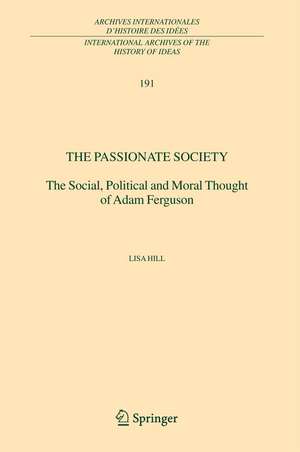
The Passionate Society
Autor Lisa Hillen Limba Engleză Paperback – 30 noi 2010
Though somewhat overlooked in the nineteenth century, Ferguson was rescued from obscurity in the first half of the twentieth century by scholars interested in the origins of sociology and early critiques of modernity. Ferguson’s interest in the mechanics of social life and especially social change led him to many groundbreaking insights. In fact, he is sometimes identified as the 'Father of Modern Sociology'. In addition to exploring whether or not he merits this title, this study examines the whole of Ferguson’s thought as a system and includes his moral and faculty psychology, historiography, theology, politics and social science.
Ferguson is distinguished by his deep appreciation of the complexity of the human condition; his study of society is based on the belief that it is not only reason, but the unseen, unplanned, sub-rational and visceral forces that keep the human universe in motion. Ferguson’s appreciation of this fact, and his ability to make social science of it, is his major achievement.
Preț: 619.47 lei
Preț vechi: 728.79 lei
-15%
Puncte Express: 929
Carte tipărită la comandă
Livrare economică 05-19 decembrie
Livrare prin curier în România Termenul estimat este afișat lângă disponibilitate.
Transport gratuit pentru acest produs Plată online sau ramburs, în funcție de opțiunile comenzii.
Retur gratuit în 14 zile Comandă securizată și suport în română.
Specificații
ISBN-13: 9789048169917
ISBN-10: 9048169917
Pagini: 300
Ilustrații: XII, 286 p.
Dimensiuni: 155 x 235 x 17 mm
Greutate: 0.46 kg
Ediția:Softcover reprint of hardcover 1st edition 2006
Editura: Springer
Locul publicării:Dordrecht, Netherlands
ISBN-10: 9048169917
Pagini: 300
Ilustrații: XII, 286 p.
Dimensiuni: 155 x 235 x 17 mm
Greutate: 0.46 kg
Ediția:Softcover reprint of hardcover 1st edition 2006
Editura: Springer
Locul publicării:Dordrecht, Netherlands
V-ar putea interesa
-
 The Social Construction of RealityPeter L. Berger-19%Preț: 63.79 lei78.73 lei
 -
 RespectRichard Sennett-19%Preț: 86.34 lei107.04 lei
 -
 Human Well-Being and the Natural EnvironmentPartha Dasgupta-27%Preț: 374.70 lei511.75 lei
 -
 Social Theory at WorkMarek Korczynski-27%Preț: 432.47 lei589.30 lei
 -
 Power: A Radical ViewSteven LukesPreț: 252.48 lei
 -
 POPULISMN/A Taggart-29%Preț: 164.64 lei233.43 lei
 -
 DISCOURSEDavid Howarth-30%Preț: 179.56 lei256.13 lei
 -
 Preț: 453.49 lei
 -
 Idea Of CultureEagletonPreț: 309.26 lei
 -
 -23%Preț: 501.31 lei651.05 lei
 -
 Preț: 157.18 lei
 -
 History and Social TheoryPeter BurkePreț: 156.53 lei
 -
 Southern TheoryRaewyn ConnellPreț: 157.82 lei
 -
 The Established and the OutsidersNorbert Elias-8%Preț: 574.26 lei624.20 lei
 -
 Big BrotherJ. BignellPreț: 383.83 lei
 -
 Social Theories of Risk and UncertaintyJens O ZinnPreț: 420.37 lei
 -
 Guy DebordAndy MerrifieldPreț: 90.23 lei
Public țintă
ResearchCuprins
Introduction: The Passionate Society.- Reading Ferguson.- Ferguson’s Theology/Ontology.- Method and Historiography.- Ferguson’s Faculty and Moral Psychology.- Ferguson’s “Invisible Hand”.- Ferguson’S Early Conflict Theory.- Habit.- The Environment.- Corruption And Problems Of Modernity.- Progress and Decline.- Ferguson’s Conservatism.- Conclusion.
Textul de pe ultima copertă
Adam Ferguson (1723-1816) was a major figure of the Scottish Enlightenment whose thought was, in many respects, original and distinctive. This book is a study of his ideas and of the intellectual forces that shaped them.
Though somewhat overlooked in the nineteenth century, Ferguson was rescued from obscurity in the first half of the twentieth century by scholars interested in the origins of sociology and early critiques of modernity. Ferguson’s interest in the mechanics of social life and especially social change led him to many groundbreaking insights. In fact, he is sometimes identified as the 'Father of Modern Sociology'. In addition to exploring whether or not he merits this title, this study examines the whole of Ferguson’s thought as a system and includes his moral and faculty psychology, historiography, theology, politics and social science.
Ferguson is distinguished by his deep appreciation of the complexity of the human condition; his study of society is based on the belief that it is not only reason, but the unseen, unplanned, sub-rational and visceral forces that keep the human universe in motion. Ferguson’s appreciation of this fact, and his ability to make social science of it, is his major achievement.
Though somewhat overlooked in the nineteenth century, Ferguson was rescued from obscurity in the first half of the twentieth century by scholars interested in the origins of sociology and early critiques of modernity. Ferguson’s interest in the mechanics of social life and especially social change led him to many groundbreaking insights. In fact, he is sometimes identified as the 'Father of Modern Sociology'. In addition to exploring whether or not he merits this title, this study examines the whole of Ferguson’s thought as a system and includes his moral and faculty psychology, historiography, theology, politics and social science.
Ferguson is distinguished by his deep appreciation of the complexity of the human condition; his study of society is based on the belief that it is not only reason, but the unseen, unplanned, sub-rational and visceral forces that keep the human universe in motion. Ferguson’s appreciation of this fact, and his ability to make social science of it, is his major achievement.
Caracteristici
Only general reader on Ferguson since 1965 Exhaustive treatment of his social science, including his moral philosophy, historiography and political thought Shows where Ferguson stands in terms of the prevailing and emerging intellectual traditions of his time Explores his thought as a conceptual system including any conceptual problems or irregularities within it Assesses Ferguson’s achievement and the ways in which his ideas resonate with the contemporary reader