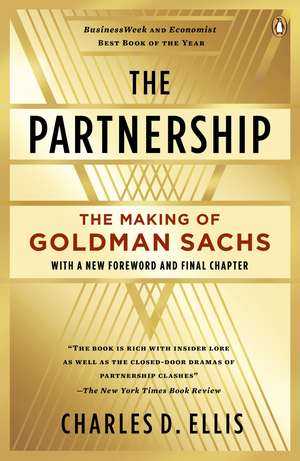
The Partnership
Autor Charles D. Ellisen Limba Engleză Paperback – sep 2009
Subliniem faptul că succesul Goldman Sachs nu este un accident al pieței, ci rezultatul unui model de parteneriat bazat pe o cultură de management unică și tehnici de recrutare neortodoxe. În The Partnership, Charles D. Ellis propune un cadru analitic riguros prin care cititorul poate înțelege mecanismele interne ale celei mai influente bănci de investiții din lume. Considerăm că forța acestei lucrări rezidă în capacitatea autorului de a decoda „secretomania” instituției, evidențiind modul în care valorile comune și disciplina de fier au transformat o mică afacere de familie într-o forță globală. Dacă Goldman Sachs de Lisa Endlich v-a oferit cadrul teoretic și istoria timpurie a firmei, această carte oferă instrumentele practice și studiile de caz necesare pentru a înțelege reziliența organizațională în perioade de criză financiară. Apreciem modul în care Ellis integrează parcursurile unor figuri emblematice precum Sidney Weinberg sau Lloyd Blankfein, demonstrând cum viziunea individuală se subordonează interesului colectiv al parteneriatului. Față de lucrările sale anterioare, precum The Elements of Investing sau Winning the Loser's Game, unde se concentra pe strategii de investiții pentru publicul larg, în The Partnership autorul schimbă perspectiva către macro-structuri. Aici, accentul nu mai cade pe portofoliul individual, ci pe arhitectura unei instituții care a modelat sistemul bancar modern. Este o analiză despre putere, supraviețuire și etica profesională într-un mediu de o competitivitate extremă.
Preț: 149.76 lei
Carte disponibilă
Livrare economică 02-16 noiembrie
Specificații
ISBN-10: 0143116126
Pagini: 768
Dimensiuni: 139 x 213 x 58 mm
Greutate: 0.69 kg
Ediția:Trade Paperback.
Editura: Penguin Publishing Group
V-ar putea interesa
-
 Console WarsBlake J. HarrisPreț: 141.35 lei
 -
 VanderbiltAnderson CooperPreț: 94.14 lei
 -
 The LEGO StoryJens AndersenPreț: 205.92 lei
 -
 Small GiantsBo Burlingham-25%Preț: 69.52 lei92.87 lei
 -
 The Big RichBryan BurroughPreț: 116.91 lei
 -
 -11%Preț: 357.06 lei401.20 lei
 -
 -23%Preț: 483.32 lei627.68 lei
 -
 -20%Preț: 463.92 lei581.11 lei
 -
 Flying BlindPeter Robison-19%Preț: 75.07 lei93.14 lei
 -
 The Freedom to Be FreeHannah Arendt-21%Preț: 44.77 lei56.45 lei
 -
 American IconBryce G. HoffmanPreț: 113.14 lei
 -
 -26%Preț: 68.27 lei92.57 lei
 -
 -15%Preț: 483.06 lei568.31 lei
 -
 Boards, Governance and Value CreationMorten Huse-11%Preț: 439.19 lei493.47 lei
 -
 DisneywarJames B. StewartPreț: 143.68 lei
 -
 The Modern Corporation and Private PropertyAdolf A. BerlePreț: 441.79 lei
 -
 Value-Creating BoardsMorten HusePreț: 147.94 lei
 -
 The Independent DirectorG. BrownPreț: 472.76 lei
 -
 -32%Preț: 163.39 lei241.00 lei
 -
 The Devil's DerivativesNicholas DunbarPreț: 151.57 lei
 -
 Empire of Pain: The Secret History of the Sackler DynastyPatrick Radden Keefe-41%Preț: 56.21 lei95.26 lei
 -
 -22%Preț: 83.75 lei107.57 lei
 -
 Understanding Boards of DirectorsJay W. LorschPreț: 321.71 lei
 -
 -13%Preț: 98.87 lei113.45 lei
 -
 The Lords of Easy Money: How the Federal Reserve Broke the American EconomyChristopher LeonardPreț: 180.02 lei
 -
 Disaster in the BoardroomGerry BrownPreț: 339.95 lei
De ce să citești această carte
Recomandăm această carte liderilor și profesioniștilor din finanțe care doresc să înțeleagă anatomia unei organizații de elită. Veți învăța cum să construiți o cultură a excelenței și cum să gestionați talentele de top pentru a asigura sustenabilitatea pe termen lung. Este un studiu esențial despre cum disciplina și valorile parteneriatului pot proteja o instituție în fața celor mai dure turbulențe economice.
Despre autor
Charles D. Ellis este o figură proeminentă în lumea financiară, acumulând peste 28 de ani de experiență ca managing partner la Greenwich Associates. Expertiza sa academică este la fel de vastă, predând cursuri de management al investițiilor la instituții de prestigiu precum Harvard Business School și Yale School of Management. A servit în comitetele de investiții ale Universității Yale și Whitehead Institute, fiind recunoscut la nivel mondial pentru capacitatea sa de a distila concepte financiare complexe în strategii de succes. Această experiență practică și teoretică îi oferă autoritatea necesară pentru a analiza parcursul Goldman Sachs.
Descriere scurtă
Now with a new foreword and final chapter, The Partnership chronicles the most important periods in Goldman Sachs?s history and the individuals who built one of the world?s largest investment banks. Charles D. Ellis, who worked as a strategy consultant to Goldman Sachs for more than thirty years, reveals the secrets behind the firm?s continued success through many life-threatening changes. Disgraced and nearly destroyed in 1929, Goldman Sachs limped along as a break-even operation through the Depression and WWII. But with only one special service and one improbable banker, it began the stage-by-stage rise that took the firm to global leadership, even in the face of the world-wide credit crisis.
Notă biografică
Extras
This book was almost never written—several different times. In the winter of 1963 at Harvard Business School, I was, like all my classmates, looking for a job. My attention was drawn to a three-by-five piece of yellow paper posted at eye level on a bulletin board in Baker Library. In the upper left corner was printed "Correspondence Opportunities" and typed to the right was the name "Goldman Sachs." As a Boston securities lawyer, my dad had a high regard for the firm, so I read the brief description of the job with interest but was stopped by the salary: $5,800.
My then wife had just graduated from Wellesley with three distinctions: she was a member of Phi Beta Kappa, a soprano soloist, and a recipient of student loans. I was determined to pay off those loans, so I figured I'd need to earn at least $6,000. With no thought of the possibility of earning a bonus or a raise, I naively "knew" I could not make it on $5,800. So Goldman Sachs was not for me. If I had joined the firm, like everyone else who has made a career with Goldman Sachs I would never have written an insider's study of Goldman Sachs.*
In the early 1970s, while promising future partners that we would develop our fledgling consultancy, Greenwich Associates, into a truly superior professional firm, I had to laugh at myself: "You dummy! You make the promise, but you don't even know what a truly superior professional firm is all about or how to get there. You've never even worked for one. You'd better learn quickly."
From then on, at every opportunity I asked my friends and acquaintances in law, consulting, investing, and banking which firms they thought were the best in their field and what characteristics made them the best. Over and over again, well past the bounds of persistence, I probed those same questions. Inevitably, a pattern emerged.
A truly great professional firm has certain characteristics: The most capable professionals agree that it is the best firm to work for and that it recruits and keeps the best people. The most discriminating and significant clients agree that the firm consistently delivers the best service value. And the great firms have been and will be, sometimes grudgingly, recognized by competitors as the real leaders in their field over many years. On occasion, challenger firms rise to prominence—usually on the strength of one exciting and compelling service capability—but do not sustain excellence.
Many factors that contribute to sustained excellence vary from profession to profession, but certain factors are important in every great firm: long-serving and devoted "servant leaders"; meritocracy in compensation and authority; disproportionate devotion to client service; distinctively high professional and ethical standards; a strong culture that always reinforces professional standards of excellence; and long-term values, policies, concepts, and behavior consistently trumping near-term "opportunities." Each great organization is a "one-firm firm" with consistent values, practices, and culture across geographies, across very different lines of business, and over many years. All the great firms have constructive "paranoia"—they are always on the alert for and anxious about challenging competitors. However, they seldom try to learn much from competitors: they see themselves as unique. But like Olympic athletes who excel in different events, they are also very much the same.
Armed by Greenwich Associates' extensive proprietary research and working closely as a strategy consultant with all the major securities firms, I was in a unique position to make comparisons between competing firms on the dozens of salient criteria on which they were evaluated by their own clients market by market, year after year, and particularly over time. Over the years, I became convinced that my explorations were producing important discoveries that would be of interest to others who are fascinated by excellence, who retain professional firms for important services, or who will spend their working careers in professional firms. One discovery surprised me: In each profession, one single firm is usually recognized as "the best of us" by the professional practitioners—Capital Group in investing, McKinsey in consulting, Cravath in law (nicely rivaled by Davis Polk or Skadden Arps), and the Mayo Clinic in medicine (nicely rivaled by Johns Hopkins). And Goldman Sachs in securities.
Ten or twenty years ago, many people in the securities business would have argued that other firms were as good or better, but no longer. (Much further back, few would have ever chosen Goldman Sachs.) For many years, it has seemed clear to me that Goldman Sachs had unusual strengths. Compared to its competitors, the firm recruited more intriguing people who cared more about their firm. Their shared commitments, or "culture," was stronger and more explicit. And the leaders of the firm at every level were more rigorous, more thoughtful, and far more determined to improve in every way over the longer term. They took a longer horizon view and were more alert to details. They knew more about and cared more about their people. They worked much harder and were more modest. They knew more andwere hungrier to learn. Their focus was always on finding ways to do better and be better. Their aspirations were not on what they wanted to be, but on what they wanted to do.
Goldman Sachs has, in the last sixty years, gone from being a marginal Eastern U.S. commercial-paper dealer, with fewer than three hundred employees and a clientele largely dependent on one improbable investment banker, to a global juggernaut, serially transforming itself from agent to managing agent to managing partner to principal investor with such strengths that it operates with almost no external constraints in virtually any financial market it chooses, on the terms it chooses, on the scale it chooses, when it chooses, and with the partners it chooses.
Of the thirty thousand people of Goldman Sachs, fewer than half of one percent are even mentioned in this book, but the great story of Goldman Sachs is really their story—and that of the many thousands who joined the firm before them and enabled it to become today's Goldman Sachs. Goldman Sachs is a partnership.
The legal fact that after more than a hundred years it became a public corporation may matter to lawyers and investors, but the dominating reality is that Goldman Sachs is a true partnership in the way people at the firm work together, in the way alumni feel about the firm and each other, and in the powerful spiritual bonds that command their attention and commitment.
The leaders of Goldman Sachs today and tomorrow may have even tougher jobs than their predecessors. The penalties of industry leadership, particularly the persistent demand to meet or beat both internal and external expectations for excellence—over and over again on the frontiers of competitive innovation—are matched by the persistent challenges of Lord Acton's warning: "Power tends to corrupt. Absolute power corrupts absolutely."
Three great questions come immediately to any close observer: Why is Goldman Sachs so very powerful on so many dimensions? How did the firm achieve its present leadership and acknowledged excellence? Will Goldman Sachs continue to excel?
The adventures that crowd the following pages point to the answers.
Charles D. Ellis
New Haven, Connecticut
June 2008
* John Whitehead and Robert Rubin have both included a few stories about the firm in their books but have certainly not tried to provide a complete picture. Lisa Endlich, a fine writer but with limited access to the full range of partners, wrote a thoughtful and wide-ranging study centered on the development of the firm in the 1980s and 1990s.
Bob Lenzner, a gifted writer for Forbes who had worked in arbitrage at Goldman Sachs a generation ago, started a book but set it aside, saying he didn't want to lose his friends at the firm.