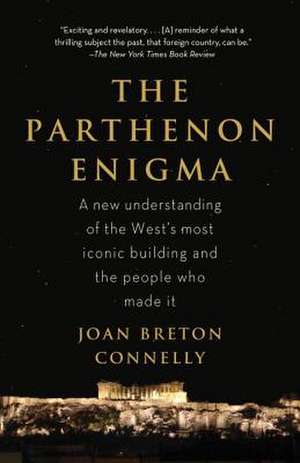
The Parthenon Enigma
Autor Joan Breton Connellyen Limba Engleză Paperback – 4 noi 2014
Începem analiza acestui volum prin prisma autorității autoarei: Joan Breton Connelly este profesor de studii clasice și istoria artei la New York University, fiind un arheolog de teren cu o experiență vastă în situri din Grecia, Kuweit și Cipru. Distinsă cu prestigioasa bursă MacArthur pentru contribuțiile sale în studiul mitului și religiei grecești, Connelly aduce în The Parthenon Enigma o rigoare academică dublată de o capacitate narativă remarcabilă. Descoperim aici o provocare directă la adresa interpretărilor convenționale care, încă din perioada Iluminismului, au văzut în Parthenon simbolul suprem al valorilor democratice raționaliste. Remarcăm modul în care autoarea reconstruiește identitatea monumentului nu prin prisma politicii moderne, ci prin rețeaua densă de ritualuri cultice și mituri fondatoare care guvernau viața atenienilor. Analiza sa asupra frizei Parthenonului, bazată pe dovezi textuale și vizuale noi, propune o lectură în care sacrificiul și datoria religioasă primează în fața reprezentării civice abstracte. Din punct de vedere al contextului academic, The Parthenon Enigma extinde cadrul propus de Worshipping Athena de Jenifer Neils cu date noi despre complexitatea festivalului Panathenaia. În timp ce Jenifer Neils se concentrează pe aspectele iconografice și controversele interpretative ale frizei, Connelly merge mai departe, integrând arhitectura într-o cosmologie religioasă vastă, unde democrația, în sensul său contemporan, ar fi fost de neconceput. Structura cărții, deși densă și documentată prin 512 pagini de cercetare, menține un ritm alert, transformând o monografie de istorie antică într-o investigație fascinantă despre rădăcinile civilizației occidentale.
Preț: 159.36 lei
Carte disponibilă
Livrare economică 02-16 noiembrie
Specificații
ISBN-10: 0307476596
Pagini: 546
Dimensiuni: 132 x 203 x 30 mm
Greutate: 0.5 kg
Editura: Knopf Doubleday Publishing Group
V-ar putea interesa
-
 Preț: 208.77 lei
 -
 Tutankhamen & The Discovery of His TombHoward CarterPreț: 230.33 lei
 -
 Preț: 218.34 lei
 -
 The Cambridge History of Greek and Roman WarfarePhilip Sabin-23%Preț: 1203.45 lei1562.92 lei
 -
 PindarDr Richard Stoneman-20%Preț: 167.82 lei210.33 lei
 -
 EusebiusAaron P. Johnson-21%Preț: 165.03 lei207.68 lei
 -
 Early Aegean Warrior 5000–1450 BCRaffaele D’Amato-32%Preț: 78.80 lei115.16 lei
 -
 Orpheus: The Song of LifeAnn Wroe-19%Preț: 97.58 lei120.42 lei
 -
 The Poets of AlexandriaSusan A. Stephens-16%Preț: 128.70 lei153.45 lei
De ce să citești această carte
Recomandăm această carte cititorilor pasionați de istorie clasică și arheologie care doresc să depășească clișeele despre Grecia Antică. The Parthenon Enigma oferă o perspectivă proaspătă și curajoasă asupra celui mai faimos monument al antichității, demonstrând cum religia și mitul, mai degrabă decât politica pură, au modelat estetica ateniană. Este o lectură esențială pentru a înțelege complexitatea spirituală a strămoșilor noștri culturali, dincolo de idealizările moderne.
Despre autor
Joan Breton Connelly este profesor de studii clasice și istoria artei la New York University și un reputat arheolog de teren. A condus excavările de pe insula Yeronisos din Cipru și a lucrat extensiv în Grecia și Kuweit. Recunoașterea sa internațională a fost consolidată de bursa MacArthur, acordată pentru munca sa inovatoare în reinterpretarea artei și religiei grecești. Este, de asemenea, autoarea volumului „Votive Sculpture of Hellenistic Cyprus”, expertiza sa îmbinând analiza riguroasă a artefactelor cu o înțelegere profundă a contextului mitologic antic.
Descriere scurtă
Winner of the Ralph Waldo Emerson Award
Since the Enlightenment, the Parthenon the greatest example of Athenian architecture has been venerated as the definitive symbol of Western democratic values. Here, Joan Breton Connelly challenges this conventional wisdom, drawing on previously undiscovered sources to present a revolutionary new view of this peerless building. Reaching back across time to trace the Parthenon s story from the laying of its foundation, Connelly finds its true meaning not in the rationalist ideals we typically associate with Athens but in a vast web of ceaseless cultic observances and a unique mythic identity, in which democracy in our sense of the word would have been inconceivable. Marshalling a breathtaking range of textual and visual evidence, and full of fresh insights woven into a thrilling narrative that brings the distant past to life, "The Parthenon Enigma" sheds a stunning new light on the ancient Athenians from whom we claim cultural descent and on Western civilization itself."
Descriere
For more than two millennia, the Parthenon has been revered as the symbol of Western culture, the epitome of the ancient society from which we derive our highest ideals. It was understood to honor the city-state's patron deity Athena, and its intricately sculpted surface believed to depict a celebration of civic continuity in the birthplace of democracy. But through a close reading of a lost play by Euripides, accidentally discovered on a papyrus wrapping an Egyptian mummy, Joan Connelly began to develop a new theory that has sparked one of the fiercest controversies ever to rock the world of classics. Now, she recounts how our most basic sense of the Parthenon and of the culture that built it may have been crucially mistaken. Re-creating the ancient structure from its natural environment to its pediment, and using a breathtaking range of textual and visual evidence, she uncovers a monument glorifying human sacrifice set in a world of cult rituals quite unlike anything conventionally conjured by the word "Athenian."