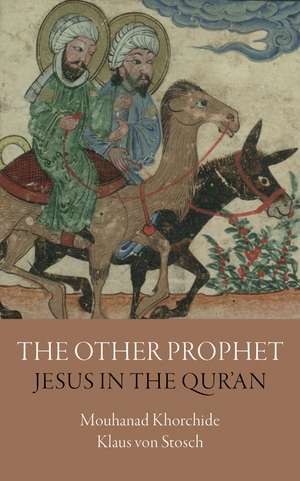
The Other Prophet: Jesus in the Qur’an
Autor Mouhanad Khorchide, Klaus von Stosch Traducere de Simon Pareen Limba Engleză Hardback – 21 noi 2019
Această monografie de cercetare, publicată sub egida Interfaith Series de editura Gingko, reprezintă un demers academic rar în studiile interreligioase, fiind scrisă în colaborare de un teolog musulman, Mouhanad Khorchide, și unul creștin, Klaus von Stosch. Notăm cu interes că volumul nu se limitează la o simplă trecere în revistă a versetelor coranice, ci plasează figura lui Iisus într-un context istoric și dogmatic riguros, începând cu analiza stării cristologiei în secolul al VII-lea.
Structura lucrării este una progresivă, debutând cu o examinare a controverselor politice și dogmatice post-Calcedon și a modului în care Peninsula Arabă a devenit un punct de confluență pentru diverse interpretări teologice. Reținem că autorii fac tranziția către modernitate prin discutarea ontologiei relaționale și a paradigmelor actuale de conștiință cristologică, înainte de a trece la analiza exegetică propriu-zisă. Un element distinctiv îl constituie lectura diacronică a textului sacru islamic, concentrându-se pe Surele Maryam (19), Al-Imran (3) și Al-Ma'ida (5), oferind o perspectivă asupra evoluției imaginii lui Iisus în discursul coranic.
Alternativă la Images of Jesus Christ in Islam de Oddbjørn Leirvik pentru cursurile de teologie comparată sau studii islamice, The Other Prophet aduce ca avantaj principal dialogul direct între cele două tradiții pe parcursul aceleiași argumentații, spre deosebire de lucrările care tratează perspectivele separat. Ritmul este unul academic, dens, axat pe clarificarea termenilor de specialitate precum „enhypostasis” sau „intervenție anti-cristologică”, transformând lectura într-un exercițiu intelectual de profunzime despre modul în care Iisus poate servi drept punte de legătură între două religii majore.
Preț: 197.54 lei
Preț vechi: 280.16 lei
-29%
Carte disponibilă
Livrare economică 09-23 noiembrie
Specificații
ISBN-10: 1909942367
Pagini: 332
Dimensiuni: 152 x 229 x 20 mm
Greutate: 0.43 kg
Ediția:1st Edition
Editura: Gingko
Colecția Gingko
De ce să citești această carte
Recomandăm această carte cercetătorilor și studenților la teologie care doresc să depășească viziunile polemice tradiționale. Cititorul câștigă o înțelegere nuanțată a modului în care Coranul îl portretizează pe Iisus, nu doar ca figură profetică, ci ca punct de intersecție istorică și teologică. Este o resursă esențială pentru oricine este interesat de dialogul interreligios fundamentat pe rigoare academică și respect reciproc.
Despre autor
Mouhanad Khorchide este un renumit profesor de pedagogie islamică, cunoscut pentru abordările sale reformatoare și dialogul deschis cu valorile europene. Klaus von Stosch este un teolog catolic german, specialist în teologie sistematică și comparată, remarcat pentru eforturile sale de a găsi puncte de contact dogmatice între creștinism și islam. Împreună, cei doi autori combină expertiza în exegeza coranică și istoria dogmelor creștine pentru a oferi o analiză echilibrată și documentată în cadrul volumului The Other Prophet.
Descriere scurtă
The Qur’an identifies Jesus as a sign of God, and he holds a place as one of the most important prophets in Islam. Looking at Jesus in Islam also reveals both deep differences from and rich connections to the view of Jesus in Christianity. In The Other Prophet, Mouhanad Khorchide and Klaus von Stosch explore and explain the position of the Qur’anic Jesus, with one scholar working from the Muslim and the other from the Christian theological perspective. Their combined research presents a history of Jesus’ presence in the Qur’an and provides astute observations to deepen the understanding of both Christians and Muslims. Here we find that a common view of Jesus from the Muslim and Christian sides is not only possible but also expands our understanding of Jesus and his message.
Notă biografică
Recenzii
Cuprins
2. The State of Christology in the Seventh Century
2.1 The Chalcedon controversy
2.2 A political compromise on dogma
2.3 The neo-Chalcedonian doctrine of enhypostasis
2.4 Christological debates among non-Chalcedonians
2.5 The Arabian Peninsula as a confluence of heresies?
2.6 The situation in the Arabian Peninsula in the seventh century
3. New Developments in Modern Christology
3.1 The starting point of consciousness Christology
3.2 The modern paradigm shift in relational ontology and its impact on Christology
3.3 Testing against the historical Jesus
3.4 Multiple incarnations?
4. A Holistic Reading of Surahs 19, 3 and 5 in the Context of a Diachronic Reading of the Qur’an’s Verses about Jesus
4.1 Jesus in Surah Maryam
4.1.1 Zachariah and John
4.1.2 Mary and her child
4.1.3 Jesus’s self-image
4.1.4 An anti-Christological intervention in Q 19:34–40?
4.1.5 Further themes in Surah Maryam
4.1.6 Prophetological consolidation in the late Meccan and early Medinan periods
4.2 Surah al ‘Imran
4.2.1 Prologue (verses 1–32)
4.2.2 Narrative core (verses 33–62)
4.2.3 Religio-political arguments (verses 63–99)
4.2.4 Self-assurance of the Muslim community (verses 100–200)
4.2.5 Jesus crucified?
4.3 Surah al-Ma’ida
4.3.1 Structure and themes of the surah
4.3.2 Criticism of any deification of human beings
4.3.3 A break with Christianity?
5. Jesus’s Position in Qur’anic Prophetology (Zishan Ghaffar)
5.1 the early Meccan surahs: eschatological prophecy
5.1.1 Imminent eschatological expectation?
5.2 The middle Meccan surahs: prophetology as a combination of salvation, election and mercy
5.2.1 The new context of the proclamation in the middle Meccan
period and its central topoi
5.2.2 The Qur’an’s apostolic doctrine in the middle Meccan period
5.2.3 The birth of prophecy out of God’s mercy
5.2.4 Muhammad as Moses redivivus – the consolidation of Qur’anic prophetology in the middle Meccan period
5.3 Late Meccan prophetology: the apology of the messengers
5.4 Qur’anic prophetology in Medina
5.4.1 from existential to textual typology
5.4.2 from community of fate to the universal community of the covenant: Qur’anic prophetology between universality and
exclusivity
5.4.3 the Messenger Muhammad as lawmaker and his special
prestige as a prophetic dignitary
5.4.4 Prophetology as a counter-discourse to Christology?
6. The Work of Jesus Christ and the Qur’an: A Forensic Search for Functional Equivalents
6.1 God’s self-revelation in the Islamic tradition (with the involvement of Darius asghar-Zadeh)
6.2 The relation between God and humans as a liberating relationship
6.3 On the soteriological relevance of the Qur’an (with the involvement of Darius asghar-Zadeh)
6.4 Can God suffer?
6.5 Qur’anic stimuli for conceiving of emotions in God
7. New Perspectives on the Qur’an
7.1 Systematic conclusions from a Christian perspective
7.2 Systematic conclusions from a Muslim perspective
Bibliography
Reference text