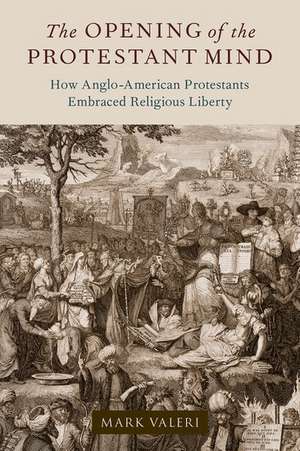
The Opening of the Protestant Mind: How Anglo-American Protestants Embraced Religious Liberty
Autor Mark Valerien Limba Engleză Hardback – 28 sep 2023
Preț: 150.31 lei
Preț vechi: 178.39 lei
-16% Nou
Puncte Express: 225
Preț estimativ în valută:
26.60€ • 31.19$ • 23.36£
26.60€ • 31.19$ • 23.36£
Carte disponibilă
Livrare economică 15-21 ianuarie 26
Livrare express 27 decembrie 25 - 02 ianuarie 26 pentru 64.11 lei
Preluare comenzi: 021 569.72.76
Specificații
ISBN-13: 9780197663677
ISBN-10: 0197663672
Pagini: 308
Ilustrații: 24
Dimensiuni: 237 x 165 x 25 mm
Greutate: 0.63 kg
Editura: Oxford University Press
Colecția OUP USA
Locul publicării:New York, United States
ISBN-10: 0197663672
Pagini: 308
Ilustrații: 24
Dimensiuni: 237 x 165 x 25 mm
Greutate: 0.63 kg
Editura: Oxford University Press
Colecția OUP USA
Locul publicării:New York, United States
Recenzii
The Opening of the Protestant Mind provides a new origin story for the idea of freedom of conscience, demonstrating its intertwined roots in eighteenth-century political and religious concerns. Eschewing portrayals of puritans as pillars of intolerance, Valeri takes readers deep inside the minds of English Protestants during the colonial conquests that created the British Empire, introduced the comparative study of religion, and paved the way for missionary movements and argues that the imperialism of the nineteenth century was far from inevitable.
A deeply thoughtful, subtly multifaceted, and cogently argued intervention in ongoing discussions regarding Euro-American views of other peoples and religious traditions.
This is a compelling account of how, between the Restoration and the American Revolution, Anglo-Protestants learned—at least sometimes—to tolerate non-Protestant people of faith and imagine them as trustworthy imperial subjects or republican citizens. Valeri's moderate Protestants did not embrace radical egalitarianism, but neither were they merely masking and enabling colonialism, imperialism, and racism. Under the regime of British religious toleration, Valeri finds a story marked by contingency, contestation, and conceptual transformation.
Historians of religious toleration often tell a simple tale of atavistic bigotry yielding to enlightened, pragmatic secularism. The Opening of the Protestant Mind tells a more complicated story of sincere believers struggling to imagine a social order that accommodated religious difference. Making unexpected connections between domestic debates and imperial efforts to 'convert' non-European peoples, Mark Valeri deepens our appreciation of a now-imperiled legacy built by those who seriously—if imperfectly—embraced moderation as a spiritual value.
The Opening of the Protestant Mind provides readers with a rich understanding of how those changes came to take place.
Engagingly written and blessedly short on jargon, this study is an important addition to the study of American political history and the development of religious liberty.
Using a variety of sources--travel narratives, dictionaries and encyclopaedias of the world's religions, missionary tracts, and sermons, The Opening of the Protestant Mind: How Anglo-American Protestants Embraced Religious Liberty by Dr. Mark Valeri traces a transformation in how English and colonial American Protestants described other religions during a crucial period of English colonisation of North America.
The Opening of the Protestant Mind makes several important contributions to historical understanding of Anglo-American life in the seventeenth and eighteenth centuries. First, the book succeeds in emphasizing the significance of the discourse around other religions in this era. With careful readings of the texts cataloging and comparing world religions, the work demonstrates the need to take the endeavor seriously. Second, the book carefully delineates the significant implications of Whig moralism and republican thought for religion. The argument on this point helps make sense of attitudes in Georgian England that were then adopted and adapted in the American context. Finally, the result of the whole project is to demonstrate how multiple concerns came together in the thinking and writing of Anglo-American Protestants.
Deep research and conceptual sophistication make Mark Valeri's Opening of the Protestant Mind a landmark account of a discursive "before" and "after" in the English/British homeland and its colonies during the early modern era (Englandbecame Britain after the 1707 Union of English and Scottish monarchies). The success of The Opening of the Protestant Mind depends upon Valeri's nuancedaccount of "discourse," or instincts, assumptions, and taken-for-granted habits of mind. He recognizes that deference to certain instincts of the ancien regime did not vanish entirely, also that eighteenth century's standards of reasonableness could be employed to justify the enslavement of Africans and the extermination of Natives.
The Opening of the Protestant Mind is an impressive work, bursting with original source quotations set within helpful historical context.
A deeply thoughtful, subtly multifaceted, and cogently argued intervention in ongoing discussions regarding Euro-American views of other peoples and religious traditions.
This is a compelling account of how, between the Restoration and the American Revolution, Anglo-Protestants learned—at least sometimes—to tolerate non-Protestant people of faith and imagine them as trustworthy imperial subjects or republican citizens. Valeri's moderate Protestants did not embrace radical egalitarianism, but neither were they merely masking and enabling colonialism, imperialism, and racism. Under the regime of British religious toleration, Valeri finds a story marked by contingency, contestation, and conceptual transformation.
Historians of religious toleration often tell a simple tale of atavistic bigotry yielding to enlightened, pragmatic secularism. The Opening of the Protestant Mind tells a more complicated story of sincere believers struggling to imagine a social order that accommodated religious difference. Making unexpected connections between domestic debates and imperial efforts to 'convert' non-European peoples, Mark Valeri deepens our appreciation of a now-imperiled legacy built by those who seriously—if imperfectly—embraced moderation as a spiritual value.
The Opening of the Protestant Mind provides readers with a rich understanding of how those changes came to take place.
Engagingly written and blessedly short on jargon, this study is an important addition to the study of American political history and the development of religious liberty.
Using a variety of sources--travel narratives, dictionaries and encyclopaedias of the world's religions, missionary tracts, and sermons, The Opening of the Protestant Mind: How Anglo-American Protestants Embraced Religious Liberty by Dr. Mark Valeri traces a transformation in how English and colonial American Protestants described other religions during a crucial period of English colonisation of North America.
The Opening of the Protestant Mind makes several important contributions to historical understanding of Anglo-American life in the seventeenth and eighteenth centuries. First, the book succeeds in emphasizing the significance of the discourse around other religions in this era. With careful readings of the texts cataloging and comparing world religions, the work demonstrates the need to take the endeavor seriously. Second, the book carefully delineates the significant implications of Whig moralism and republican thought for religion. The argument on this point helps make sense of attitudes in Georgian England that were then adopted and adapted in the American context. Finally, the result of the whole project is to demonstrate how multiple concerns came together in the thinking and writing of Anglo-American Protestants.
Deep research and conceptual sophistication make Mark Valeri's Opening of the Protestant Mind a landmark account of a discursive "before" and "after" in the English/British homeland and its colonies during the early modern era (Englandbecame Britain after the 1707 Union of English and Scottish monarchies). The success of The Opening of the Protestant Mind depends upon Valeri's nuancedaccount of "discourse," or instincts, assumptions, and taken-for-granted habits of mind. He recognizes that deference to certain instincts of the ancien regime did not vanish entirely, also that eighteenth century's standards of reasonableness could be employed to justify the enslavement of Africans and the extermination of Natives.
The Opening of the Protestant Mind is an impressive work, bursting with original source quotations set within helpful historical context.
Notă biografică
Mark Valeri is the Reverend Priscilla Wood Neaves Distinguished Professor of Religion and Politics at Washington University in St. Louis. His book Heavenly Merchandize: How Religion Shaped Commerce in Puritan America, received the 2011 Philip Schaff Prize from the American Society of Church History. He was a National Endowment for the Humanities fellow at the American Antiquarian Society and a Los Angeles Times Distinguished Fellow in the Culture of the Americas at the Huntington Library.