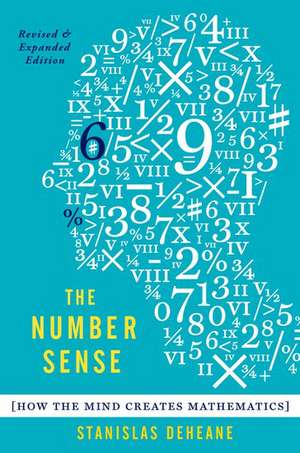
The Number Sense: How the Mind Creates Mathematics, Revised and Updated Edition
Autor Stanislas Dehaeneen Limba Engleză Paperback – 9 iun 2011
Recomandăm The Number Sense studenților la psihologie cognitivă, cercetătorilor în neuroștiințe și pedagogilor care doresc să înțeleagă fundamentul biologic al competențelor matematice. Această ediție actualizată a lucrării semnate de Stanislas Dehaene oferă o perspectivă riguroasă asupra modului în care creierul uman a evoluat pentru a procesa cantități, demonstrând că matematica nu este doar un construct cultural, ci o funcție „cablată” neurologic.
Suntem de părere că elementul distinctiv al cărții rezidă în capacitatea autorului de a face legătura între biologia evoluționistă — observând cum animalele și sugarii posedă un simț numeric primar — și neuroimagistica modernă. Ediția revizuită aduce date noi despre modul în care neuronii individuali codifică numerele, oferind o claritate tehnică necesară înțelegerii proceselor de calcul. The Number Sense completează perspectiva oferită de Numerical Cognition, adăugând o analiză profundă a cazurilor clinice, de la genii matematice la pacienți cu leziuni cerebrale care pierd capacitatea de a efectua operații simple.
În contextul operei sale, The Number Sense pune bazele teoretice pe care autorul le-a explorat ulterior în Reading in the Brain și How We Learn. Dacă în lucrările mai recente se concentrează pe mecanismele generale ale învățării și conștiinței, aici Stanislas Dehaene izolează specificul matematic, explicând de ce anumite structuri lingvistice, precum cele din limba chineză, facilitează o memorie numerică superioară celei din spațiul anglo-saxon. Tonul este precis, ancorat în experimente de laborator, oferind o structură narativă care transformă datele tehnice într-o investigație lucidă despre natura minții umane.
Preț: 279.22 lei
Preț vechi: 338.25 lei
-17%
Carte tipărită la comandă
Livrare economică 20-25 noiembrie
Specificații
ISBN-10: 0199753873
Pagini: 352
Dimensiuni: 157 x 236 x 23 mm
Greutate: 0.46 kg
Ediția:Updated Edition
Editura: Oxford University Press
Colecția OUP USA
Locul publicării:New York, United States
V-ar putea interesa
-
 Fundamental NeuroscienceLarry Squire-30%Preț: 592.97 lei851.46 lei
 -
 Consciousness and the BrainStanislas DehaenePreț: 106.53 lei
 -
 Conversations on ConsciousnessSusan Blackmore-18%Preț: 82.94 lei101.43 lei
 -
 Introduction to NeuropsychopharmacologyLeslie Iversen, PhD-30%Preț: 470.28 lei667.42 lei
 -
 Sensory Cue IntegrationJulia Trommershauser-32%Preț: 961.20 lei1417.61 lei
 -
 Mindmelding: Consciousness, Neuroscience, and the Mind's PrivacyWilliam Hirstein-32%Preț: 681.54 lei1008.24 lei
 -
 -34%Preț: 570.52 lei867.38 lei
 -
 -31%Preț: 607.34 lei875.98 lei
 -
 -32%Preț: 539.46 lei797.96 lei
 -
 -31%Preț: 792.55 lei1148.53 lei
 -
 Aesthetics and the Sciences of MindGreg Currie-31%Preț: 634.50 lei919.61 lei
 -
 The Brain Supremacy: Notes from the frontiers of neuroscienceKathleen TaylorPreț: 223.04 lei
 -
 Neuroculture: On the implications of brain scienceEdmund T. Rolls-22%Preț: 503.51 lei646.82 lei
 -
 Preț: 117.55 lei
 -
 Psychiatric Disorders: Methods and ProtocolsFiras H. Kobeissy-18%Preț: 937.73 lei1143.57 lei
De ce să citești această carte
Recomandăm această carte oricărui cititor curios să descopere rădăcinile biologice ale matematicii. Veți câștiga o înțelegere profundă a modului în care creierul procesează numerele, de la intuiția animală la calcule complexe. Este o resursă esențială pentru a înțelege de ce unii oameni au o afinitate naturală pentru cifre și cum influențează limba maternă performanța noastră matematică, totul explicat de unul dintre cei mai importanți neurocercetători contemporani.
Despre autor
Stanislas Dehaene este un renumit neurocercetător francez, director al Unității de Neuroimagistică Cognitivă din Saclay și profesor la Collège de France. Expertiza sa se concentrează pe bazele neuronale ale funcțiilor cognitive superioare, precum cititul, limbajul și calculul numeric. Pentru contribuțiile sale remarcabile, a fost recompensat cu prestigiosul Brain Prize în 2014. În lucrările sale, printre care se numără și Consciousness and the Brain sau How We Learn, acesta utilizează tehnici avansate de scanare cerebrală pentru a descifra misterele minții umane, fiind o autoritate mondială în domeniul neuroștiinței cognitive.
Descriere
Recenzii
From the origin of Roman numerals to the latest MRI results, everything you might like to know about numbers and the brain, as filtered through the lively and engaging brain of Stanislas Dehaene.
A delight.
Whether he is explaining how this neural macherinery begins its numerical magic early in infancy, how it attains the sophistication required for complex calculations, or how it misfires when the brain suffers certain types of injuries, Dehaene weaves the latest technical research into a remarkably lucid and engrossing investigation. Even readers normally indifferent to mathematics will find themselves marveling at the wonder of minds making numbers.
This interesting and informative book sets forth the latest findings by Dehaene and other psychologists trying to determine how the brain understands and manipulates numbers and other forms of mathematical information. Included are many startling results of experiments involving animals and infants that shed light on the extent and nature of our inborn number sense. These findings, if they receive the consideration they merit, should have a major impact on the way mathematics is taught at the elementary and secondary level. Highly recommended.
Notă biografică
Cuprins
- Preface to the Revised and Expanded Edition
- Preface to the First Edition
- Introduction
- Part I: Our Numerical Heritage
- Chapter 1: Talented and Gifted Animals
- Chapter 2: Babies Who Count
- Chapter 3: The Adult Number Line
- Part II: Beyond Approximation
- Chapter 4: The Language of Numbers
- Chapter 5: Small Heads for Big Calculations
- Chapter 6: Geniuses and Prodigies
- Part III: Of Neurons and Numbers
- Chapter 7: Losing Number Sense
- Chapter 8: The Computing Brain
- Chapter 9: What Is a Number?
- Epilogue. The Contemporary Science of Number and Brain
- Appendix
- Notes and References
- Bibliography
- Main books consulted
- Useful web resources
- Detailed bibliography
- Index