
The Night Land
Autor William Hope Hodgsonen Limba Engleză Paperback
The Night Land
William Hope Hodgson
The Night Land is a classic horror novel by William Hope Hodgson, first published in 1912. As a work of fantasy it belongs to the Dying Earth subgenre. Hodgson also published a much shorter version of the novel, entitled The Dream of X (1912).
The importance of The Night Land was recognised by its later revival in paperback by Ballantine Books, which republished the work in two parts as the 49th and 50th volumes of its celebrated Ballantine Adult Fantasy series in July 1972.
H. P. Lovecraft's essay "Supernatural Horror in Literature" describes the novel as "one of the most potent pieces of macabre imagination ever written." Clark Ashton Smith wrote of it that "In all literature, there are few works so sheerly remarkable, so purely creative, as The Night Land. Whatever faults this book may possess, however inordinate its length may seem, it impresses the reader as being the ultimate saga of a perishing cosmos, the last epic of a world beleaguered by eternal night and by the unvisageable spawn of darkness. Only a great poet could have conceived and written this story; and it is perhaps not illegitimate to wonder how much of actual prophecy may have been mingled with the poesy."
When the book was written, the nature of the energy source that powers stars was not known: Lord Kelvin had published calculations based on the hypothesis that the energy came from the gravitational collapse of the gas cloud that had formed the sun and found that this mechanism gave the Sun a lifetime of only a few tens of million of years. Starting from this premise, Hodgson wrote a novel describing a time, millions of years in the future, when the Sun has gone dark
Preț: 94.79 lei
Carte disponibilă
Livrare economică 18 noiembrie-02 decembrie
Specificații
ISBN-10: 1523703245
Pagini: 262
Dimensiuni: 216 x 280 x 14 mm
Greutate: 0.61 kg
Editura: CreateSpace Independent Publishing Platform
V-ar putea interesa
-
 Hello Earth, Are You There?Brian AldissPreț: 72.16 lei
 -
 Feynman's Lost LectureDavid L Goodstein-33%Preț: 52.70 lei78.65 lei
 -
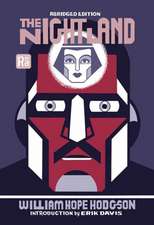 The Night Land, Abridged EditionWilliam Hope Hodgson-13%Preț: 73.00 lei84.28 lei
 -
 Atlas ShruggedAyn RandPreț: 82.13 lei
 -
 Necronomicon: The Best Weird Tales of H.P. LovecraftHP LovecraftPreț: 248.17 lei
 -
 Eldritch Tales: A Miscellany of the MacabreHP Lovecraft-24%Preț: 123.90 lei162.53 lei
 -
 VinelandThomas PynchonPreț: 65.81 lei
 -
 The Essential Tales of H.P. LovecraftH. P. Lovecraft-15%Preț: 94.32 lei111.20 lei
 -
 The Classic Horror CollectionH. P. LovecraftPreț: 130.74 lei
 -
 At the Mountains of Madness and Other StoriesH. P. LovecraftPreț: 54.47 lei
 -
 The Poems of H. P. LovecraftH. P. LovecraftPreț: 56.75 lei
 -
 World Classics Library: H. G. WellsH. G. WellsPreț: 154.72 lei
 -
 -27%Preț: 250.63 lei345.53 lei
 -
 The King in Yellow & Other Tales of the SupernaturalRobert Chambers W.-28%Preț: 91.59 lei126.73 lei
 -
 The Colour Out of SpaceH. P. LovecraftPreț: 47.70 lei
 -
 The House on the BorderlandWilliam Hope HodgsonPreț: 40.07 lei
 -
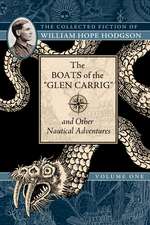 Preț: 175.37 lei
 -
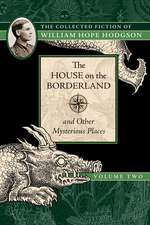 Preț: 126.17 lei
 -
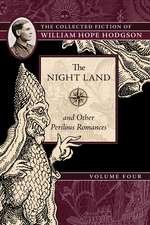 The Night Land and Other Perilous RomancesWilliam Hope HodgsonPreț: 125.09 lei
 -
 Syntactic StructuresNoam ChomskyPreț: 100.08 lei
 -
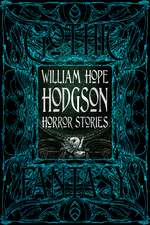 William Hope Hodgson Horror StoriesWilliam Hope Hodgson-28%Preț: 107.38 lei149.02 lei
 -
 The Haunter of the DarkH. P. LovecraftPreț: 33.81 lei
 -
 The Fantastic Tales of Fitz-James O'Brien: Fully Annotated EditionFitz-James O'BrienPreț: 64.87 lei
 -
 The Time MachineH. G. WellsPreț: 33.23 lei
Notă biografică
Descriere
The Night Land (1912) is a terrifying tale of romance and fantasy in which William Hope Hodgson imagines humanity at the end of the world. Noted for its creative exploration of concepts such as telepathy, futuristic technologies, and reincarnation, Hodgson's novel is an indisputable classic of literary science fiction. When a widower dreams of Earth in a far-off future, what he sees is nearly unrecognizable. The sun has been extinguished, and all human life has been forced to gather within the Last Redoubt, a metal pyramid looming miles above the darkened planet. Outside, monstrous forces gather, waiting for the mysterious energy source powering humanity's last refuge to die out. When the narrator unexpectedly connects with a young woman telepathically, he makes the horrifying choice to leave the safety of the pyramid in order to search for her at the rumored Lesser Redoubt, long thought lost to the dark. The Night Land journeys to the outer reaches of space and time to see how far humanity will go to keep love, and itself, alive. Complex and kaleidoscopic, William Hope Hodgson's The Night Land is a classic story of romance and loss projected into a harsh, unpredictable future. It is often considered a seminal work in the Dying Earth or apocalyptic subgenre of science fiction and fantasy. For its strange blend of futuristic imagery and archaic narration, the book was initially deemed difficult to read. However, as time has passed, and with the help of positive reviews by such figures as H.P. Lovecraft, The Night Land is now appreciated for the depths of its vision and the experimental nature of its form. For modern readers, who face the daily reality of a deadly pandemic and a future threatened by global climate disaster, Hodgson's work can only prove timely. For fans of classic science fiction, horror, and fantasy, The Night Land is a guaranteed hit. With a beautifully designed cover and professionally typeset manuscript, this new edition of William Hope Hodgson's The Night Land is a classic work of science fiction reimagined for modern readers.
Recenzii
For all its flaws and idiosyncracies, The Night Land is utterly unsurpassed, unique, astounding. A mutant vision like nothing else there has ever been.—China Mieville
One of the most potent pieces of macabre imagination ever written.—H.P. Lovecraft,
[Good science fiction stories] give, like certain rare dreams, sensations we never had before, and enlarge our conception of the range of possible experience... W.H. Hodgson's The Night Land [makes the grade] in eminence from the unforgettable sombre splendour of the images it presents...— C.S. Lewis
For all its flaws and idiosyncracies, "The Night Land" is utterly unsurpassed, unique, astounding. A mutant vision like nothing else there has ever been.--China MievilleOne of the most potent pieces of macabre imagination ever written.--H.P. Lovecraft, [Good science fiction stories] give, like certain rare dreams, sensations we never had before, and enlarge our conception of the range of possible experience... W.H. Hodgson's "The Night Land" [makes the grade] in eminence from the unforgettable sombre splendour of the images it presents...-- C.S. Lewis