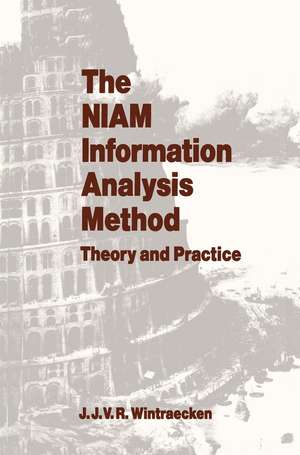
The NIAM Information Analysis Method
Autor J. J. V. R. Wintraeckenen Limba Engleză Paperback – 4 oct 2011
Preț: 332.05 lei
Preț vechi: 415.06 lei
-20%
Puncte Express: 498
Carte tipărită la comandă
Livrare economică 25 noiembrie-09 decembrie
Livrare prin curier în România Termenul estimat este afișat lângă disponibilitate.
Transport gratuit de la 400.00 lei Plată online sau ramburs, în funcție de opțiunile comenzii.
Retur gratuit în 14 zile Comandă securizată și suport în română.
Specificații
ISBN-13: 9789401066877
ISBN-10: 9401066876
Pagini: 488
Ilustrații: 484 p.
Dimensiuni: 155 x 235 x 27 mm
Greutate: 0.73 kg
Ediția:Softcover reprint of the original 1st ed. 1990
Editura: Springer
Locul publicării:Dordrecht, Netherlands
ISBN-10: 9401066876
Pagini: 488
Ilustrații: 484 p.
Dimensiuni: 155 x 235 x 27 mm
Greutate: 0.73 kg
Ediția:Softcover reprint of the original 1st ed. 1990
Editura: Springer
Locul publicării:Dordrecht, Netherlands
V-ar putea interesa
-
 -20%Preț: 308.16 lei385.20 lei
 -
 -20%Preț: 259.36 lei324.21 lei
 -
 Making Embedded SystemsElecia White-38%Preț: 200.48 lei324.68 lei
 -
 Ada for Software EngineersMordechai Ben-Ari-20%Preț: 557.53 lei696.91 lei
 -
 Java Methods for Financial EngineeringPhilip Barker-20%Preț: 603.86 lei754.82 lei
 -
 -20%Preț: 226.12 lei282.65 lei
 -
 Explore It!Elisabeth Hendrickson-20%Preț: 172.09 lei215.12 lei
 -
 Successful Test ManagementIris Pinkster-20%Preț: 355.40 lei444.26 lei
 -
 Algorithms and Architectures for Parallel ProcessingAnu G. Bourgeois-20%Preț: 324.22 lei405.27 lei
 -
 Model Driven Engineering and Ontology DevelopmentDragan Ga¿evic-20%Preț: 677.21 lei846.51 lei
 -
 Assurances for Self-Adaptive SystemsJavier Cámara-20%Preț: 337.80 lei422.24 lei
 -
 -20%Preț: 410.80 lei513.50 lei
Public țintă
ResearchCuprins
1 The NIAM Method of Information Analysis.- 1.1 Knowledge, information, and communication.- 1.2 The information system.- 1.3 The development of an information system.- 1.4 The main principles of the NIAM method of information analysis.- 1.5 Summary.- 2 An Information System Model.- 2.1 The message exchange with the environment.- 2.2 The information base.- 2.3 The grammar.- 2.4 The information processor.- 2.5 Summary.- 3 From Object System Analysis to Information Analysis.- 3.1 The organization of the library.- 3.2 The activity diagram.- 3.3 The information system within the object system.- 3.4 From object system analysis to information analysis.- 3.5 The information flow diagram.- 4 The Structure of Information.- 4.1 A more detailed definition of information.- 4.2 Elementary propositions.- 4.3 Lexical and non-lexical objects.- 4.4 Facts, ideas, and bridges.- 4.5 Non-lexical and lexical object types.- 4.6 Fact types, idea types, and bridge types.- 4.7 Facts and rules.- 4.8 Static constraints and transition constraints.- 5 Describing Information.- 5.1 The natural language principle.- 5.2 A general structural formula for elementary sentences.- 5.3 Elementary deep structure sentences.- 5.4 Elementary sentence types.- 5.5 Sentences of the same type with different predicates.- 5.6 Population tables.- 5.7 A general structural formula for elementary sentence types.- 5.8 A graphical representation for elementary deep structure sentences.- 5.9 A graphical representation for elementary sentence types.- 5.10 Describing the grammar of an information system.- 5.11 The information structure diagram.- 5.12 References to roles and role populations.- 5.13 References to subsets and combinations of role populations.- 5.14 Graphical and non-graphical constraints.- 5.15 The operation of an information system.- 6 The NIAM Method of Information Analysis in Practice — 1.- 6.1 The catalog card.- 6.2 The first addition to the catalog card.- 6.3 Summary.- 7. Graphical Constraints Involving one Fact Type.- 7.1 Uniqueness constraints.- 7.2 Some examples of uniqueness constraints.- 7.3 Uniqueness constraints involving bridge types.- 7.4 Totality constraints.- 7.5 Totality constraints involving bridge types.- 7.6 Referenceability.- 7.7 An abridged notation for bridge types.- 8 The NIAM Method of Information Analysis in Practice — 2.- 9 Graphical Constraints Involving Multiple Fact Types.- 9.1 Equality constraints.- 9.2 Subset constraints.- 9.3 Exclusion constraints.- 9.4 Implied equality and subset constraints.- 10 Graphical Constraints Involving Combinations of Roles.- 10.1 Subset constraints involving combinations of roles.- 10.2 Exclusion constraints involving combinations of roles.- 10.3 Uniqueness constraints involving roles of different fact types.- 10.4 Totality constraints involving combinations of roles.- 10.5 Referenceability.- 10.6 Idea types involving one object type.- 11 The NIAM Method of Information Analysis in Practice — 3.- 11.1 The classification system.- 11.2 Primary and secondary categories.- 11.3 Translations.- 11.4 The loan card.- 11.5 Historical information.- 11.6 Summary.- 12 Fact Types Consisting of More Than Two Roles.- 12.1 Unique combinations of roles in ternary sentence types.- 12.2 Implied uniqueness constraints.- 12.3 Unique roles in ternary sentence types.- 12.4 The n-1 rule.- 12.5 Replacing non-binary fact types by binary fact types.- 13 The NIAM Method of Information Analysis in Practice — 4.- 13.1 The reservation card.- 13.2 The day number sequence 305 13.3 Summary.- 14 Fact Types Consisting of one Role.- 14.1 Unarysentence types and unary fact types.- 14.2 Subtypes.- 14.3 Constraints with respect to subtypes.- 14.4 Object type families.- 14.5 Introducing subtypes into an information structure diagram.- 15 The NIAM Method of Information Analysis in Practice — 5.- 16 Non-Graphical Constraints.- 16.1 Value constraints.- 16.2 Cardinality constraints.- 16.3 Subtype defining constraints.- 16.4 Other non-graphical constraints.- 16.5 Non-graphical descriptions of graphical constraints.- 16.6 Derivable fact types.- 16.7 Transition constraints.- 16.8 Summary.- 17 The NIAM Method of Information Analysis in Practice — 6.- Appendix 1: The data model.- Appendix 2: Definitions, symbols, principles, rules and analysis steps.- References and Bibliography.