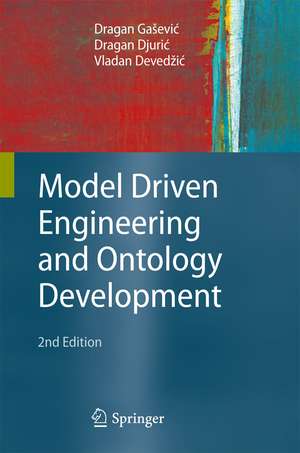
Model Driven Engineering and Ontology Development
Autor Dragan Ga¿evic, Dragan Djurić, Vladan Deved¿icen Limba Engleză Hardback – 18 mai 2009
Descoperim aici un ecosistem complex care armonizează două lumi adesea divergente: ingineria software bazată pe modele și tehnologiile Web-ului Semantic. Volumul se concentrează pe utilizarea unor instrumente și standarde riguroase precum XML, RDF, OWL și UML, oferind o punte tehnică între conceptele de inteligență artificială (logici de descriere) și practicile de dezvoltare mainstream. Observăm un accent deosebit pe interoperabilitate, facilitată prin utilizarea Metamodelului de Definire a Ontologiilor (ODM) propus de OMG, esențial pentru orice arhitectură software care depășește simpla manipulare de date. Structura este organizată progresiv pentru a asigura o tranziție lină de la teorie la execuție. Prima parte fundamentează reprezentarea cunoștințelor și Web-ul Semantic, a doua parte explorează infrastructura MDA (Model Driven Architecture) și profilurile UML pentru ontologii, în timp ce partea finală se axează pe aplicații practice și platforme specifice, cum este AIR. Pe linia practică a lucrării Ontology-Driven Software Development, dar cu focus pe rigoarea metamodelării și a transformărilor de model (ATL), autorii demonstrează cum ontologiile pot deveni artefacte software reutilizabile, nu doar concepte academice. Această a doua ediție extinde orizontul explorat anterior de Dragan Ga¿evic în Software Language Engineering, trecând de la conferințele de specialitate la un ghid comprehensiv de implementare. Apreciem în mod deosebit includerea exemplelor de mapare între limbaje bazate pe MDA și ontologii, precum și actualizarea capitolului dedicat OCL (Object Constraint Language), elemente vitale pentru inginerii care caută precizie în definirea domeniilor complexe.
Preț: 677.21 lei
Preț vechi: 846.51 lei
-20%
Carte tipărită la comandă
Livrare economică 30 noiembrie-14 decembrie
Specificații
ISBN-10: 3642002811
Pagini: 400
Ilustrații: XXI, 378 p. 183 illus.
Dimensiuni: 160 x 241 x 26 mm
Greutate: 0.71 kg
Ediția:2nd edition 2009
Editura: Springer
Locul publicării:Berlin, Heidelberg, Germany
V-ar putea interesa
-
 Applying UML and PatternsCraig Larman-15%Preț: 605.79 lei712.70 lei
 -
 Domain-Driven DesignEric J. Evans-20%Preț: 423.02 lei528.78 lei
 -
 Patterns of Enterprise Application ArchitectureMartin Fowler-20%Preț: 396.95 lei496.18 lei
 -
 SysML DistilledLenny DelligattiPreț: 323.34 lei
 -
 Programming Language PragmaticsMichael Scott-40%Preț: 488.02 lei808.04 lei
 -
 -20%Preț: 991.31 lei1239.14 lei
 -
 -20%Preț: 647.69 lei809.60 lei
 -
 Pro/Engineer Wildfire 4.0 EssentialsInc Kogent-20%Preț: 580.51 lei725.63 lei
 -
 -20%Preț: 627.14 lei783.93 lei
 -
 Coding For Dummies, All New EditionPaul McFedries-20%Preț: 116.94 lei146.18 lei
 -
 -18%Preț: 958.57 lei1169.00 lei
 -
 Handbook of Metadata, Semantics and OntologiesSaurabh Pal-18%Preț: 1041.55 lei1270.18 lei
 -
 Model-Driven Software Development with UML and JavaKevin (King's College Lano-35%Preț: 585.21 lei897.39 lei
 -
 -18%Preț: 943.53 lei1150.65 lei
 -
 Feature Models: AI-Driven Design, Analysis and ApplicationsAlexander Felfernig-20%Preț: 175.41 lei219.27 lei
 -
 Ontology EngineeringElisa F. KendallPreț: 448.88 lei
 -
 Engineering Information Systems with Large Language ModelsFrancesca de Luzi-24%Preț: 1002.12 lei1318.58 lei
 -
 -20%Preț: 733.68 lei917.09 lei
 -
 -20%Preț: 324.19 lei405.23 lei
 -
 -20%Preț: 333.68 lei417.09 lei
 -
 Building Model-based Enterprise ArchitectureMudar Bahri-20%Preț: 241.80 lei302.25 lei
Public țintă
ResearchDe ce să citești această carte
Recomandăm această lucrare cercetătorilor și arhitecților software care doresc să depășească bariera dintre programarea orientată pe obiecte și ingineria cunoștințelor. Cititorul câștigă o înțelegere profundă a modului în care ODM și ATL pot automatiza dezvoltarea ontologiilor, transformând Web-ul Semantic dintr-o promisiune teoretică într-o componentă funcțională a ciclului de viață software.
Despre autor
Dragan Ga¿evic, Dragan Djurić și Vladan Deved¿ic sunt experți recunoscuți în intersecția dintre ingineria software și tehnologiile semantice. Dragan Gaševic este o figură proeminentă în comunitatea de cercetare, fiind implicat în evenimente de prestigiu precum conferința Software Language Engineering. Expertiza lor colectivă acoperă modelarea sistemelor, limbajele de metamodelare și infrastructurile MDA, contribuind semnificativ la standardizarea modului în care ontologiile sunt integrate în procesele de dezvoltare industrială prin intermediul publicațiilor apărute la edituri de renume precum Springer.
Descriere scurtă
Gaševic and his co-authors try to fill this gap by detailing how to use model-driven engineering for ontology development on the Semantic Web. Part I of their book describes existing technologies, tools, and standards like XML, RDF, OWL, MDA, and UML. Part II presents the first detailed description of OMG's new ODM (Ontology Definition Metamodel) initiative, a specification which is expected to be in the form of an OMG language like UML. Finally, Part III is dedicated to applications and practical aspects of developing ontologies using MDA-based languages.
For this second edition, the descriptions of the related standards (like MOF, ODM, OCL, and OWL) have been revised and updated; new chapters introducing the basic principles of model-driven engineering, recent research results on metamodeling Semantic Web rule languages, an introduction to the Atlas Transformation Language (ATL) and its tool support, and, last but not least, many new examples have been added.
Cuprins
Recenzii
"The central theme of this book is the definition and application of ontologies for developing software systems. … The presentation style is clear and accessible … . This book provides adequate guidelines for enjoying the semantic Web’s benefits, and warns of the potential dangers of its misuse. It is well written, innovative, and definitely recommended as a book to return to from time to time, to gather some fresh ideas and continue working on their implementation." (M. Ivanovi, Computing Reviews, January, 2007)
“The book is equally suited to those who merely want to be informed of the relevant technological landscape, to practitioners dealing with concrete problems, and to researchers seeking pointers to potentially fruitful areas of research. The writing is technical yet clear and accessible, illustrated throughout with useful and easily digestible examples.” (from the Foreword by Bran Selic, IBM Rational Software, Canada)
“I do notknow another book that offers such a high quality insight into UML and ontologies“ (Steffen Staab, U Koblenz, Germany)
“The authors offer not only high level conceptual presentations, but also implementation-level coverage of the presented technologies, and even hands-on guidance to their practical application.“ (Jean Bézivin, U Nantes, France)
Notă biografică
Dragan Djuric is an assistant professor of computer science at the Department of Software Engineering, FON - School of Business Administration, University of Belgrade, Serbia. He is also a memeber of the GOOD OLD AI research group. His main research interests include software engineering, web engineering, intelligent systems, knowledge representation, ontologies and the Semantic Web. Vladan Devedzic is a professor of computer science at the Department of Software Engineering, FON - School of Business Administration, University of Belgrade, Serbia. He is also the head of the GOOD OLD AI research group. His main research interests include software engineering, intelligent systems, knowledge representation, ontologies, Semantic Web, intelligent reasoning, and applications of artificial intelligence techniques to education and healthcare.