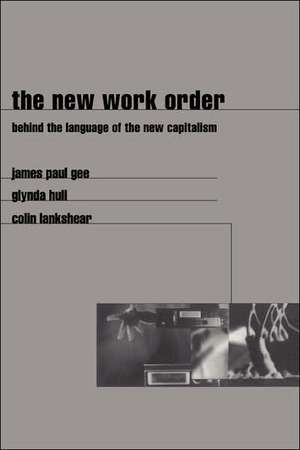
The New Work Order
Autor James Gee, Glynda Hull, Colin Lankshearen Limba Engleză Paperback – 15 oct 1996
Preț: 450.95 lei
Puncte Express: 676
Carte tipărită la comandă
Livrare economică 07-21 decembrie
Livrare prin curier în România Termenul estimat este afișat lângă disponibilitate.
Transport gratuit pentru acest produs Plată online sau ramburs, în funcție de opțiunile comenzii.
Retur gratuit în 14 zile Comandă securizată și suport în română.
Specificații
ISBN-13: 9780813332611
ISBN-10: 0813332613
Pagini: 200
Dimensiuni: 152 x 229 x 15 mm
Greutate: 0.45 kg
Ediția:1
Editura: Taylor & Francis
Colecția Routledge
Locul publicării:Oxford, United Kingdom
ISBN-10: 0813332613
Pagini: 200
Dimensiuni: 152 x 229 x 15 mm
Greutate: 0.45 kg
Ediția:1
Editura: Taylor & Francis
Colecția Routledge
Locul publicării:Oxford, United Kingdom
V-ar putea interesa
-
 State by State: A Panoramic Portrait of AmericaMatt WeilandPreț: 109.53 lei
 -
 A Handbook for Teacher ResearchColin Lankshear-27%Preț: 188.20 lei256.84 lei
 -
 New Literacies: Everyday Practices and Social LearningColin Lankshear-26%Preț: 201.65 lei271.23 lei
 -
 The Technological SocietyJacques EllulPreț: 91.11 lei
 -
 Preț: 401.04 lei
 -
 The Moral AnimalRobert WrightPreț: 120.24 lei
 -
 Muslim Youth: Tensions And Transitions In TajikistanColette HarrisPreț: 405.33 lei
 -
 Regulating Sex/WorkScoularPreț: 278.24 lei
 -
 European societiesSteffen MauPreț: 304.77 lei
 -
 Preț: 306.28 lei
Cuprins
Preface -- Sociocultural literacy, discourses, and the new work order -- Fast capitalism: theory and practice -- Alignments: education and the new capitalism -- A tale of one factory: training for teams -- A tale of one factory: teams at work -- A tale of one village: global capitalism and Nicaragua -- What is to be done?
Notă biografică
James Paul Gee is professor of education at Clark University; Glynda Hull is professor of language and literacy education at the University of California at Berkeley; and Colin Lankshear is professor in the School of Language and Literacy Education at Queensland University of Technology. James Paul Gee is professor of education at Clark University; Glynda Hull is professor of language and literacy education at the University of California at Berkeley; and Colin Lankshear is professor in the School of Language and Literacy Education at Queensland University of Technology. James Paul Gee is professor of education at Clark University; Glynda Hull is professor of language and literacy education at the University of California at Berkeley; and Colin Lankshear is professor in the School of Language and Literacy Education at Queensland University of Technology.
Descriere
This book presents a sociocultural approach to language, literacy, and learning that deals directly with the new work order and that integrates concern for schools with concern for workplaces. It helps readers to confront complex problems and to construct their own broader theories.