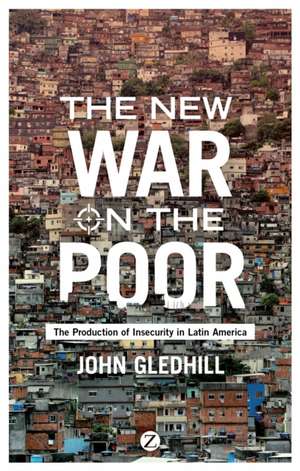
The New War on the Poor: The Production of Insecurity in Latin America
Autor John Gledhillen Limba Engleză Paperback – 15 iul 2015
The New War on the Poor links the experiences of labour migrants crossing Latin America's international borders, indigenous Mexicans defending their territories against capitalist mega-projects, drug wars and paramilitary violence, Afro-Brazilians living on the urban periphery of Salvador, and farmers and business people tired of paying protection to criminal mafias. John Gledhill looks at how and why governments are failing to provide security to disadvantaged citizens while all too often painting them as a menace to the rest of society simply for being poor.
Preț: 158.43 lei
Preț vechi: 200.85 lei
-21%
Puncte Express: 238
Carte disponibilă
Livrare economică 18 mai-01 iunie
Specificații
ISBN-13: 9781783603022
ISBN-10: 178360302X
Pagini: 240
Dimensiuni: 136 x 216 x 14 mm
Greutate: 0.34 kg
Editura: Bloomsbury Publishing
Colecția Zed Books
Locul publicării:London, United Kingdom
ISBN-10: 178360302X
Pagini: 240
Dimensiuni: 136 x 216 x 14 mm
Greutate: 0.34 kg
Editura: Bloomsbury Publishing
Colecția Zed Books
Locul publicării:London, United Kingdom
V-ar putea interesa
-
 -14%Preț: 843.08 lei980.32 lei
 -
 Preț: 352.87 lei
 -
 Fighting Poverty TogetherA. Karnani-8%Preț: 437.45 lei475.49 lei
 -
 Democracy Without DecencyWilliam M. EpsteinPreț: 239.17 lei
 -
 Demanding the LandPaul DoshPreț: 275.77 lei
 -
 -15%Preț: 447.76 lei526.78 lei
 -
 Preț: 263.05 lei
 -
 Collateral DamageZygmunt BaumanPreț: 125.80 lei
 -
 -30%Preț: 916.57 lei1315.62 lei
 -
 Slumming It: The Tourist Valorization of Urban PovertyFabian Frenzel-16%Preț: 139.46 lei165.27 lei
 -
 Making Poverty: A HistoryThomas Lines-13%Preț: 161.88 lei186.26 lei
 -
 -24%Preț: 245.87 lei325.00 lei
 -
 -23%Preț: 681.58 lei885.18 lei
 -
 From Poverty to PowerDuncan GreenPreț: 250.07 lei
Cuprins
1. Securitization, the state and capitalism
2. Violence, urban development and the privatization of public power in Brazil
3. Pacifying the urban periphery: a case study of the Bahian UPP
4. State transformations, illegal economies and counter-insurgency in Mexico
5. Paramilitaries, autodefensas and the pacification of Michoacán
6. Achieving human security: the contradictions of repressive intervention
2. Violence, urban development and the privatization of public power in Brazil
3. Pacifying the urban periphery: a case study of the Bahian UPP
4. State transformations, illegal economies and counter-insurgency in Mexico
5. Paramilitaries, autodefensas and the pacification of Michoacán
6. Achieving human security: the contradictions of repressive intervention
Recenzii
Highly recommended ... the book challenges conventional thinking about how modernizing societies can work toward more inclusive and democratic societies. It belongs in all libraries with extensive Latin American holdings.
Gledhill shows that behind the discourses of "war" against drug traffickers hides a war against the poor. He brilliantly articulates two new ethnographies of Mexico and Brazil, providing insight into the trans-nationalization of criminal networks in the Americas.
Drawing on decades of field research in Mexico and Brazil, Gledhill pries apart recent processes of "securitization" from the ostensibly similar notion of human security. Equal parts searing critique and sensible call to action, this book speaks truth to powerful actors.
Sweeping and compelling, John Gledhill takes us inside the wars that states wage on inconvenient populations. The result is a powerful critique of contemporary global capitalism.
A powerful analysis that uncovers the relationship between securitization, neoliberal views of development, and repressive intervention. The book will interest - and inspire - a wide readership concerned with suffering and inequality.
Drawing on his own extensive fieldwork, and with a passionate sense of justice, Gledhill shows how contemporary news stories on Latin America - violent drug trafficking, dramatic electoral battles, and the excitement of emerging markets - are best viewed as scenes in a broader canvas of predation, which in recent years has rendered a bitter irony: that security policy is tending to undermine the security of many Latin Americans, and especially the most vulnerable.
Displaying his hallmark combination of deep ethnography and expansive theory, Gledhill compellingly lays out how the contradictions of neoliberal capital accumulation and securitization affect the livelihoods and politics of ordinary people in violence-ridden Brazil and Mexico, and, above all, how these people struggle to build spaces of popular sovereignty and dignity.
Gledhill shows that behind the discourses of "war" against drug traffickers hides a war against the poor. He brilliantly articulates two new ethnographies of Mexico and Brazil, providing insight into the trans-nationalization of criminal networks in the Americas.
Drawing on decades of field research in Mexico and Brazil, Gledhill pries apart recent processes of "securitization" from the ostensibly similar notion of human security. Equal parts searing critique and sensible call to action, this book speaks truth to powerful actors.
Sweeping and compelling, John Gledhill takes us inside the wars that states wage on inconvenient populations. The result is a powerful critique of contemporary global capitalism.
A powerful analysis that uncovers the relationship between securitization, neoliberal views of development, and repressive intervention. The book will interest - and inspire - a wide readership concerned with suffering and inequality.
Drawing on his own extensive fieldwork, and with a passionate sense of justice, Gledhill shows how contemporary news stories on Latin America - violent drug trafficking, dramatic electoral battles, and the excitement of emerging markets - are best viewed as scenes in a broader canvas of predation, which in recent years has rendered a bitter irony: that security policy is tending to undermine the security of many Latin Americans, and especially the most vulnerable.
Displaying his hallmark combination of deep ethnography and expansive theory, Gledhill compellingly lays out how the contradictions of neoliberal capital accumulation and securitization affect the livelihoods and politics of ordinary people in violence-ridden Brazil and Mexico, and, above all, how these people struggle to build spaces of popular sovereignty and dignity.