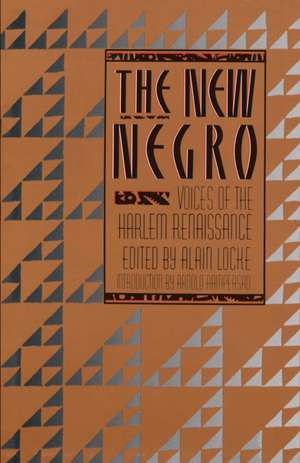
The New Negro
Autor Alain Lockeen Limba Engleză Paperback – mar 1999
With stunning works by seminal black voices such as Zora Neale Hurston, Countee Cullen, and W.E.B. DuBois, Locke has constructed a vivid look at the new negro, the changing African American finding his place in the ever shifting sociocultural landscape that was 1920s America. With poetry, prose, and nonfiction essays, this collection is widely praised for its literary strength as well as its historical coverage of a monumental and fascinating time in the history of America.
| Toate formatele și edițiile | Preț | Express |
|---|---|---|
| Paperback (3) | 52.77 lei 22-27 zile | +27.51 lei 6-12 zile |
| OUP OXFORD – 13 noi 2025 | 52.77 lei 22-27 zile | +27.51 lei 6-12 zile |
| Scribner – mar 1999 | 128.21 lei 3-5 săpt. | |
| Mint Editions – mar 2021 | 94.68 lei 6-8 săpt. | |
| Hardback (1) | 145.79 lei 3-5 săpt. | |
| Mint Editions – 24 mar 2021 | 145.79 lei 3-5 săpt. |
Preț: 128.21 lei
Nou
Puncte Express: 192
Preț estimativ în valută:
22.69€ • 26.60$ • 19.92£
22.69€ • 26.60$ • 19.92£
Carte disponibilă
Livrare economică 22 ianuarie-05 februarie
Preluare comenzi: 021 569.72.76
Specificații
ISBN-13: 9780684838311
ISBN-10: 0684838311
Pagini: 452
Dimensiuni: 141 x 209 x 35 mm
Greutate: 0.43 kg
Ediția:Touchstone.
Editura: Scribner
ISBN-10: 0684838311
Pagini: 452
Dimensiuni: 141 x 209 x 35 mm
Greutate: 0.43 kg
Ediția:Touchstone.
Editura: Scribner
V-ar putea interesa
-
 Harlem RenaissanceNathan Irvin HugginsPreț: 130.13 lei
 -
 Preț: 139.03 lei
 -
 The Life of Langston Hughes: Volume II: 1914-1967, I Dream a WorldArnold RampersadPreț: 140.66 lei
 -
 The Souls of Black Folk (The Oxford W. E. B. Du Bois)Henry Louis Gates-27%Preț: 142.90 lei195.59 lei
 -
 Days of GraceArthur AshePreț: 54.27 lei
 -
 Jackie Robinson: A BiographyArnold RampersadPreț: 139.54 lei
 -
 Ralph Ellison: A BiographyArnold RampersadPreț: 128.22 lei
 -
 Langston Hughes: The Man, His Art, and His Continuing InfluenceC. James Trotman-18%Preț: 1011.94 lei1234.08 lei
 -
 Tropic DeathEric WalrondPreț: 119.66 lei
 -
 But Enough about You: EssaysChristopher BuckleyPreț: 107.00 lei
 -
 Cigar JournalSpeedy Publishing LlcPreț: 79.60 lei
 -
 Life JournalSpeedy Publishing LLCPreț: 79.03 lei
 -
 Lock JournalSpeedy Publishing LLCPreț: 79.03 lei
 -
 Love JournalSpeedy Publishing LLCPreț: 79.03 lei
 -
 Pocket JournalSpeedy Publishing LLCPreț: 67.33 lei
 -
 Secret JournalSpeedy Publishing LLCPreț: 79.03 lei
 -
 Jackmans Cliff: Tales to Take You Beyond the BrinkCliff JackmanPreț: 242.31 lei
Descriere
Descriere de la o altă ediție sau format:
'We have to-morrowBright before usLike a flame'The New Negro: An Interpretation is a multidisciplinary anthology of poetry, fiction, essays, criticism, art, and philosophy woven together into a seamless statement of Black agency in the arts and humanities that became, upon its publication in 1925, an instant publishing success. Edited by Alain Locke, a man known as the father of the Harlem Renaissance, the text is a powerful, provocative, and affecting anthology of writers who shaped the Harlem Renaissance movement and who help us to consider the evolution of the African American in society. With works by Black voices such as Zora Neale Hurston, Countee Cullen, and W. E. B. DuBois, Locke constructed a vivid look at the changing African American, finding their place in the ever shifting sociocultural landscape that was 1920s America. With an introduction from Jeffrey C. Stewart, leading biographer of Locke, this collection explores the literary strength as well as the historical context of a monumental and fascinating time in the history of America.
'We have to-morrowBright before usLike a flame'The New Negro: An Interpretation is a multidisciplinary anthology of poetry, fiction, essays, criticism, art, and philosophy woven together into a seamless statement of Black agency in the arts and humanities that became, upon its publication in 1925, an instant publishing success. Edited by Alain Locke, a man known as the father of the Harlem Renaissance, the text is a powerful, provocative, and affecting anthology of writers who shaped the Harlem Renaissance movement and who help us to consider the evolution of the African American in society. With works by Black voices such as Zora Neale Hurston, Countee Cullen, and W. E. B. DuBois, Locke constructed a vivid look at the changing African American, finding their place in the ever shifting sociocultural landscape that was 1920s America. With an introduction from Jeffrey C. Stewart, leading biographer of Locke, this collection explores the literary strength as well as the historical context of a monumental and fascinating time in the history of America.
Notă biografică
Alain Locke (1885-1954) was an African American philosopher, scholar, educator, and patron of the arts. Born in Philadelphia, Locke was raised the only child of Pliny Ishmael and Mary Locke. His father was the first black employee of the United States Postal Service, and his mother was a teacher. He excelled at Central High School before enrolling at Harvard University in 1907, where he was made a member of the Phi Beta Kappa Society, was awarded the Bowdoin prize, and became the first African American recipient of the prestigious Rhodes Scholarship. He attended Hertford College at Oxford, overcoming several rejections from other schools attached to the university to study literature, philosophy, Greek, and Latin. After four years as an assistant professor at Howard University, Locke returned to Harvard to complete his doctoral dissertation on the nature of social values. Back at Howard, he worked as the chair of the philosophy department and advocated for equal pay for black and white faculty, which ultimately led to his dismissal in 1925. That same year, he expanded an issue of Survey Graphic, a sociopolitical magazine, into The New Negro, a groundbreaking anthology of writing from Countee Cullen, Langston Hughes, Zora Neale Hurston, Jean Toomer, and himself. The New Negro would become a foundational text of the Harlem Renaissance, establishing Locke¿s reputation as a leading voice on African American arts and culture and a figurehead of the movement. He regained his position at Howard University in 1928, teaching generations of philosophy students until his retirement in 1953. Due to his race and homosexuality, Locke has been long overlooked by scholars and the public at large.