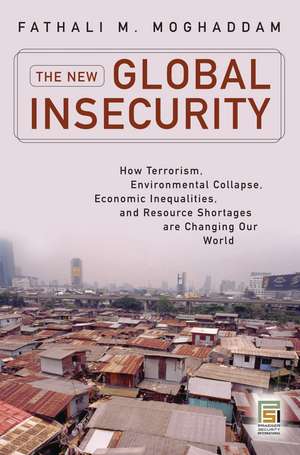
The New Global Insecurity: How Terrorism, Environmental Collapse, Economic Inequalities, and Resource Shortages Are Changing Our World
Autor Fathali M. Moghaddamen Limba Engleză Hardback – 21 ian 2010 – vârsta până la 17 ani
Preț: 522.13 lei
Puncte Express: 783
Carte tipărită la comandă
Livrare economică 01-15 decembrie
Livrare prin curier în România Termenul estimat este afișat lângă disponibilitate.
Transport gratuit pentru acest produs Plată online sau ramburs, în funcție de opțiunile comenzii.
Retur gratuit în 14 zile Comandă securizată și suport în română.
Specificații
ISBN-13: 9780313365072
ISBN-10: 0313365075
Pagini: 212
Ilustrații: 3
Dimensiuni: 156 x 235 x 23 mm
Greutate: 0.5 kg
Editura: Bloomsbury Publishing
Colecția Praeger
Locul publicării:New York, United States
ISBN-10: 0313365075
Pagini: 212
Ilustrații: 3
Dimensiuni: 156 x 235 x 23 mm
Greutate: 0.5 kg
Editura: Bloomsbury Publishing
Colecția Praeger
Locul publicării:New York, United States
V-ar putea interesa
-
 The Looming TowerLawrence Wright-26%Preț: 101.85 lei137.57 lei
 -
 -31%Preț: 791.40 lei1147.83 lei
 -
 -11%Preț: 379.61 lei425.44 lei
 -
 -31%Preț: 827.04 lei1196.61 lei
 -
 Two Nations Indivisible: Mexico, the United States, and the Road AheadShannon K. O'NeilPreț: 206.96 lei
 -
 Preț: 212.31 lei
 -
 Pirates and Emperors, Old and NewNoam ChomskyPreț: 135.92 lei
 -
 Dirty WarsSimon RobbinsPreț: 188.61 lei
 -
 Asia's CauldronRobert D KaplanPreț: 121.50 lei
 -
 Psychology for the Third MillenniumRom Harré-18%Preț: 755.24 lei921.03 lei
 -
 The Global TransformationGeorge LawsonPreț: 253.55 lei
 -
 LondonistanMelanie Phillips-36%Preț: 79.20 lei124.46 lei
 -
 War with No EndPhyllis BennisPreț: 111.49 lei
 -
 Inside the Global JihadOmar Nasiri-16%Preț: 128.44 lei153.37 lei
 -
 Great Ideas in Psychology: A Cultural and Historical IntroductionFathali Moghaddam-12%Preț: 214.96 lei243.07 lei
 -
 Morocco's War on TerrorismMostafa El Rezrazi-11%Preț: 94.28 lei105.44 lei
 -
 Talking to TerroristsAnne SpeckhardPreț: 239.09 lei
Notă biografică
Fathali M. Moghaddam is an Iranian-born, British-educated psychologist who worked for the United Nations and McGill University before joining Georgetown University, where he is now director of the Conflict Studies Program.
Descriere
Descriere de la o altă ediție sau format:
A noted conflict expert shows how accelerating globalization is causing dangerous global insecurity that must be met by new security models and policies.
The New Global Insecurity: How Terrorism, Environmental Collapse, Economic Inequalities, and Resource Shortages Are Changing Our World explores insecurity arising out of accelerating globalization. In this unique and forward-thinking work, psychologist Fathali M. Moghaddam, director of the Conflict Studies Program at Georgetown University, explains how and why worldwide insecurity is rising and what steps we must take to quell or reverse that insecurity to make the future of the world more peaceful.
The book first analyzes the elements and roots of global insecurity, discussing it in relation to terrorism, torture, economic instability, threatened identity, and religious fundamentalism. It then puts forward a new model for understanding security, wherein "soft security capital" serves as the enabling condition for "hard security capital." Finally, the current policies for managing diversity, "multiculturalism" and "assimilation" are both rejected in favor of an exciting new policy-"omniculturalism". Drawing on his years of study and expertise, Moghaddam likewise proposes a new policy for better managing intergroup relations in an insecure age.
A noted conflict expert shows how accelerating globalization is causing dangerous global insecurity that must be met by new security models and policies.
The New Global Insecurity: How Terrorism, Environmental Collapse, Economic Inequalities, and Resource Shortages Are Changing Our World explores insecurity arising out of accelerating globalization. In this unique and forward-thinking work, psychologist Fathali M. Moghaddam, director of the Conflict Studies Program at Georgetown University, explains how and why worldwide insecurity is rising and what steps we must take to quell or reverse that insecurity to make the future of the world more peaceful.
The book first analyzes the elements and roots of global insecurity, discussing it in relation to terrorism, torture, economic instability, threatened identity, and religious fundamentalism. It then puts forward a new model for understanding security, wherein "soft security capital" serves as the enabling condition for "hard security capital." Finally, the current policies for managing diversity, "multiculturalism" and "assimilation" are both rejected in favor of an exciting new policy-"omniculturalism". Drawing on his years of study and expertise, Moghaddam likewise proposes a new policy for better managing intergroup relations in an insecure age.