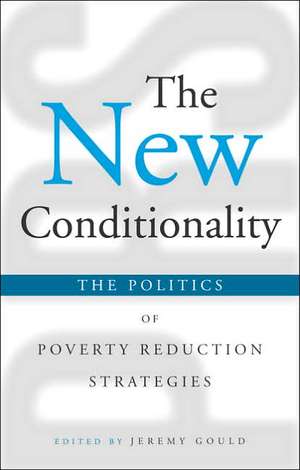
The New Conditionality: The Politics of Poverty Reduction Strategies
Editat de Jeremy Goulden Limba Engleză Paperback – 20 sep 2005
PRSs, as with the Structural Adjustment policies that they have ostensibly replaced, run up against a central paradox: in vesting decisive policymaking powers in external agencies, the very process of drawing up development strategies to prioritize reducing poverty can undermine the consolidation of democratic forces, structures and ideas in developing countries. While the nuanced conclusions of these field studies show that the political terrain and the specific impacts of PRSs in different countries are highly variegated, serious questions arise about the long-term political consequences of this new generation of contemporary development practices.
Preț: 258.61 lei
Preț vechi: 307.95 lei
-16%
Puncte Express: 388
Carte tipărită la comandă
Livrare economică 23 noiembrie-07 decembrie
Livrare prin curier în România Termenul estimat este afișat lângă disponibilitate.
Transport gratuit de la 400.00 lei Plată online sau ramburs, în funcție de opțiunile comenzii.
Retur gratuit în 14 zile Comandă securizată și suport în română.
Specificații
ISBN-13: 9781842775233
ISBN-10: 1842775235
Pagini: 192
Dimensiuni: 138 x 216 x 10 mm
Greutate: 0.25 kg
Editura: Bloomsbury Publishing
Colecția Zed Books
Locul publicării:London, United Kingdom
ISBN-10: 1842775235
Pagini: 192
Dimensiuni: 138 x 216 x 10 mm
Greutate: 0.25 kg
Editura: Bloomsbury Publishing
Colecția Zed Books
Locul publicării:London, United Kingdom
V-ar putea interesa
-
 Battling Corruption: Has NREGA Reached India's Rural Poor?Shylashri ShankarPreț: 341.35 lei
 -
 -13%Preț: 352.21 lei405.06 lei
 -
 -15%Preț: 465.33 lei547.45 lei
 -
 The Future of Development: A Radical ManifestoGustavo EstevaPreț: 191.76 lei
 -
 Days of Destruction, Days of RevoltChris Hedges-25%Preț: 118.97 lei158.34 lei
 -
 -27%Preț: 998.96 lei1362.05 lei
 -
 Slumming It: The Tourist Valorization of Urban PovertyFabian Frenzel-15%Preț: 145.65 lei170.78 lei
 -
 Making Poverty: A HistoryThomas Lines-12%Preț: 172.93 lei195.45 lei
 -
 -23%Preț: 260.96 lei340.37 lei
 -
 -23%Preț: 681.58 lei885.18 lei
 -
 Down and Out in Paris & LondonGeorge OrwellPreț: 50.96 lei
Cuprins
1. Poverty, Politics and States of Partnership - Jeremy Gould
2. Tanzania: Merging in the Circle - Jeremy Gould & Julia Ojanen
3. Vietnam: Dealing with Donors - Irene Nørlund, Tran Ngoc Ca and Nguyen Dinh Tuyen
4. Honduras: Transforming the Concessional State - Maaria Seppänen
5. The Politics of Consultation - Jeremy Gould
2. Tanzania: Merging in the Circle - Jeremy Gould & Julia Ojanen
3. Vietnam: Dealing with Donors - Irene Nørlund, Tran Ngoc Ca and Nguyen Dinh Tuyen
4. Honduras: Transforming the Concessional State - Maaria Seppänen
5. The Politics of Consultation - Jeremy Gould
Recenzii
A fascinating ground-level exploration of the current development mantras 'civil society participation' and 'country ownership'. The case studies pull no punches in arguing that international institutions, including some international NGOs, have entrenched their places at the policy-making table and helped marginalise independent national civil society formations and indigenous institutions. The analysis shows the dangers of a new generation of one size fits all thinking, but also the importance of national political circumstances in determining outcomes.
The arguments presented in this book are thought-provoking and, at times, extremely provocative. The forensic approach to some of the country case material makes the book an important contribution to the growing academic literature that offers a critique of the politics of post-conditionality.
This wonderful contribution...captivating...carefully written, with first-hand experience at the local level; this book is a fascinating account about the current situation of the politics of international aid. The book is a useful complementary book for undergraduate or graduate courses in development studies.
The strength of the book is its emphasis on the role of civil society in the aid relatioship, a topic infrequently studied.
The great value of this book comes from seeing aid as profoundly political, that is, the new poverty reduction consensus is not dismissed as pure rhetoric, nor endorsed as an unquestionable good, but instead analysed in terms of its actual impact and reconfiguration of domestic political arenas. Most revealingly perhaps, the book shows how partnerships can undermine democratic accountability, promoting a distinctively technocratic approach to development. For anyone seeking to understand the contemporary aid relationship, this is both crucial and exciting reading.
The arguments presented in this book are thought-provoking and, at times, extremely provocative. The forensic approach to some of the country case material makes the book an important contribution to the growing academic literature that offers a critique of the politics of post-conditionality.
This wonderful contribution...captivating...carefully written, with first-hand experience at the local level; this book is a fascinating account about the current situation of the politics of international aid. The book is a useful complementary book for undergraduate or graduate courses in development studies.
The strength of the book is its emphasis on the role of civil society in the aid relatioship, a topic infrequently studied.
The great value of this book comes from seeing aid as profoundly political, that is, the new poverty reduction consensus is not dismissed as pure rhetoric, nor endorsed as an unquestionable good, but instead analysed in terms of its actual impact and reconfiguration of domestic political arenas. Most revealingly perhaps, the book shows how partnerships can undermine democratic accountability, promoting a distinctively technocratic approach to development. For anyone seeking to understand the contemporary aid relationship, this is both crucial and exciting reading.