
The Musical-Mathematical Mind: Computational Music Science
Editat de Gabriel Pareyon, Emilio Lluis-Puebla, Octavio A. Agustín-Aquino, Silvia Pina-Romeroen Limba Engleză Paperback – 23 aug 2018
The authors include many of the leading researchers in this domain, and the book will be of value to researchers working in computational music, particularly in the areas of counterpoint, gesture, and Topos theory.
| Toate formatele și edițiile | Preț | Express |
|---|---|---|
| Paperback (1) | 616.36 lei 38-45 zile | |
| Springer International Publishing – 23 aug 2018 | 616.36 lei 38-45 zile | |
| Hardback (1) | 903.95 lei 6-8 săpt. | |
| Springer International Publishing – 30 oct 2017 | 903.95 lei 6-8 săpt. |
Din seria Computational Music Science
- 24%
 Preț: 987.94 lei
 - 18%
 Preț: 698.75 lei
 - 20%
 Preț: 573.63 lei
 - 20%
 Preț: 566.46 lei
 - 15%
 Preț: 616.95 lei
 - 20%
 Preț: 320.37 lei
 - 20%
 Preț: 322.74 lei
 - 20%
 Preț: 486.34 lei
 - 20%
 Preț: 485.54 lei
 - 20%
 Preț: 903.95 lei
 - 24%
 Preț: 861.07 lei
 - 24%
 Preț: 662.80 lei
 - 20%
 Preț: 552.89 lei
 - 20%
 Preț: 513.21 lei
 - 18%
 Preț: 698.97 lei
 - 15%
 Preț: 558.59 lei
 - 15%
 Preț: 453.14 lei
 - 20%
 Preț: 311.36 lei
Preț: 616.36 lei
Preț vechi: 770.45 lei
-20%
Puncte Express: 925
Preț estimativ în valută:
109.01€ • 125.82$ • 94.20£
109.01€ • 125.82$ • 94.20£
Carte tipărită la comandă
Livrare economică 27 aprilie-04 mai
Specificații
ISBN-13: 9783319837154
ISBN-10: 331983715X
Pagini: 376
Ilustrații: XXIX, 345 p. 144 illus., 43 illus. in color.
Dimensiuni: 155 x 235 x 21 mm
Greutate: 0.57 kg
Ediția:Softcover reprint of the original 1st edition 2017
Editura: Springer International Publishing
Seria Computational Music Science
Locul publicării:Cham, Switzerland
ISBN-10: 331983715X
Pagini: 376
Ilustrații: XXIX, 345 p. 144 illus., 43 illus. in color.
Dimensiuni: 155 x 235 x 21 mm
Greutate: 0.57 kg
Ediția:Softcover reprint of the original 1st edition 2017
Editura: Springer International Publishing
Seria Computational Music Science
Locul publicării:Cham, Switzerland
V-ar putea interesa
-
 BlueprintsMarcus Du SautoyPreț: 118.13 lei
 -
 Music's OdysseyRobin HollowayPreț: 342.09 lei
 -
 Preț: 95.17 lei
 -
 On the Sensations of ToneHerman HelmoholtzPreț: 146.38 lei
 -
 A Perfect HarmonyDavid DarlingPreț: 75.82 lei
 -
 -22%Preț: 277.84 lei355.34 lei
 -
 Preț: 116.73 lei
 -
 The Madman's OrchestraEdward Brooke-Hitching-27%Preț: 164.77 lei224.40 leiRecomandat
 -
 Music Between Your EarsSamuel MarkindPreț: 190.24 lei
 -
 Sound TracksGraeme LawsonPreț: 89.65 lei
 -
 Preț: 95.52 lei
 -
 Maths & MusicJulia Winterson-17%Preț: 174.07 lei209.99 lei
 -
 RhythmJulian GerstinPreț: 50.41 lei
 -
 Fundamentals of Music ProcessingMeinard Müller-20%Preț: 359.93 lei449.92 lei
 -
 The Mathematics of Music and ArtArturo PortnoyPreț: 311.27 lei
 -
 Resonances: Klanghaus ToggenburgErol DoguogluPreț: 334.30 lei
 -
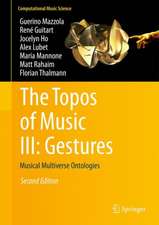 The Topos of Music III: Gestures: Musical Multiverse OntologiesGuerino Mazzola-24%Preț: 987.94 lei1299.92 lei
 -
 -20%Preț: 573.63 lei717.03 lei
 -
 Proportions and Their MusicKarlheinz SchüfflerPreț: 419.96 lei
 -
 Preț: 156.93 lei
Cuprins
Introduction.- Extended Counterpoint Symmetries and Continuous Counterpoint.- A Survey of Applications of the Discrete Fourier Transform in Music Theory.- Gestures on Locales and Localic Topoi.- A Proposal for a Music Writing for the Visually Impaired.- Group Theory for Pitch Sequence Representation.- The Mechanics of Tipping Points.- Lexicographic Orderings of Modes and Morphisms.- Music of Quantum Circles.- Algebraic Combinatorics on Modes.- Proportion, Perception, Speculation.- Models and Algorithms for Music Generated by Physiological Processes.- Music, Expectation, and Information Theory.- Gestural Dynamics in Modulation: (Towards) A Musical String Theory.- The Sense of Subdominant: A Fregean Perspective on Music-Theoretical Conceptualization.- How Learned Patterns Allow Artist-Level Improvisers to Focus on Planning and Interaction During Improvisation.- Wooden Idiophones: Classification Through Phase Synchronization Analysis.- A Fuzzy Rule Model for High-Level Musical Featureson Automated Composition Systems.- The Musical Experience Between Measurement and Computation.- Generic Additive Synthesis.- Dynamical Virtual Sounding Networks.- Melodic Pattern Segmentation of Polyphonic Music as a Set Partitioning Problem.- Diagrams, Games and Time (Towards the Analysis of Open Form Scores).- On Minimal Change Musical Morphologies.
Recenzii
“It is impossible to summarize a work of such depth. Suffice it to say that abstract algebra, topology, number theory, geometry, and so on are all involved. If you are a serious devotee of musical-mathematical theory and have a very extensive background in both areas, the book will be a treasure.” (James Van Speybroeck, Computing Reviews, April, 2018)
Textul de pe ultima copertă
This book presents a deep spectrum of musical, mathematical, physical, and philosophical perspectives that have emerged in this field at the intersection of music and mathematics. In particular the contributed chapters introduce advanced techniques and concepts from modern mathematics and physics, deriving from successes in domains such as Topos theory and physical string theory.
The authors include many of the leading researchers in this domain, and the book will be of value to researchers working in computational music, particularly in the areas of counterpoint, gesture, and Topos theory.
Caracteristici
Presents and explains important ideas in counterpoint, gesture, and Topos theory Contributors among leading researchers in this domain Valuable for researchers working in the area of computational music