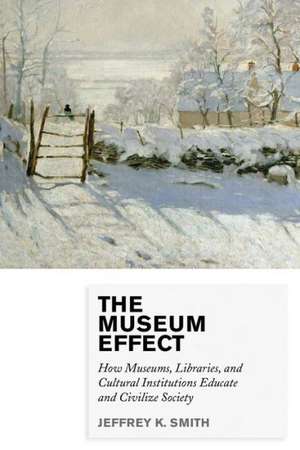
The Museum Effect: How Museums, Libraries, and Cultural Institutions Educate and Civilize Society
Autor Jeffrey K. Smithen Limba Engleză Hardback – 29 mai 2014
Cultural institutions vary dramatically in size, nature and purpose, but they all allow visitors to hold conversations with artists and authors perhaps long dead. These conversations, sometimes with others present, and sometimes with artists, scientists, explorers, or authors not present, allow visitors to explore their lives and their "possible selves." Cultural institutions inspire personal reflection, and help visitors better themselves, in that they leave having contemplated what is noble, excellent, or exemplary about the society in which they live.
The "museum effect" is a process through which cultural institutions educate and civilize us as individuals and as societies. These institutions allow visitors to spend some time with their thoughts elevated, and leave the institution better people in some meaningful fashion than when they entered. This visionary book presents the underlying idea and the argument for the museum effect, along with empirical research supporting that argument. It will help those working in museums, libraries, and archivists to facilitate this process, and study how this is working in their own institutions.
Preț: 657.71 lei
Preț vechi: 1003.77 lei
-34%
Puncte Express: 987
Carte tipărită la comandă
Livrare economică 30 noiembrie-14 decembrie
Livrare prin curier în România Termenul estimat este afișat lângă disponibilitate.
Transport gratuit pentru acest produs Plată online sau ramburs, în funcție de opțiunile comenzii.
Retur gratuit în 14 zile Comandă securizată și suport în română.
Specificații
ISBN-13: 9780759122949
ISBN-10: 0759122946
Pagini: 201
Ilustrații: black & white illustrations, black & white tables, figures
Dimensiuni: 161 x 234 x 21 mm
Greutate: 0.45 kg
Editura: Bloomsbury Publishing
Colecția Rowman & Littlefield
Locul publicării:New York, United States
ISBN-10: 0759122946
Pagini: 201
Ilustrații: black & white illustrations, black & white tables, figures
Dimensiuni: 161 x 234 x 21 mm
Greutate: 0.45 kg
Editura: Bloomsbury Publishing
Colecția Rowman & Littlefield
Locul publicării:New York, United States
Cuprins
Acknowledgments
Preface
Chapter 1 : Introduction -Who We were, Who We are, Who We Might Become
Chapter 2 The Nature of Visits to Cultural Institutions
Five museum visits
Who goes to cultural institutions and events, and why?
What do people do during their visit? What are their visiting preferences?
Time and number of works viewed
Locus of attention
The influence of art-related knowledge
Summary
Chapter 3 Time, Flow, and the Unit of Analysis
What is a museum like?
Time and museums
Experiencing flow in museums
The unit of analysis in looking at art
Setting the stage
Chapter 4 DefiningThe Museum Effect
How should we look at art versus how do we look at art?
A brief tour of model city
What (all) happens when we look at art?
Art as mirror
The model of the Museum Effect
Investigating the Museum Effect
What to make of all this?
Chapter 5 Expanding the Museum Effect to Other Cultural Institutions and Events
What is essential about the museum effect?
What is similar and different about various cultural institutions?
What is a painting like?
So, does the Museum Effect extend to other cultural institutions?
Chapter 6 How to Enhance the Museum Effect
How best to interact with visitors?
The "right way" to look at a painting
The basics: "We are in your hands!"
The options, current and future
Looking ahead
Chapter 7 Investigating the Museum Effect and Other Research in Cultural Institutions
The nature of asking questions, in particular, research questions
Models of the processes involved in research and evaluation
Examples and extensions
Extending what we know about the Museum Effect
A Final Word
Index
Preface
Chapter 1 : Introduction -Who We were, Who We are, Who We Might Become
Chapter 2 The Nature of Visits to Cultural Institutions
Five museum visits
Who goes to cultural institutions and events, and why?
What do people do during their visit? What are their visiting preferences?
Time and number of works viewed
Locus of attention
The influence of art-related knowledge
Summary
Chapter 3 Time, Flow, and the Unit of Analysis
What is a museum like?
Time and museums
Experiencing flow in museums
The unit of analysis in looking at art
Setting the stage
Chapter 4 DefiningThe Museum Effect
How should we look at art versus how do we look at art?
A brief tour of model city
What (all) happens when we look at art?
Art as mirror
The model of the Museum Effect
Investigating the Museum Effect
What to make of all this?
Chapter 5 Expanding the Museum Effect to Other Cultural Institutions and Events
What is essential about the museum effect?
What is similar and different about various cultural institutions?
What is a painting like?
So, does the Museum Effect extend to other cultural institutions?
Chapter 6 How to Enhance the Museum Effect
How best to interact with visitors?
The "right way" to look at a painting
The basics: "We are in your hands!"
The options, current and future
Looking ahead
Chapter 7 Investigating the Museum Effect and Other Research in Cultural Institutions
The nature of asking questions, in particular, research questions
Models of the processes involved in research and evaluation
Examples and extensions
Extending what we know about the Museum Effect
A Final Word
Index
Recenzii
Although entitled The Museum Effect this book is also about libraries and other cultural institutions. The book takes a reflective approach, discussing how these places affect us and the communities in which we live. . . .[The Museum Effect] provides plenty of food for thought for those in the profession wishing to reflect on the impact of their services.
Smith writes as a psychologist rather than an art historian but clearly has a deep knowledge and understanding of art which he conveys with infectious enthusiasm. This engagingly written and thought-provoking book makes some considerable claims about the effect of museums on their visitors. . . .[T]here is much to be gained from viewing this book through an archival lens. . . . .More research into the effect archives have had on users at a personal and emotional level might generate novel perceptions and provide valuable additional evidence when making the case for our services. There seems little doubt to this reviewer that the experiences and emotions that archives offer to people can be just as profound as any derived from works of art or other objects and activities.
What a wonderful book! Jeff Smith has done an amazing job of capturing the museum experience in a totally engaging way, interweaving research data with real-life anecdotes so compellingly that the book is, indeed, a page-turner. Writing fluidly and with both wit and respect, he takes us on a first-person tour through how people respond to art, what they do in museums, and how these findings can help us make museums even better. Though his research is based in art museums, he connects his findings to museums of all kinds as well as to libraries, music, and astronomy; he even includes a reference to Monty Python. It's a pleasure to read research on museum visitors' experiences that presents the questions, the methods, the findings and their implications so enjoyably. This is a book that every current and would-be museum professional and every teacher about museums should read, enjoy, and use. It's a treasure.
With his idea of the museum effect, Smith provides one of the most compelling explanations for what makes art such a fundamental and profound aspect of our personal lives, our societies, our cultures, and our shared human history. Smith is a museum insider and empirical researcher, and in this piece he successfully bridges psychological science and art as well as artist and viewer, while along the way revealing to us why cultural institutions, museums in particular, affect us in positive ways. An essential book for anyone wanting the why and how of art.
Smith writes as a psychologist rather than an art historian but clearly has a deep knowledge and understanding of art which he conveys with infectious enthusiasm. This engagingly written and thought-provoking book makes some considerable claims about the effect of museums on their visitors. . . .[T]here is much to be gained from viewing this book through an archival lens. . . . .More research into the effect archives have had on users at a personal and emotional level might generate novel perceptions and provide valuable additional evidence when making the case for our services. There seems little doubt to this reviewer that the experiences and emotions that archives offer to people can be just as profound as any derived from works of art or other objects and activities.
What a wonderful book! Jeff Smith has done an amazing job of capturing the museum experience in a totally engaging way, interweaving research data with real-life anecdotes so compellingly that the book is, indeed, a page-turner. Writing fluidly and with both wit and respect, he takes us on a first-person tour through how people respond to art, what they do in museums, and how these findings can help us make museums even better. Though his research is based in art museums, he connects his findings to museums of all kinds as well as to libraries, music, and astronomy; he even includes a reference to Monty Python. It's a pleasure to read research on museum visitors' experiences that presents the questions, the methods, the findings and their implications so enjoyably. This is a book that every current and would-be museum professional and every teacher about museums should read, enjoy, and use. It's a treasure.
With his idea of the museum effect, Smith provides one of the most compelling explanations for what makes art such a fundamental and profound aspect of our personal lives, our societies, our cultures, and our shared human history. Smith is a museum insider and empirical researcher, and in this piece he successfully bridges psychological science and art as well as artist and viewer, while along the way revealing to us why cultural institutions, museums in particular, affect us in positive ways. An essential book for anyone wanting the why and how of art.