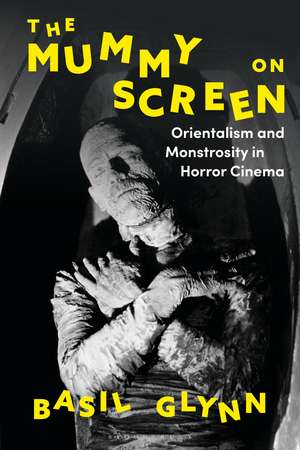
The Mummy on Screen: Orientalism and Monstrosity in Horror Cinema
Autor Dr Basil Glynnen Limba Engleză Hardback – 28 noi 2019
Preț: 707.95 lei
Preț vechi: 1147.17 lei
-38%
Puncte Express: 1062
Carte disponibilă
Livrare economică 04-18 noiembrie
Livrare prin curier în România Termenul estimat este afișat lângă disponibilitate.
Transport gratuit pentru acest produs Plată online sau ramburs, în funcție de opțiunile comenzii.
Retur gratuit în 14 zile Comandă securizată și suport în română.
Specificații
ISBN-13: 9781788314084
ISBN-10: 1788314085
Pagini: 214
Ilustrații: 15 bw illus
Dimensiuni: 160 x 236 x 16 mm
Greutate: 0.57 kg
Editura: Bloomsbury Publishing
Colecția Bloomsbury Academic
Locul publicării:London, United Kingdom
ISBN-10: 1788314085
Pagini: 214
Ilustrații: 15 bw illus
Dimensiuni: 160 x 236 x 16 mm
Greutate: 0.57 kg
Editura: Bloomsbury Publishing
Colecția Bloomsbury Academic
Locul publicării:London, United Kingdom
V-ar putea interesa
-
 Art in Mind: How Contemporary Images Shape ThoughtErnst van AlphenPreț: 314.63 lei
 -
 Preț: 240.95 lei
 -
 Pollock and After: The Critical DebateFrancis FrascinaPreț: 368.31 lei
 -
 Preț: 479.44 lei
 -
 Bollywood Cinema: Temples of DesireVijay MishraPreț: 403.50 lei
 -
 Preț: 418.78 lei
 -
 The Erotic Thriller in Contemporary CinemaLinda Ruth Williams-15%Preț: 239.28 lei282.79 lei
 -
 -19%Preț: 217.13 lei267.37 lei
 -
 Jane Austen in HollywoodLinda TroostPreț: 192.05 lei
 -
 A History of Spanish Film: Cinema and Society 1910-2010Professor Sally Faulkner-16%Preț: 196.85 lei233.38 lei
 -
 The Historical Epic and Contemporary Hollywood: From Dances with Wolves to GladiatorProfessor James Russell-16%Preț: 292.10 lei346.90 lei
 -
 -16%Preț: 256.84 lei304.38 lei
 -
 Women in Film NoirE. Ann KaplanPreț: 244.10 lei
 -
 Pulp FictionDana Polan-43%Preț: 62.18 lei108.35 lei
 -
 Good Girls and Wicked WitchesAmy M. DavisPreț: 157.08 lei
 -
 -25%Preț: 179.72 lei239.30 lei
 -
 The Middle Ages in Popular Imagination: Memory, Film and MedievalismPaul B. Sturtevant-25%Preț: 249.82 lei331.79 lei
 -
 Godzilla on My MindWilliam TsutsuiPreț: 111.90 lei
 -
 Hollywood Math and Aftermath: The Economic Image and the Digital RecessionProfessor J.D. Connor-33%Preț: 839.27 lei1244.92 lei
 -
 -24%Preț: 247.44 lei324.63 lei
 -
 Out of the PastBarry GiffordPreț: 269.92 lei
 -
 Jung and Film: Post-Jungian Takes on the Moving ImageChristopher Hauke-5%Preț: 386.01 lei406.33 lei
 -
 Rosemary's BabyMichael Newton-32%Preț: 67.32 lei99.37 lei
 -
 Screening the CityTony FitzmauricePreț: 159.27 lei
 -
 A Spanish Labyrinth: The Films of Pedro AlmodóvarMark Allinson-21%Preț: 180.96 lei228.50 lei
Cuprins
Acknowledgements
Author's Notes
Introduction:
Death is Only the Beginning: Unravelling the Mummy on Screen
Section 1: The Mummy in the West and Western Cinema
1. The Creature's Features: Moulding the Mummy and the Mummy Movie
The Oriental Mummy as Western Projection
The Mummy Genre: Interest and Disinterest
2.The Mutating Mummy: From Ancient Artefact to Modern Attraction
Mummy Medicine: An Egyptian Prescription
The Mummy as Memento: A Collectible Corpse
The Mummy as Public Attraction: Exhumed, Examined and Exhibited
Section II: The Mummy in Literature, on Stage and the Silent Screen
3.On the Page and Stage: The Mummy Movie's Literary and Theatrical Influences
The Mummy's Tome: A Body of Literature
The Rediscovery of Ancient Egypt: A Pharaoh to Remember
The Mummy's Literary Life: Electrifying Tales!
Romance and the Mummy: Amorous Archaeologists and Comely Corpses
Literature's Monstrous Mummies: Dread, Despair and Doyle
The Empire Strikes Back: Stoker's Au Revoir to the Voyeur Archaeologist
Playing Dead: The Mummy in the Theatre
4. Preserved on Film: The Silent Mummy of Early Cinema
Egypt and the Cinema: Monoliths, Mesmerism and Mummies
The 'Mummy Complex' and the Preservative Nature of Film
The First On-Screen Mummies: Short-lived Moments of Horror in the
Trick Film
Winding People Up: Pretend Mummies and Mummy Mix-ups in Silent Comedies
Mummy Dearest: The Mummy as Romantic Character
Tomb Raiders: Egypt and Early Horror
Teutonic Terrors: The First Mummy Horror Movies
Grave Danger: Tutmania, the Curse and the Death of the Silent Mummy
Section III: Universal Studios and the Mummy of the 1930s and 1940s
5. The Mummy (1932): Overcoming the Silent Treatment
'The Mummy:' Art Horror or Production Line Horror?
The Delicate Horror of 'The Mummy:' A Shudder not a Shriek!
A Dichotomized Damsel: A 1920s/1930s Eastern/Western Woman
A Real Lady-Killer: "The Mummy" as Gothic Romance
The Mummy and the Nubian: Yellow Peril and Black Brute
6. The 1940s Mummy Film: A Decade of Decay
The Mummy Returns: The 1940s Mummy as Cadaverous Copy
More than the Sum of Its Parts: Innovation and the 1940s Mummy
'The Mummy's Hand' (1940): Reinventing the Mummy
'The Mummy's Tomb' (1942): A Memorably Murderous Mummy
Lon Chaney Jr.: Cursing the Mummy!
The Mummy in America: Fear and Roaming in New England
"The Mummy's Ghost (1944):" Escaping Bandaged Bondage
"The Mummy's Curse (1944):" The Female Mummy Returns
The Demise and Rise of the Mummy: To Buffoon and Back Again
Section IV. Hammer Studios and Beyond: The Mummy of the 1950s-Present
7. Hammer's Resurrection of the Mummy: Sex and Digs and Wrap and Roll
Show Me the Mummy: Realism with Restraint in 'The Mummy'
Culture Clash: The Mummy's Case and the Aftermath of Suez
8. Wrapping up the Mummy: The Last 60 Years
Bibliography
Author's Notes
Introduction:
Death is Only the Beginning: Unravelling the Mummy on Screen
Section 1: The Mummy in the West and Western Cinema
1. The Creature's Features: Moulding the Mummy and the Mummy Movie
The Oriental Mummy as Western Projection
The Mummy Genre: Interest and Disinterest
2.The Mutating Mummy: From Ancient Artefact to Modern Attraction
Mummy Medicine: An Egyptian Prescription
The Mummy as Memento: A Collectible Corpse
The Mummy as Public Attraction: Exhumed, Examined and Exhibited
Section II: The Mummy in Literature, on Stage and the Silent Screen
3.On the Page and Stage: The Mummy Movie's Literary and Theatrical Influences
The Mummy's Tome: A Body of Literature
The Rediscovery of Ancient Egypt: A Pharaoh to Remember
The Mummy's Literary Life: Electrifying Tales!
Romance and the Mummy: Amorous Archaeologists and Comely Corpses
Literature's Monstrous Mummies: Dread, Despair and Doyle
The Empire Strikes Back: Stoker's Au Revoir to the Voyeur Archaeologist
Playing Dead: The Mummy in the Theatre
4. Preserved on Film: The Silent Mummy of Early Cinema
Egypt and the Cinema: Monoliths, Mesmerism and Mummies
The 'Mummy Complex' and the Preservative Nature of Film
The First On-Screen Mummies: Short-lived Moments of Horror in the
Trick Film
Winding People Up: Pretend Mummies and Mummy Mix-ups in Silent Comedies
Mummy Dearest: The Mummy as Romantic Character
Tomb Raiders: Egypt and Early Horror
Teutonic Terrors: The First Mummy Horror Movies
Grave Danger: Tutmania, the Curse and the Death of the Silent Mummy
Section III: Universal Studios and the Mummy of the 1930s and 1940s
5. The Mummy (1932): Overcoming the Silent Treatment
'The Mummy:' Art Horror or Production Line Horror?
The Delicate Horror of 'The Mummy:' A Shudder not a Shriek!
A Dichotomized Damsel: A 1920s/1930s Eastern/Western Woman
A Real Lady-Killer: "The Mummy" as Gothic Romance
The Mummy and the Nubian: Yellow Peril and Black Brute
6. The 1940s Mummy Film: A Decade of Decay
The Mummy Returns: The 1940s Mummy as Cadaverous Copy
More than the Sum of Its Parts: Innovation and the 1940s Mummy
'The Mummy's Hand' (1940): Reinventing the Mummy
'The Mummy's Tomb' (1942): A Memorably Murderous Mummy
Lon Chaney Jr.: Cursing the Mummy!
The Mummy in America: Fear and Roaming in New England
"The Mummy's Ghost (1944):" Escaping Bandaged Bondage
"The Mummy's Curse (1944):" The Female Mummy Returns
The Demise and Rise of the Mummy: To Buffoon and Back Again
Section IV. Hammer Studios and Beyond: The Mummy of the 1950s-Present
7. Hammer's Resurrection of the Mummy: Sex and Digs and Wrap and Roll
Show Me the Mummy: Realism with Restraint in 'The Mummy'
Culture Clash: The Mummy's Case and the Aftermath of Suez
8. Wrapping up the Mummy: The Last 60 Years
Bibliography
Recenzii
The mummy has long been neglected in horror criticism as a stiff and lifeless movie monster. But The Mummy on Screen finds a beating heart beneath the bandages. With exhaustive research and deft analysis, Basil Glynn lifts the shroud on the mummy and finds a fascinating and malleable monster whose mute body nonetheless speaks volumes about the Orientalist imagination.
If the Mummy has enjoyed considerably less critical attention or regard than its fellow movie undead, Basil Glynn rectifies that neglect in this persuasive reappraisal, tracing the beat of the cloth-wrapped feet in an authoritative and illuminating study of an enduring and deceptively versatile movie monster.
Glynn not only shows us the origins of the shambling terror . he takes us on an intellectually thrilling tour of the orientalist assumptions western audiences bring to the fictional mummy. Glynn will make you wonder why you ever cared so much about zombies and vampires in this accessible and brilliant examination of a truly terrifying monster that, until now, has never been given its due. Beware the mummy's curse! But read this book anyway.
Glynn's observation that the Mummy has 'stalked . . . its way through the movies, largely unappreciated by critics, academics and cultural commentators' is an astute, if unfortunate one. Just as the Mummy is often without voice in the cinema, the same may largely be said of its presence in academic literature. Glynn's book isn't just welcome: it's essential. The Mummy, as Glynn points out, is perhaps the cinema's most lucrative yet (paradoxically) unappreciated teratological figure. The Mummy on Screen's legibility and wealth of research will make it indispensably useful. Undergraduate students will love it-graduate students will appreciate its accessibility; professors will wish they had written it.
The time has come to understand and embrace the Mummy's ongoing cultural relevance. Glynn unwraps the archetypal Mummy's relentless trajectory from ancient artefact to modern attraction!
If the Mummy has enjoyed considerably less critical attention or regard than its fellow movie undead, Basil Glynn rectifies that neglect in this persuasive reappraisal, tracing the beat of the cloth-wrapped feet in an authoritative and illuminating study of an enduring and deceptively versatile movie monster.
Glynn not only shows us the origins of the shambling terror . he takes us on an intellectually thrilling tour of the orientalist assumptions western audiences bring to the fictional mummy. Glynn will make you wonder why you ever cared so much about zombies and vampires in this accessible and brilliant examination of a truly terrifying monster that, until now, has never been given its due. Beware the mummy's curse! But read this book anyway.
Glynn's observation that the Mummy has 'stalked . . . its way through the movies, largely unappreciated by critics, academics and cultural commentators' is an astute, if unfortunate one. Just as the Mummy is often without voice in the cinema, the same may largely be said of its presence in academic literature. Glynn's book isn't just welcome: it's essential. The Mummy, as Glynn points out, is perhaps the cinema's most lucrative yet (paradoxically) unappreciated teratological figure. The Mummy on Screen's legibility and wealth of research will make it indispensably useful. Undergraduate students will love it-graduate students will appreciate its accessibility; professors will wish they had written it.
The time has come to understand and embrace the Mummy's ongoing cultural relevance. Glynn unwraps the archetypal Mummy's relentless trajectory from ancient artefact to modern attraction!
Notă biografică
Dr Basil Glynn is a Senior Lecturer in Film and Television at Leeds Trinity University, London, UK.