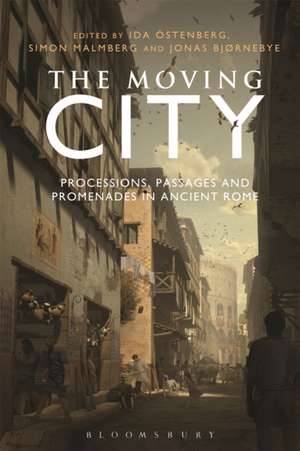
The Moving City: Processions, Passages and Promenades in Ancient Rome
Editat de Ida Ostenberg, Simon Malmberg, Jonas Bjørnebyeen Limba Engleză Paperback – 25 aug 2016
Covering a wide range of people, places, sources, and times, the volume includes a survey of Republican, imperial, and late antique movement, triumphal processions of conquering generals, seditious, violent movement of riots and rebellion, religious processions and rituals and the everyday movements of individual strolls or household errands. By way of its longue durée, dense location and the variety of available sources, the city of ancient Rome offers a unique possibility to study movements as expressions of power, ritual, writing, communication, mentalities, trade, and - also as a result of a massed populace - violent outbreaks and attempts to keep order. The emerging picture is of a bustling, lively society, where cityscape and movements are closely interactive and entwined.
| Toate formatele și edițiile | Preț | Express |
|---|---|---|
| Paperback (1) | 262.74 lei 6-8 săpt. | |
| Bloomsbury Publishing – 25 aug 2016 | 262.74 lei 6-8 săpt. | |
| Hardback (1) | 985.26 lei 6-8 săpt. | |
| Bloomsbury Publishing – 27 aug 2015 | 985.26 lei 6-8 săpt. |
Preț: 262.74 lei
Preț vechi: 314.85 lei
-17%
Puncte Express: 394
Preț estimativ în valută:
46.45€ • 53.82$ • 40.17£
46.45€ • 53.82$ • 40.17£
Carte tipărită la comandă
Livrare economică 07-21 mai
Specificații
ISBN-13: 9781350005860
ISBN-10: 135000586X
Pagini: 384
Dimensiuni: 154 x 232 x 24 mm
Greutate: 0.58 kg
Editura: Bloomsbury Publishing
Colecția Bloomsbury Academic
Locul publicării:London, United Kingdom
ISBN-10: 135000586X
Pagini: 384
Dimensiuni: 154 x 232 x 24 mm
Greutate: 0.58 kg
Editura: Bloomsbury Publishing
Colecția Bloomsbury Academic
Locul publicării:London, United Kingdom
V-ar putea interesa
-
 -12%Preț: 118.39 lei134.15 lei
 -
 A Commentary on Thucydides: Volume III: Books 5.25-8.109Simon Hornblower-25%Preț: 644.33 lei855.54 lei
 -
 Policing the Roman Empire: Soldiers, Administration, and Public OrderChristopher Fuhrmann-17%Preț: 752.80 lei910.94 lei
 -
 Studies on the Text of Macrobius' SaturnaliaRobert Kaster-22%Preț: 306.33 lei394.54 lei
 -
 Preț: 349.46 lei
 -
 Trouble in the West: Egypt and the Persian Empire, 525-332 BCStephen Ruzicka-14%Preț: 692.70 lei805.46 lei
 -
 The Greek and Roman MythsPhilip Matyszak-18%Preț: 86.57 lei105.49 lei
 -
 Chronicle of the Roman EmperorsChris ScarrePreț: 141.54 lei
 -
 The Roman Empire: Roots of ImperialismNeville MorleyPreț: 219.08 lei
 -
 Rome: Empire of the Eagles, 753 BC – AD 476Neil FaulknerPreț: 462.71 lei
 -
 The Lagoon: How Aristotle Invented ScienceArmand Marie Leroi-26%Preț: 67.40 lei90.93 lei
 -
 Owning the Earth: The Transforming History of Land OwnershipAndro Linklater-27%Preț: 85.43 lei117.30 lei
 -
 The Complete Histories of PolybiusPolybiusPreț: 169.29 lei
 -
 SheepAlan ButlerPreț: 74.44 lei
 -
 HannibalNic Fields-42%Preț: 73.26 lei125.81 lei
 -
 The Darylgac Survey ProjectPia Guldager Bilde-15%Preț: 626.16 lei736.66 lei
 -
 Pottery in the Archaeological RecordMark L. LawallPreț: 175.39 lei
Cuprins
Introduction
I. Elite Movement
1. Power Walks: Aristocratic Escorted Movements in Republican Rome, Ida Östenberg (University of Gothenburg, Sweden)
2. 'Moving Through Town': Foreign Dignitaries in Rome in the Middle and Late Republic, Richard Westall (Pontificia Università Gregoriana / The Catholic University of America, Italy)
3. Livia on the Move, Lovisa Brännstedt (Lund University, Sweden)
4. Fast Movement through the City: Ideals, Stereotypes and City Planning, Monica Hellström (Swedish Institute in Rome, Italy)
5. Veiled Visibility: Morality, Movement and Sacred Virginity in Late Antiquity, Sissel Undheim (University of Bergen, Norway)
II. Literary Movement
6. Rolling Thunder: Movement, Violence and Narrative in the History of the Late Roman Republic, Isak Hammar (Lund University, Sweden)
7. 'A Shouting and Bustling on All Sides (Hor. Sat. 1.9.77-8): Everyday Justice in the Streets of Republican Rome, Anthony Corbeill (University of Kansas, USA)
8. Urban flux: Varro's Rome-in-progress, Diana Spencer (University of Birmingham, Great Britain)
9. Augustan Literary Tours: Walking and Reading the City, Timothy M. O'Sullivan (Trinity University, USA)
III. Processional Movement
10. Moving In and Moving Out: Pagan ritual movements between Rome and its Suburbium, Kristine Iara (American Academy in Rome, Italy)
11. Augustus' Triumphal and Triumph-like Returns, Carsten Hjort Lange (Aalborg University, Denmark)
12. Rites of Passage: On Ceremonial Movements and Vicarious Memories, Gitte Lønstrup Dal Santo (Danish Institute in Rome/Copenhagen, Denmark)
13. The Laetaniae Septiformes of Gregory I, S. Maria Maggiore and early Marian cult in Rome, Margaret M. Andrews (University of Pennsylvania, USA)
14. Movement and the Hero: Following St. Lawrence in Late Antique Rome, Michael Mulryan (University of Kent, Great Britain)
IV. Movement and Urban Form
15. Towards a History of Mobility in Ancient Rome (300 BCE to 100 CE), Ray Laurence (University of Kent, Great Britain)
16. 'Ships are Seen Gliding Swiftly along the Sacred Tiber': The River as an Artery of Urban Movement and Development, Simon Malmberg (University of Bergen, Norway)
17. Monuments and Images of the Moving City, Anne-Marie Leander Touati (Lund University, Sweden)
18. Mithraic Movement: Negotiating Topography and Space in Late Antique Rome, Jonas Bjørnebye (Norwegian Institute in Rome, Italy/Bardu, Norway)
Index
I. Elite Movement
1. Power Walks: Aristocratic Escorted Movements in Republican Rome, Ida Östenberg (University of Gothenburg, Sweden)
2. 'Moving Through Town': Foreign Dignitaries in Rome in the Middle and Late Republic, Richard Westall (Pontificia Università Gregoriana / The Catholic University of America, Italy)
3. Livia on the Move, Lovisa Brännstedt (Lund University, Sweden)
4. Fast Movement through the City: Ideals, Stereotypes and City Planning, Monica Hellström (Swedish Institute in Rome, Italy)
5. Veiled Visibility: Morality, Movement and Sacred Virginity in Late Antiquity, Sissel Undheim (University of Bergen, Norway)
II. Literary Movement
6. Rolling Thunder: Movement, Violence and Narrative in the History of the Late Roman Republic, Isak Hammar (Lund University, Sweden)
7. 'A Shouting and Bustling on All Sides (Hor. Sat. 1.9.77-8): Everyday Justice in the Streets of Republican Rome, Anthony Corbeill (University of Kansas, USA)
8. Urban flux: Varro's Rome-in-progress, Diana Spencer (University of Birmingham, Great Britain)
9. Augustan Literary Tours: Walking and Reading the City, Timothy M. O'Sullivan (Trinity University, USA)
III. Processional Movement
10. Moving In and Moving Out: Pagan ritual movements between Rome and its Suburbium, Kristine Iara (American Academy in Rome, Italy)
11. Augustus' Triumphal and Triumph-like Returns, Carsten Hjort Lange (Aalborg University, Denmark)
12. Rites of Passage: On Ceremonial Movements and Vicarious Memories, Gitte Lønstrup Dal Santo (Danish Institute in Rome/Copenhagen, Denmark)
13. The Laetaniae Septiformes of Gregory I, S. Maria Maggiore and early Marian cult in Rome, Margaret M. Andrews (University of Pennsylvania, USA)
14. Movement and the Hero: Following St. Lawrence in Late Antique Rome, Michael Mulryan (University of Kent, Great Britain)
IV. Movement and Urban Form
15. Towards a History of Mobility in Ancient Rome (300 BCE to 100 CE), Ray Laurence (University of Kent, Great Britain)
16. 'Ships are Seen Gliding Swiftly along the Sacred Tiber': The River as an Artery of Urban Movement and Development, Simon Malmberg (University of Bergen, Norway)
17. Monuments and Images of the Moving City, Anne-Marie Leander Touati (Lund University, Sweden)
18. Mithraic Movement: Negotiating Topography and Space in Late Antique Rome, Jonas Bjørnebye (Norwegian Institute in Rome, Italy/Bardu, Norway)
Index
Recenzii
In its fashionable focus on society's experience of space [The Moving City] is a product of its time. It is an enjoyable read, successfully presenting a picture 'of a bustling, lively society, where cityscape and movements are closely interactive and entwined'.
The monuments of ancient Rome, rooted in time and place, impress us with their calm stolidity. This rich collection of essays successfully reminds us that they were the backdrop to a city in permanent motion - from the stately processions of ambassadors and empresses, to the regular ebb and flow of traffic on the Tiber, and to the chaos of a rampaging crowd.
Each paper is both individually valuable and makes a significant contribution to the whole, and the volume itself, cohesive and coherent (as well as all-but-flawlessly edited), will be of interest not only to scholars working in Latin literature and Roman archaeology and social history but also potentially to informed non-specialists eager for further Blue Guide-style tidbits when visiting Rome.
The volume is consistent and well organized: it is surely an important step forward in exploring a more integrated study of the cityscape in the light of the spatial and the performative turns, combining topography, architecture, epigraphy, philology, history and semiotics. It is easy to prophesy that the book will encourage many other scholars to pursue work along these lines, since it clearly shows how fruitful and productive this approach can be.
This thoughtful, well-edited, and well-illustrated collection goes a long ways toward reanimating "the actual lived experience of movement" (176). Anyone interested in the subject of mobility, especially within the ancient Mediterranean world, will find much to think with in this volume, from its engagement with theoretical constructs to literary accounts and constructions to art historical and archaeological analyses. Like a walk around the City of Rome itself, The Moving City provides the reader with many enlightening and often unexpected new vistas on seemingly well-trodden ground.
The monuments of ancient Rome, rooted in time and place, impress us with their calm stolidity. This rich collection of essays successfully reminds us that they were the backdrop to a city in permanent motion - from the stately processions of ambassadors and empresses, to the regular ebb and flow of traffic on the Tiber, and to the chaos of a rampaging crowd.
Each paper is both individually valuable and makes a significant contribution to the whole, and the volume itself, cohesive and coherent (as well as all-but-flawlessly edited), will be of interest not only to scholars working in Latin literature and Roman archaeology and social history but also potentially to informed non-specialists eager for further Blue Guide-style tidbits when visiting Rome.
The volume is consistent and well organized: it is surely an important step forward in exploring a more integrated study of the cityscape in the light of the spatial and the performative turns, combining topography, architecture, epigraphy, philology, history and semiotics. It is easy to prophesy that the book will encourage many other scholars to pursue work along these lines, since it clearly shows how fruitful and productive this approach can be.
This thoughtful, well-edited, and well-illustrated collection goes a long ways toward reanimating "the actual lived experience of movement" (176). Anyone interested in the subject of mobility, especially within the ancient Mediterranean world, will find much to think with in this volume, from its engagement with theoretical constructs to literary accounts and constructions to art historical and archaeological analyses. Like a walk around the City of Rome itself, The Moving City provides the reader with many enlightening and often unexpected new vistas on seemingly well-trodden ground.