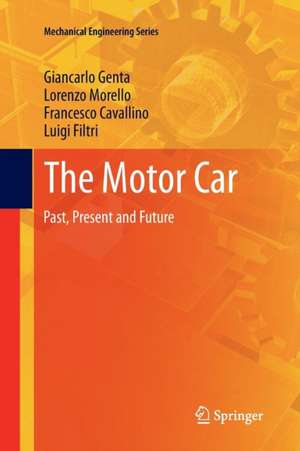
The Motor Car: Mechanical Engineering Series
Autor Giancarlo Genta, Lorenzo Morello, Francesco Cavallino, Luigi Filtrien Limba Engleză Paperback – 17 sep 2016
The first part describes how motor vehicles were invented and evolved into the present product in more than 100 years of development. The purpose is not only to supply an historical perspective, but also to introduce and discuss the many solutions that were applied (and could be applied again) to solve the same basic problems of vehicle engineering. This part also briefly describes the evolution of automotive technologies and market, including production and development processes.
The second part deals with the description and function analysis of all car subsystems, such as:
· vehicle body,
· chassis, including wheels, suspensions, brakes and steering mechanisms,
· diesel and gasoline engines,
· electric motors, batteries, fuel cells, hybrid propulsion systems,
· driveline, including manual and automatic gearboxes.
This part addresses also many non-technical issues that influence vehicle design and production, such as social and economic impact of vehicles, market, regulations, particularly on pollution and safety.
In spite of the difficulty in forecasting the paths that will be taken by automotive technology, the third part tries to open a window on the future. It is not meant to make predictions that are likely to be wrong, but to discuss the trends of automotive research and innovation and to see the possible paths that may be taken to solve the many problems that are at present open or we can expect for the future.
The book is completed by two appendices about the contribution of computers in designing cars, particularly the car body and outliningfundamentals of vehicle mechanics, including aerodynamics, longitudinal (acceleration and braking) and transversal (path control) motion.
Din seria Mechanical Engineering Series
- 18%
 Preț: 1150.77 lei
- 18%
 Preț: 790.05 lei
- 15%
 Preț: 633.78 lei
- 15%
 Preț: 541.47 lei
- 15%
 Preț: 682.71 lei
- 15%
 Preț: 643.25 lei
- 18%
 Preț: 1034.98 lei
- 15%
 Preț: 556.23 lei
- 15%
 Preț: 614.77 lei
- 18%
 Preț: 1171.45 lei
- 18%
 Preț: 1284.89 lei
- 15%
 Preț: 667.41 lei
- 15%
 Preț: 736.05 lei
- 18%
 Preț: 1046.62 lei
- 18%
 Preț: 1349.65 lei
- 15%
 Preț: 659.66 lei
- 15%
 Preț: 612.66 lei
- 18%
 Preț: 963.37 lei
- 18%
 Preț: 1436.90 lei
- 18%
 Preț: 980.87 lei
- 18%
 Preț: 977.19 lei
- 18%
 Preț: 917.76 lei
- 15%
 Preț: 663.81 lei
- 18%
 Preț: 1612.20 lei
- 15%
 Preț: 669.00 lei
- 18%
 Preț: 847.06 lei
- 15%
 Preț: 659.45 lei
-
 Preț: 414.82 lei
- 15%
 Preț: 617.27 lei
-
 Preț: 394.77 lei
-
 Preț: 386.54 lei
- 18%
 Preț: 821.38 lei
- 18%
 Preț: 1432.69 lei
- 18%
 Preț: 1059.37 lei
- 15%
 Preț: 530.78 lei
- 18%
 Preț: 1276.06 lei
- 18%
 Preț: 917.96 lei
-
 Preț: 431.55 lei
- 15%
 Preț: 663.90 lei
-
 Preț: 403.31 lei
- 18%
 Preț: 988.65 lei
- 23%
 Preț: 797.31 lei
-
 Preț: 427.14 lei
- 18%
 Preț: 807.38 lei
- 18%
 Preț: 919.51 lei
- 15%
 Preț: 540.76 lei
- 15%
 Preț: 635.46 lei
- 18%
 Preț: 846.51 lei
- 15%
 Preț: 539.13 lei
Preț: 664.37 lei
Preț vechi: 781.61 lei
-15%
Puncte Express: 997
Carte tipărită la comandă
Livrare economică 04-18 decembrie
Livrare prin curier în România Termenul estimat este afișat lângă disponibilitate.
Transport gratuit pentru acest produs Plată online sau ramburs, în funcție de opțiunile comenzii.
Retur gratuit în 14 zile Comandă securizată și suport în română.
Specificații
ISBN-13: 9789401779555
ISBN-10: 9401779554
Pagini: 688
Ilustrații: XXIV, 662 p. 418 illus. in color.
Dimensiuni: 155 x 235 x 37 mm
Greutate: 1.03 kg
Ediția:Softcover reprint of the original 1st edition 2014
Editura: Springer
Colecția Mechanical Engineering Series
Seria Mechanical Engineering Series
Locul publicării:Dordrecht, Netherlands
V-ar putea interesa
-
 Lonely Minds in the UniverseGiancarlo GentaPreț: 175.27 lei
-
 Space, the Final Frontier?Giancarlo Genta-11%Preț: 433.70 lei487.30 lei
-
 -15%Preț: 434.24 lei510.88 lei
-
 Vibration of Structures and MachinesGiancarlo Genta-15%Preț: 661.62 lei778.37 lei
-
 The HunterGiancarlo GentaPreț: 101.28 lei
-
 A Man From Planet EarthGiancarlo GentaPreț: 112.80 lei
-
 Next Stop MarsGiancarlo GentaPreț: 319.90 lei
-
 Road Vehicle Automation 4Gereon Meyer-18%Preț: 1266.20 lei1544.14 lei
-
 BremsenhandbuchBert Breuer-13%Preț: 1076.43 lei1237.28 lei
-
 Kraftfahrzeug-HybridantriebeKonrad Reif-13%Preț: 734.73 lei844.52 lei
-
 -24%Preț: 3024.64 lei3979.78 lei
-
 GlareAd Vlot-15%Preț: 631.65 lei743.11 lei
-
 Flexible Multibody DynamicsO. A. Bauchau-15%Preț: 611.13 lei718.98 lei
-
 The Automotive BodyL. Morello-9%Preț: 643.98 lei707.67 lei
-
 Introduction to the Mechanics of Space RobotsGiancarlo Genta-47%Preț: 859.06 lei1628.59 lei
-
 Operations Management in Automotive IndustriesMarco Gobetto-30%Preț: 587.62 lei838.76 lei
-
 IUTAM Symposium on Dynamics of Slender VorticesEgon KrausePreț: 404.89 lei
-
 Piezoelectric ShellsHornsen (Hs) Tzou-18%Preț: 1166.95 lei1423.11 lei
-
 MOTOR VEHICLE DYNAMICSGenta G-18%Preț: 874.60 lei1066.59 lei
-
 ROAD VEHICLE DYNAMICSGenta Giancarlo-18%Preț: 2261.97 lei2758.49 lei
Cuprins
Economic figures.- Vehicle and parts manufacturers.- Impact on economy.- Product development and marketing.- Vehicle diffusion.- Regulations.- Type approval and production conformity.- Environmental protection.- Occupants and pedestrians safety.- Body.- Body in white.- Interiors.- Body systems.- Chassis.- Tire.- Suspension.- Steering system.- Braking system.- Powertrain mounts.- Transmission.- Powertrain.- ICE working cycles.- ICE design.- ICE ancillaries.- Manual gearboxes.- Automatic gearboxes.- Full electric powertrains.- Hybrid powertrains.- Production systems and materials and materials.- Steel mill.- Body presswork.- Body welding.- Body painting.- Iron and aluminum foundry.- Plastic materials.- Fuels and lubricants.- Body.- Separated body.- Unitized body.- Body systems.- Vehicle architecture.- Future developments.
Textul de pe ultima copertă
This book is an introduction to automotive engineering, to give freshmen ideas about this technology. The text is subdivided in parts that cover all facets of the automobile, including legal and economic aspects related to industry and products, product configuration and fabrication processes, historic evolution and future developments.
The first part describes how motor vehicles were invented and evolved into the present product in more than 100 years of development. The purpose is not only to supply an historical perspective, but also to introduce and discuss the many solutions that were applied (and could be applied again) to solve the same basic problems of vehicle engineering. This part also briefly describes the evolution of automotive technologies and market, including production and development processes.
The second part deals with the description and function analysis of all car subsystems, such as:
· vehicle body,
· chassis, including wheels, suspensions, brakes and steering mechanisms,
· diesel and gasoline engines,
· electric motors, batteries, fuel cells, hybrid propulsion systems,
· driveline, including manual and automatic gearboxes.
This part addresses also many non-technical issues that influence vehicle design and production, such as social and economic impact of vehicles, market, regulations, particularly on pollution and safety. In spite of the difficulty in forecasting the paths that will be taken by automotive technology, the third part tries to open a window on the future. It is not meant to make predictions that are likely to be wrong, but to discuss the trends of automotive research and innovation and to see the possible paths that may be taken to solve the many problems that are at present open or we can expect for the future.
The book is completed by two appendices about the contribution of computers in designing cars, particularly the car body, and outlining fundamentals of vehicle mechanics, including aerodynamics, longitudinal (acceleration and braking) and transversal (path control) motion.
Caracteristici
Covers all aspects of present automotive technology Describes the historical evolution of automotive technology Supplies tools to analyze vehicle performance Includes supplementary material: sn.pub/extras
Notă biografică
Giancarlo Genta has been full Professor of Construction of Machines since 1987 and taught courses on Astronautic Propulsion, Construction of aircraft engines and motor vehicle technology. Since 1997 he has been Professor of Applied Stress Analysis II at the Master of Science courses of the University of Michigan which are held at the Politecnico di Torino.
His research activity has been focused on those subjects of Applied Mechanics more linked with the construction of machines, and particularly on static and dynamic structural analysis, dynamics of rotating machinery and of controlled systems, magnetic bearings. He is one of the founders of the Interdepartimental Mechatronics Laboratory of Politecnico di Torino, in which he works in the development of magnetic bearings and walking robots and components for spacecraft. Since 2012 he has chaired of study group SG 3.16 of the International Academy of Astronautics addressing a possible Mars mission's exploration, goals, requirements and technologies.
Giancarlo Genta is author of 24 books, 90 papers, published in Italian, American and English Journals and 263 papers presented to symposia. Two of the books are text books of Motor Vehicle Mechanics, Mechanics of Vibration and Mechanics of Space Robots (published in Italian and English), used in Italian and American Universities. Giancarlo Genta has previously co-authored a well received popular science book on space exploration with Michael Rycroft, published by Cambridge University Press. It received very good reviews, including a very favourable one from A.C. Clarke (see his website www.giancarlogenta.it) and a popular science book on the Search for Extraterrestrial Intelligence. He has also written two science fiction novels published in the Science and Fiction series by Springer.